Tap the coin to flip it
Buffalo Nickel (1913–1938)
United States5¢1913–1938 (none dated 1922, 1932 or 1933)
US 5-cent copper–nickel coin minted 1913–1938
- Issuer
- United States Mint
- Denomination
- 5 cents
- Years minted
- 1913–1938 (none dated 1922, 1932 or 1933)
- Metal
- 75% copper, 25% nickel
- Weight
- 5.0 g
- Diameter
- 21.2 mm
- Edge
- Plain
- Designer
- James Earle Fraser
- Mints
- Philadelphia (none), Denver (D), San Francisco (S)
In the hand
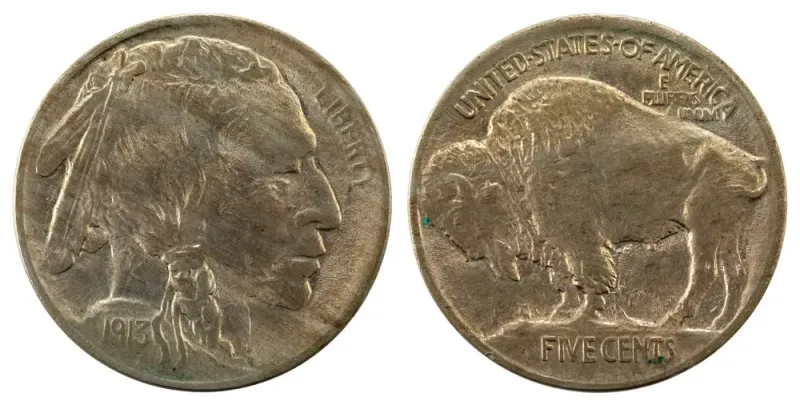
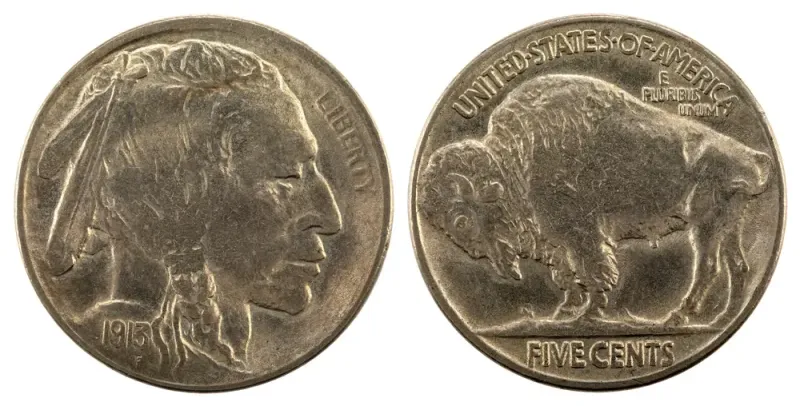
The story of the Buffalo nickel
The Buffalo nickel is the five-cent coin the US Mint struck from 1913 to 1938. It is also called the Indian Head nickel, and both names are correct. One side shows a Native American man in profile. The other shows an American bison standing on a mound.
The design came from the sculptor James Earle Fraser. Treasury Secretary Franklin MacVeagh wanted a better-looking nickel to replace the Liberty Head design, and Fraser pitched something no US coin had tried: a realistic portrait of a Native American on one side and a bison on the other. Fraser later said the portrait was a composite of several men who sat for him, and he named Iron Tail (Lakota) and Two Moons (Cheyenne) among them. The bison is usually identified as Black Diamond, who lived at the Central Park Menagerie in New York.
The coin nearly didn't launch. The Hobbs Manufacturing Company, which made coin-operated machines, complained that the new nickel would jam its mechanisms. The Mint held up production while Fraser made small changes, and the coin finally went out in early 1913.
Those first coins show the bison on a raised mound (Type 1). The words FIVE CENTS sat on top of the mound and wore off quickly, so later in 1913 the Mint recut the ground to a flat line and tucked the denomination underneath (Type 2). Collectors still collect both types from that first year.
The bigger problem was the date. Fraser put it on a raised area beside the portrait, and on a heavily used nickel it's the first thing to wear away. That's why so many Buffalo nickels turn up today with no visible date. The Mint never fully fixed this, and by the late 1930s officials were ready for a new design. The Jefferson nickel replaced it in 1938, once the 25-year minimum term for a coin design had passed.
The series was struck at Philadelphia (no mint mark), Denver (D) and San Francisco (S). Look for the mint mark under the words FIVE CENTS on the reverse. Collectors watch for a few famous coins:
- 1913-S Type 2 and 1926-S, two of the lowest-mintage dates.
- 1918/7-D, where a 1917 date was punched over with an 8.
- 1937-D "three-legged" buffalo, made when a worker polished a damaged die too hard and wiped out one of the front legs.
To read more about how US change developed, see the history articles linked below.
From the encyclopedia
The Buffalo nickel or Indian Head nickel is a five-cent piece that was struck in copper–nickel by the United States Mint from 1913 to 1938. It was designed by sculptor James Earle Fraser.
From Buffalo nickel on Wikipedia, text under CC BY-SA 4.0. Fetched November 3, 2026.
Questions people ask
Why do so many Buffalo nickels have no date?
The date sits on a raised part of the design, so it was among the first details to wear off in circulation. A worn coin with no visible date is very common.
What's the difference between Type 1 and Type 2?
Both are from 1913. Type 1 shows the bison on a raised mound. Type 2 has a flat base with FIVE CENTS set below it, so the lettering would wear less.
Where is the mint mark on a Buffalo nickel?
On the reverse, under the words FIVE CENTS. D means Denver, S means San Francisco, and no mark means Philadelphia.