Tap the coin to flip it
Mercury Dime (1916–1945)
United States10¢1916–1945 (none dated 1922, 1932 or 1933; 2016 gold centennial for collectors)
US ten-cent coin (minted 1916–1945)
- Issuer
- United States Mint
- Denomination
- 10 cents
- Years minted
- 1916–1945 (none dated 1922, 1932 or 1933; 2016 gold centennial for collectors)
- Metal
- 90% silver, 10% copper
- Weight
- 2.5 g (0.07234 troy oz of pure silver)
- Diameter
- 17.9 mm
- Edge
- Reeded
- Designer
- Adolph A. Weinman
- Mints
- Philadelphia (none), Denver (D), San Francisco (S)
In the hand
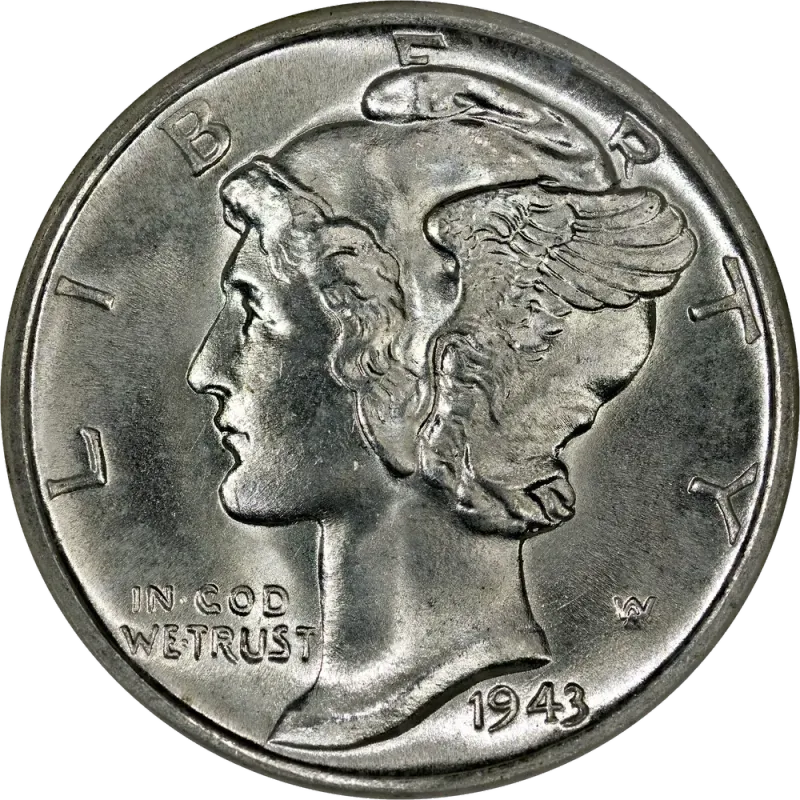
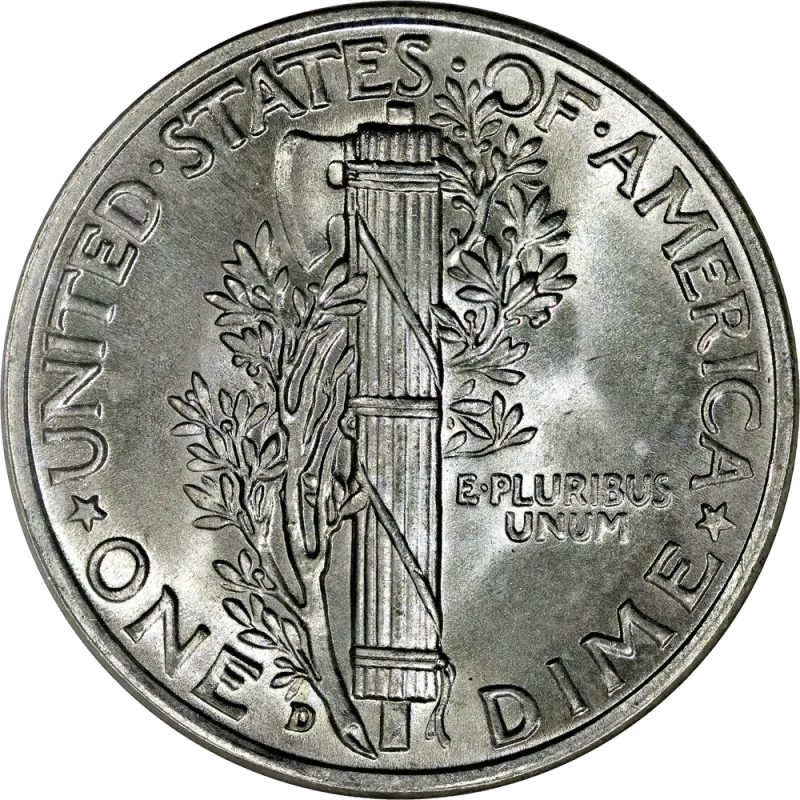
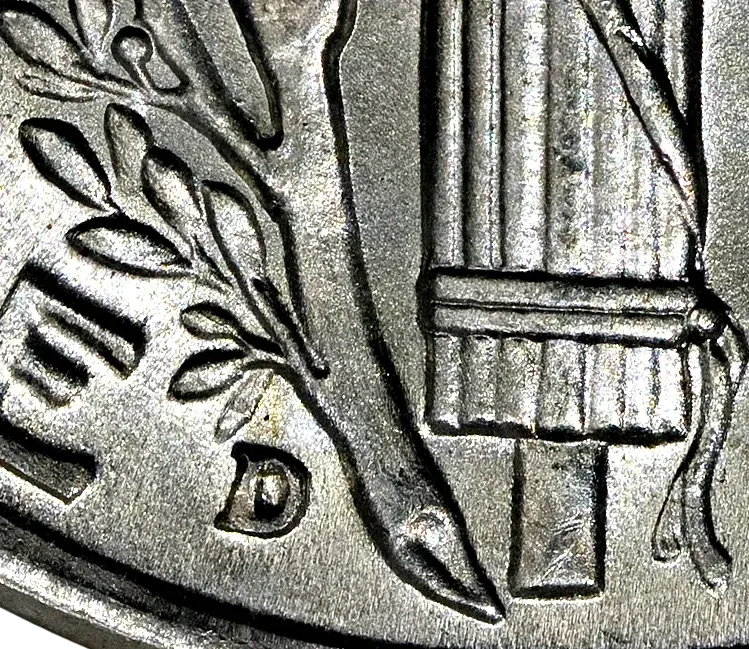
The story of the Mercury dime
The Mercury dime is the ten-cent coin the US Mint struck from 1916 to 1945. Its official name is the Winged Liberty Head dime, and that name is the more accurate one.
The figure on the front isn't the Roman god Mercury. It's Liberty, wearing a cap with small wings on it. The sculptor Adolph A. Weinman meant the wings to stand for freedom of thought. But the head looked so much like the winged messenger god that the public called it the Mercury dime almost straight away, and the nickname stuck.
Weinman won the commission in 1916, when the Mint replaced the Barber designs on the dime, quarter and half dollar in a single year. He designed the half dollar too, the Walking Liberty. The model for the dime is often said to be Elsie Kachel Stevens, wife of the poet Wallace Stevens, who lived in Weinman's building in New York.
The reverse shows a fasces: a bundle of rods wrapped around an axe, an old Roman symbol of authority, with an olive branch beside it. Weinman paired the two as symbols of readiness for war and the wish for peace. Coins in top condition with clear, separated bands across the rods are graded "Full Bands," and collectors pay more for them.
The series was struck at Philadelphia (no mark), Denver (D) and San Francisco (S). The mint mark is on the reverse, at the lower left of the fasces, near the bottom of the word ONE.
The famous rarity is the 1916-D. Denver struck only 264,000 that first year, because it switched over to making quarters. It is still the lowest mintage in the series. Other dates to know are the 1921 and 1921-D, and the 1942/1 overdate, where a 1941 die was re-punched with a 2.
After Franklin D. Roosevelt died in April 1945, the Treasury moved quickly to honour him. Because of his work for the March of Dimes, the dime was the natural choice. The Roosevelt dime replaced Weinman's design in 1946. In 2016, for the coin's 100th birthday, the Mint struck a gold version of the Mercury dime for collectors.
Want to see how the dime fits into the bigger story of American change? The articles below cover it.
From the encyclopedia
The Mercury dime is a ten-cent coin struck by the United States Mint from late 1916 to 1945. Designed by Adolph Weinman and also referred to as the Winged Liberty Head dime, it gained its common name because the obverse depiction of a young Liberty, identifiable by her winged Phrygian cap, was confused with the Roman god Mercury. Weinman is believed to have used Elsie Stevens, the wife of lawyer and poet Wallace Stevens, as a model. The coin's reverse depicts a fasces, symbolizing unity and strength, and an olive branch, signifying peace.
From Mercury dime on Wikipedia, text under CC BY-SA 4.0. Fetched November 3, 2026.
Questions people ask
Is that really Mercury on the Mercury dime?
No. It's Liberty wearing a winged cap, meant to stand for freedom of thought. The resemblance to Mercury gave the coin its nickname.
What is the rarest Mercury dime?
The 1916-D. Only 264,000 were struck, the lowest mintage in the series.
Where is the mint mark on a Mercury dime?
On the reverse, to the lower left of the fasces, near the word ONE.