Tap the coin to flip it
Peace Silver Dollar (1921–1935)
United States$11921–1928, 1934–1935 (1964-D struck and melted; collector issues from 2021)
U.S. dollar coin (1921–1928, 1934–1935, 2021-present)
- Issuer
- United States Mint
- Denomination
- 1 dollar
- Years minted
- 1921–1928, 1934–1935 (1964-D struck and melted; collector issues from 2021)
- Metal
- 90% silver, 10% copper
- Weight
- 26.73 g (0.7734 troy oz of pure silver)
- Diameter
- 38.1 mm
- Edge
- Reeded
- Designer
- Anthony de Francisci
- Mints
- Philadelphia (none), Denver (D), San Francisco (S)
In the hand
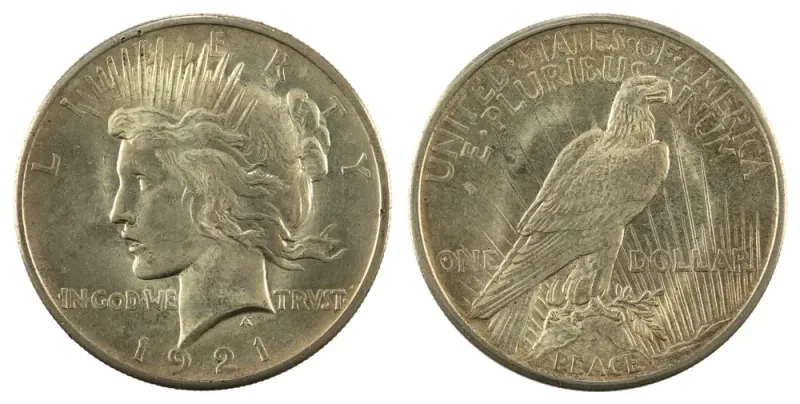
The story of the Peace dollar
The Peace dollar is the silver dollar the US Mint struck from 1921 to 1928 and again in 1934 and 1935. It was made to mark the peace after the First World War. It was also the last US silver dollar made for everyday circulation.
Collectors, led by the numismatist Farran Zerbe, campaigned for a coin that would celebrate the peace. The timing worked. The Pittman Act of 1918 had melted about 270 million silver dollars, and the law required the Treasury to strike new ones to replace them. Morgan dollars were struck again in 1921 while a new design was chosen.
A competition in late 1921 picked Anthony de Francisci, a young Italian-born sculptor. He modelled Liberty partly on his wife, Teresa, and gave her a crown of light rays, like the Statue of Liberty. The reverse shows a bald eagle at rest on a mountain top, watching the sun rise, with an olive branch in its talons and the word PEACE on the rock.
The design caused a row before the coin even came out. De Francisci's first reverse had the eagle standing on a broken sword, as a symbol of disarmament. When newspapers described it, critics said a broken sword looked like defeat. The sword was removed and the coin went out without it, though the olive branch stayed.
The first coins, dated 1921, were struck in the last days of December. They had high relief, which looked beautiful but was hard to strike well and wore out the dies quickly. In 1922 the Mint lowered the relief. Only 1,006,473 high-relief 1921 coins were made, compared with tens of millions of 1922 dollars.
Production stopped in 1928 once the Pittman Act replacements were done, then resumed briefly in 1934 and 1935. The Mint struck 316,076 Peace dollars dated 1964 at Denver in 1965, but they were never released and were all melted. In 2021 the Mint brought the design back for a collectors' coin to mark its 100th anniversary.
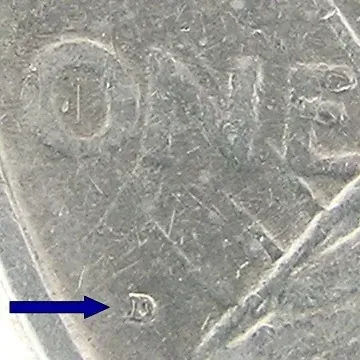
The Peace dollar was struck at Philadelphia (no mark), Denver (D) and San Francisco (S). The mint mark is on the reverse, below the word ONE and near the eagle's wingtip. The key date is the 1928 from Philadelphia, with a mintage of only 360,649. The 1921 high relief and the 1934-S are also sought after.
To see how the Peace dollar fits with the Morgan and Trade dollars, read the history article linked below.
From the encyclopedia
The Peace dollar is a United States dollar coin minted for circulation from 1921 to 1928 and 1934 to 1935, and beginning again for collectors in 2021. Designed by Anthony de Francisci, the coin was the result of a competition to find designs emblematic of peace. Its obverse represents the head and neck of the Goddess of Liberty in profile, and the reverse depicts a bald eagle at rest clutching an olive branch, with the legend "Peace". It was the last circulating United States dollar coin to be struck in 90% silver.
From Peace dollar on Wikipedia, text under CC BY-SA 4.0. Fetched November 3, 2026.
Questions people ask
Why is it called the Peace dollar?
It was made to celebrate the peace after the First World War, and the word PEACE is on the reverse.
What is the rarest Peace dollar?
Among regular issues, the 1928 from Philadelphia, with 360,649 struck. The 1964-D was struck but melted, and no legal examples are known.
Where is the mint mark on a Peace dollar?
On the reverse, below the word ONE and near the tip of the eagle's wing.