Tap the coin to flip it
The Double Eagle: America's $20 Gold Coin
United States$201850–1933 (1849 pattern; 1933 coins struck but not issued)
Gold $20 coin of the United States
- Issuer
- United States Mint
- Denomination
- 20 dollars
- Years minted
- 1850–1933 (1849 pattern; 1933 coins struck but not issued)
- Types
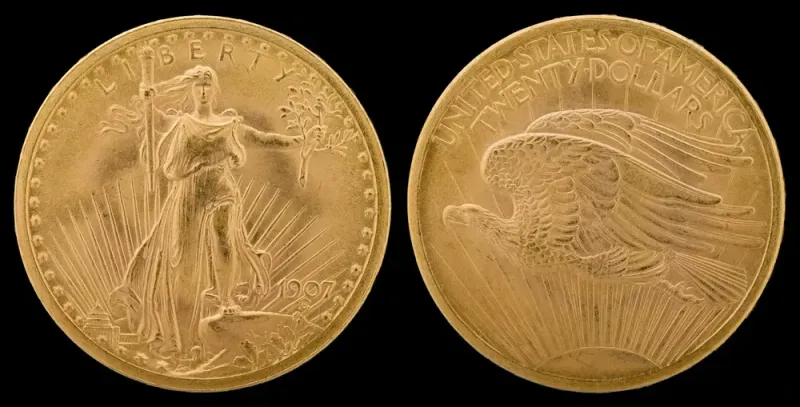
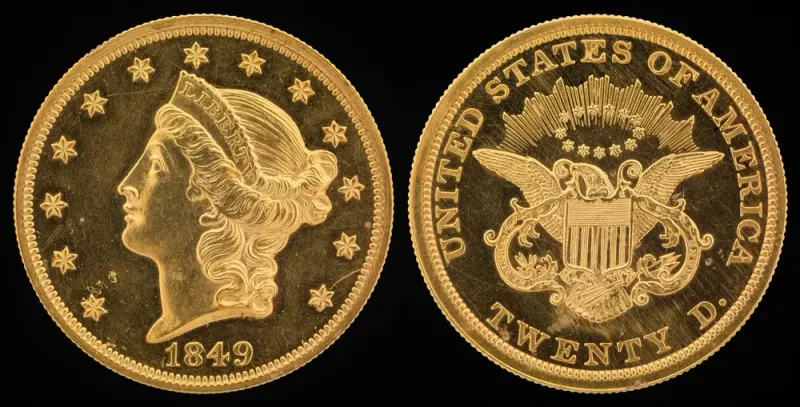
- Liberty Head (1850–1907, James B. Longacre); Saint-Gaudens (1907–1933, Augustus Saint-Gaudens)
- Metal
- 90% gold, 10% copper
- Weight
- 33.436 g (0.9675 troy oz of pure gold)
- Diameter
- 34 mm (1907 high relief about 34 mm, thicker)
- Edge
- Reeded (Saint-Gaudens: lettered E PLURIBUS UNUM)
- Mints
- Philadelphia (none), San Francisco (S), New Orleans (O), Carson City (CC), Denver (D)
In the hand
The story of the Double eagle
The double eagle is the United States' $20 gold coin. In US coinage an "eagle" was a $10 gold piece, so a $20 coin was a double eagle. It was struck for circulation from 1850 to 1933, and for most of that time it was the highest-value coin the country issued.
The California Gold Rush made it possible. Gold poured east after 1848, and Congress authorised a $20 coin in the Coinage Act of 1849. That year, the Mint's chief engraver, James B. Longacre, designed the first type, now called the Liberty Head. One 1849 pattern survives, in the Smithsonian's National Numismatic Collection. Regular production started in 1850.
The Liberty Head ran from 1850 to 1907 in three main varieties. The first lacks a motto. "In God We Trust" was added to the reverse in 1866. In 1877 the denomination changed from "TWENTY D." to "TWENTY DOLLARS." Liberty Head double eagles were struck at Philadelphia, San Francisco, New Orleans, Carson City and Denver. They moved huge amounts of value in banking and foreign trade.
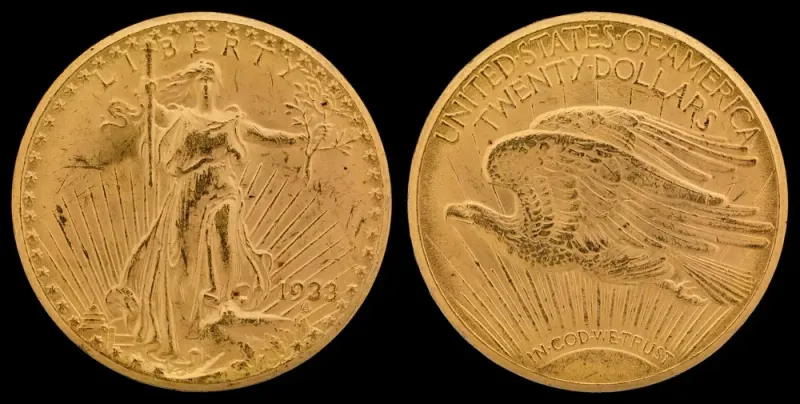
The second type is one of the most admired coin designs ever made. In 1905 President Theodore Roosevelt asked the sculptor Augustus Saint-Gaudens to redesign US gold coins with the depth of ancient Greek coins. The result shows Liberty striding forward with a torch and olive branch, the sun rising behind her, and an eagle flying over the sun on the reverse.
Saint-Gaudens died in 1907 before the coin was released. The first 1907 coins had very high relief and a date in Roman numerals (MCMVII). They looked magnificent but needed several strikes each, which was too slow for mass production. The Mint flattened the relief and switched to ordinary numerals later that year. In 1908, Congress had "In God We Trust" put back on the coin after Roosevelt had left it off.
The series ended with the gold recall. In April 1933, Executive Order 6102 required Americans to turn in most of their gold coins. Some 445,500 double eagles dated 1933 had already been struck, but they were never issued and almost all were melted. A few escaped. Only one 1933 double eagle is legal for a private person to own, and it sold for $18.9 million in 2021. The whole story is in the article linked below.
Because so many double eagles went abroad or into bank vaults before 1933, large numbers survive. Common dates are now mostly traded for their gold.
From the encyclopedia
A double eagle is a gold coin of the United States with a denomination of $20. The coins are 34 mm × 2 mm and are made from a 90% gold and 10% copper alloy and have a total weight of 1.0750 troy ounces.
From Double eagle on Wikipedia, text under CC BY-SA 4.0. Fetched November 3, 2026.
Questions people ask
Why is it called a double eagle?
US gold coins were named after the $10 "eagle." A $20 piece was twice that, so it became the double eagle.
How much gold is in a double eagle?
About 0.9675 troy ounces. The coin weighs 33.436 g and is 90% gold.
Can I own a 1933 double eagle?
Only one is legal to own privately. It was exported with US government approval in the 1940s and sold for $18.9 million in 2021. Other known examples have been taken back by the government.