The Double Eagle and the Gold Recall of 1933
Part 33 of the Americas series6 min read
In 1933 the US Mint struck 445,500 double eagles, then recalled gold and melted them. Here's how a few escaped and why one sold for $18.9 million.
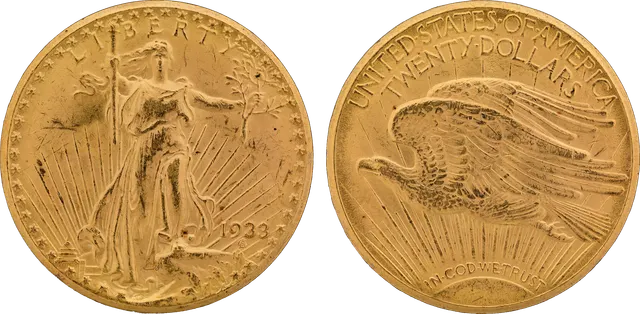
In the spring of 1933 the Philadelphia Mint struck 445,500 gold $20 coins. Almost none of them ever left the building. By 1937 they had been melted into bars.
A handful got out anyway. For seventy years the US government chased them, seized them and fought over them in court. Today only one 1933 double eagle can be legally owned by a private person, and in 2021 it sold for $18,872,250. As of 2026, no coin has sold for more at auction.
This is the story of America's biggest gold coin and the year the country called its gold back in.
Why a $20 coin was called a double eagle
US gold coins were named after the eagle, the $10 piece first struck in 1795. A $20 coin was twice that, so it became the double eagle.
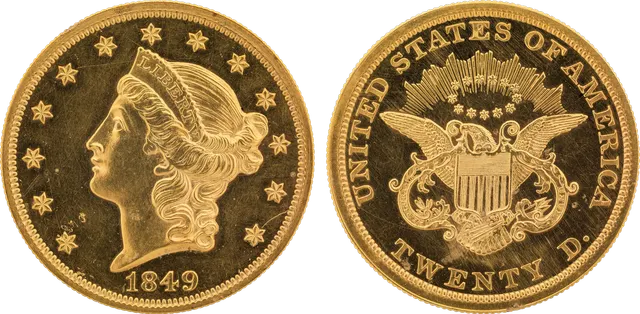
It owes its existence to the California Gold Rush. Gold flooded east after 1848, and the Coinage Act of 1849 authorized a $20 coin to put it to work. Chief Engraver James B. Longacre designed the first type, the Liberty Head, and regular production began in 1850.
The coin weighed 33.436 grams and was 90% gold, so it held about 0.9675 troy ounces of pure gold. At the official price of $20.67 an ounce, that was worth almost exactly $20. The coin was its own guarantee.
The Saint-Gaudens double eagle
By 1905 President Theodore Roosevelt thought American coins were ugly. He wanted something with the depth and life of ancient Greek coins, and he asked the sculptor Augustus Saint-Gaudens to redesign the gold coinage.
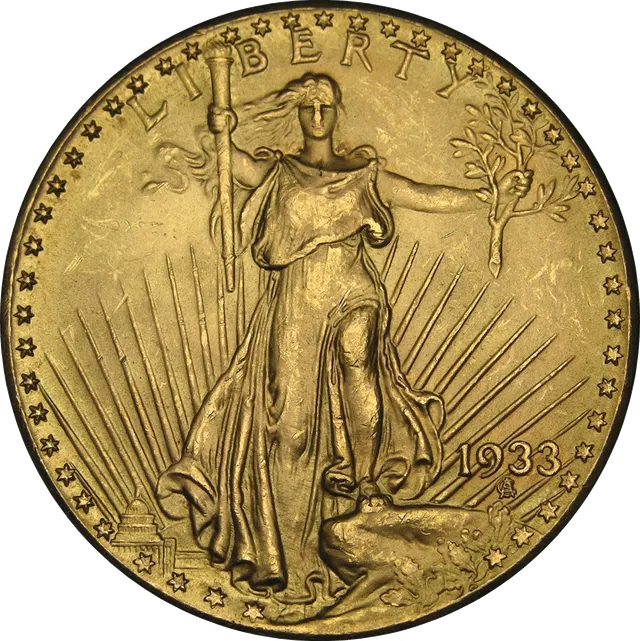
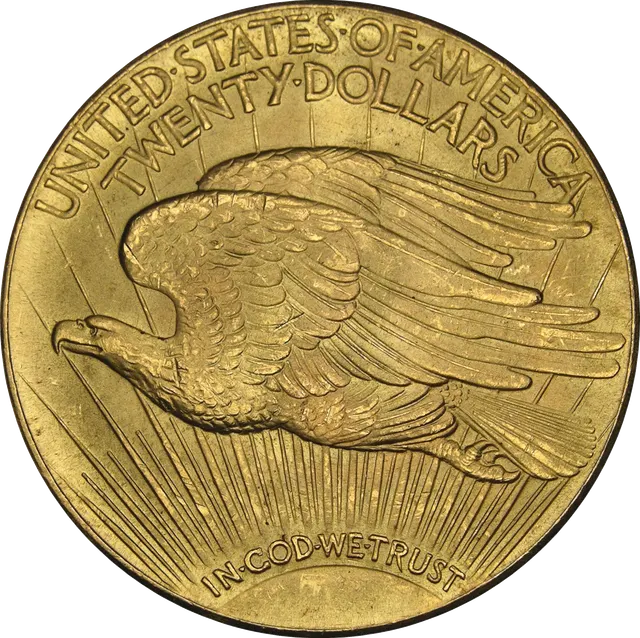
Saint-Gaudens gave the double eagle a striding Liberty, torch in her right hand and olive branch in her left, with the sun rising behind her. On the back, an eagle flies over the rays of the sun. Many collectors still call it the most beautiful US coin.
Saint-Gaudens was already seriously ill. He died on August 3, 1907, before the coin went into production.
The first 1907 coins were struck in very high relief, with the date in Roman numerals: MCMVII. They looked superb, but each one needed several blows of the press. Slightly more than 12,000 were made before the Mint flattened the design and switched to ordinary numerals.
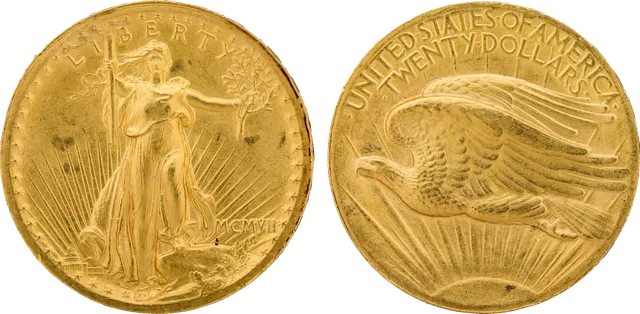
The new coin also left out "In God We Trust", because Roosevelt felt a religious motto didn't belong on money. Congress disagreed and passed a law in 1908 putting it back.
1933: the gold recall and Executive Order 6102
By early 1933 the US banking system was falling apart. People who didn't trust the banks pulled out their savings in gold coin and kept it at home. Gold drained out of the Federal Reserve's vaults, and that tied the government's hands as it tried to fight the Depression.
On April 5, 1933, a month after taking office, President Franklin D. Roosevelt signed Executive Order 6102. It ordered Americans to hand in their gold coin, gold bullion and gold certificates at a Federal Reserve bank or member bank by May 1, 1933. They were paid $20.67 an ounce in paper money.
There were exceptions. Each person could keep up to $100 in gold coin, and coins with "a recognized special value to collectors of rare and unusual coins" were allowed. Gold needed for industry, a profession or art was also exempt. The penalty for breaking the order was a fine of up to $10,000, up to ten years in prison, or both.
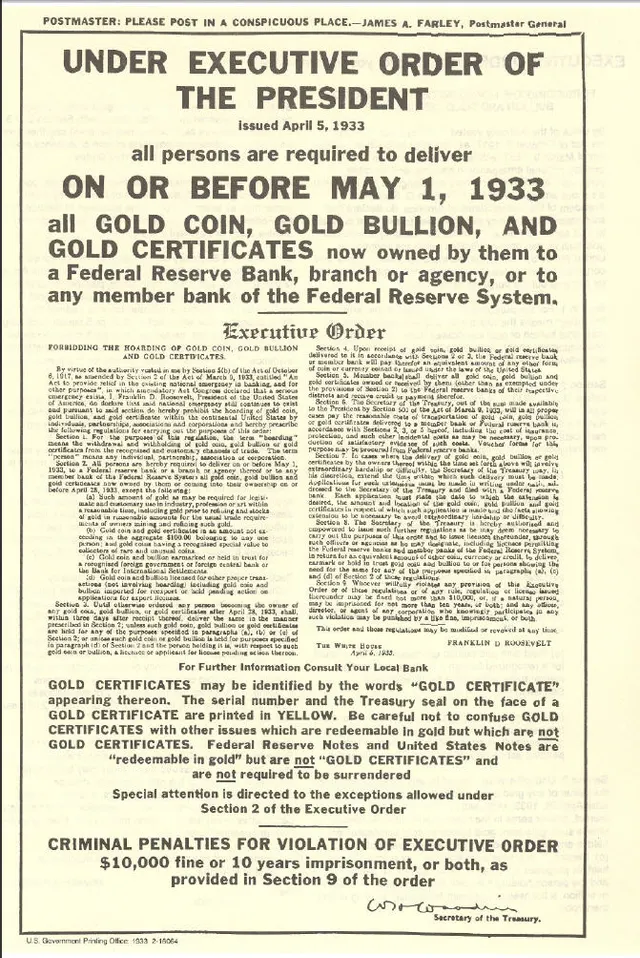
The government didn't really expect to find gold in mattresses. It wanted the gold back in the banking system, where it could serve as a reserve. In January 1934 Congress passed the Gold Reserve Act, and Roosevelt reset the official gold price to $35 an ounce. Overnight, the gold in a double eagle was worth about $33.86, but you could no longer legally spend it or hold it.
That ban lasted until December 31, 1974, when private gold ownership became legal again.
The 1933 double eagle that was never issued
Here is the odd part. The Philadelphia Mint kept striking double eagles dated 1933 from March into May, even as the recall went ahead. It made 445,500 of them. None were ever issued. They sat in the Mint's vaults.
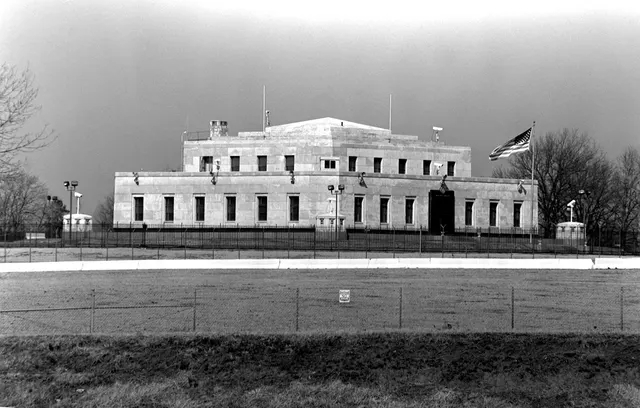
In October 1934 the Mint sent two to the Smithsonian for the National Numismatic Collection. In February 1937 the Treasury ordered the rest melted, and by March the Mint reported the job done. The gold went into bars and eventually to the new bullion vault at Fort Knox.
But some 1933 coins were already outside. In the late 1930s a Philadelphia jeweler named Israel Switt began selling them. Investigators later tied them to a Mint cashier, George McCann, who had unexplained deposits in his bank account. Exactly how the coins got out has never been proven in court, but the government's position has always been simple: no 1933 double eagle left the Mint legally, so every one is stolen property.
King Farouk and the coin that got away
In February 1944 the King of Egypt, Farouk, a keen collector, bought a 1933 double eagle for $1,575. His agents asked for an export license, and the Treasury Department issued one before anyone noticed the problem.
Later that year the Secret Service started tracing the 1933 coins. Over the following years it seized several from dealers and collectors, and those were later melted. Farouk's coin was out of reach in Cairo.
When Farouk was overthrown in 1952, Egypt's new government put his huge collection up for sale. The 1933 double eagle was listed in the 1954 auction. The United States asked for it back, and the coin was withdrawn from the sale. Then it vanished for forty years.
The 1996 sting and the 2002 sale
The Farouk coin turned up again in 1996. A British dealer, Stephen Fenton, brought it to New York to sell, and the buyer turned out to be working with the Secret Service. Agents seized the coin in a sting at the Waldorf-Astoria hotel in February 1996.
Fenton fought the seizure, arguing the coin had been legally exported to a king. In 2001 the two sides settled. The coin would be sold and the money split between Fenton and the US government.
On July 30, 2002, Sotheby's and Stack's sold it in New York for $7,590,020. That figure includes an extra $20, the coin's face value, which the buyer paid so the Treasury could formally "monetize" it. It's the only 1933 double eagle the government has ever issued or approved for private ownership. The buyer, later revealed as the shoe designer Stuart Weitzman, owned it for nineteen years.
The ten coins in a safe deposit box
Israel Switt's daughter, Joan Langbord, and her family found ten 1933 double eagles in a safe deposit box that had belonged to him. In 2004 they sent them to the US Mint to be authenticated, hoping to sell them legally.
The Mint kept them. The Langbords sued, and the case ran for more than a decade. A federal jury sided with the government in 2011. An appeals panel reversed that in 2015, but the full Third Circuit court ruled 9 to 3 for the government in 2016. In April 2017 the Supreme Court declined to hear the family's appeal.
The ten Langbord coins are held at Fort Knox. Together with one more coin that a private owner handed over later, the Mint now has eleven. In August 2026 all eleven were shown together in public for the first time, at the American Numismatic Association's World's Fair of Money in Pittsburgh.
The most expensive coin ever sold
On June 8, 2021 Weitzman sold his 1933 double eagle at Sotheby's in New York. It brought $18,872,250, almost double the previous auction record for any coin, the $10 million paid for a 1794 silver dollar in 2013.
So the tally today is fourteen known 1933 double eagles: two at the Smithsonian, eleven with the Mint and one in private hands. The other 445,000-odd became bars.
Where the story goes next
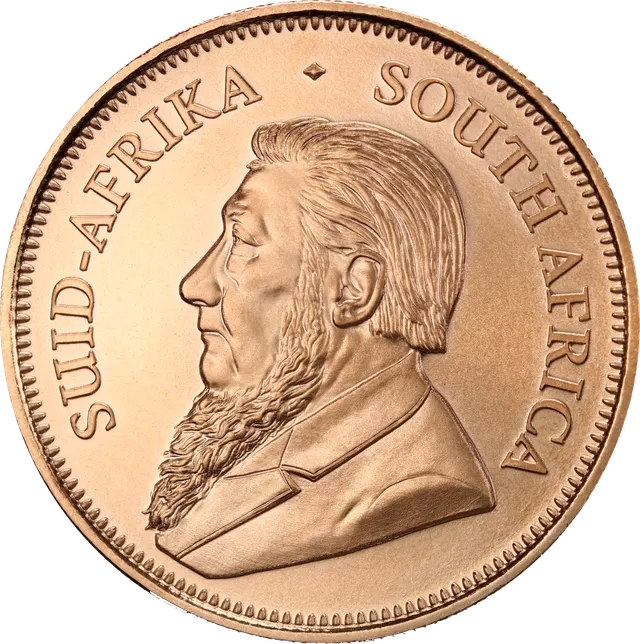
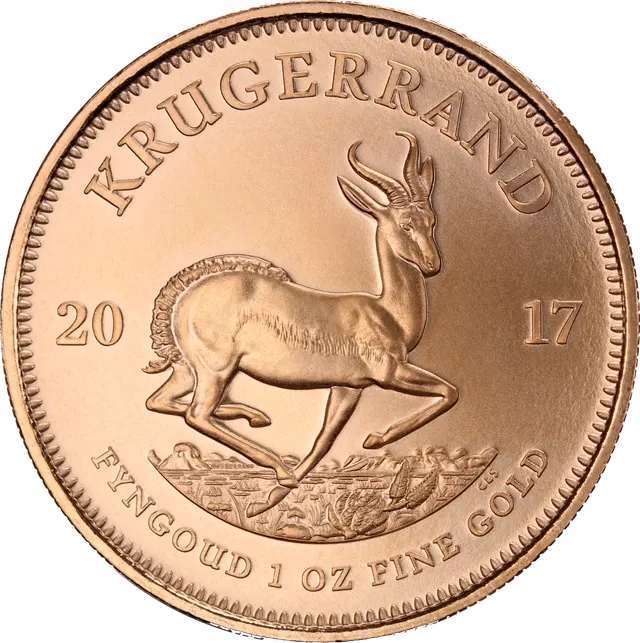
The recall ended the age of gold coins in American pockets. When Americans could own gold again after 1974, they bought bullion coins such as the South African Krugerrand instead, a story we pick up in Bullion Coins and the Krugerrand Revolution.
For the silver side of the same era, see America's Classic Silver Dollars. Several of the coins in The Rarest and Most Valuable Coins in the World also have a double eagle in their story.
You can see the double eagle up close and give it a flip. Liberty on one side and the flying eagle on the other make a fine coin toss. Try it with our coin flipper.
Questions people ask
Why is the 1933 double eagle illegal to own?
The US government says none of the 445,500 coins struck in 1933 were ever issued, so any that left the Mint were stolen. The one exception is the former King Farouk coin, which the Treasury monetized in 2002 after a legal settlement.
What was Executive Order 6102?
It was the order President Franklin D. Roosevelt signed on April 5, 1933 requiring Americans to hand in most gold coin, gold bullion and gold certificates by May 1, 1933. They received $20.67 an ounce. Rare collector coins and up to $100 in gold coin per person were exempt.
How much is a 1933 double eagle worth?
The only privately owned example sold for $18,872,250 at Sotheby's on June 8, 2021, a record for any coin at auction. No other 1933 double eagle can be legally bought or sold.
How many 1933 double eagles exist?
Fourteen are known: two in the Smithsonian's National Numismatic Collection, eleven held by the US Mint and one in private hands. The other 1933 coins were melted in 1937.
How much gold is in a double eagle?
About 0.9675 troy ounces. The coin weighs 33.436 grams and is 90% gold and 10% copper.
Sources
- Smithsonian NMAH, "20 Dollars, United States, 1933" (object record, National Numismatic Collection). (445,500 struck; never issued; two kept by the Mint and transferred to the Smithsonian)
- Sotheby's, "The 1933 Double Eagle", Three Treasures Collected by Stuart Weitzman, June 8, 2021. (Smithsonian receipt October 11, 1934; Farouk purchase February 23, 1944 for $1,575; 2002 sale $7,590,020; monetization; eleven other examples government property)
- CoinWeek, "1933 Saint-Gaudens Double Eagle: History & Value". (striking March 15 to May 19, 1933; February/March 1937 melt; Switt and McCann; February 27, 1944 export license; February 1954 Farouk sale; February 8, 1996 sting; July 30, 2002 sale; 2004 Langbord coins)
- CoinWeek, "1933 Double Eagle Demolishes Record, Sells for $18.9 Million" (2021) and CNN, "'Double Eagle' 1933 gold coin sells for a record $18.9M" (2021). (Sale price, previous $10M record for the 1794 dollar)
- CoinWeek, "Supreme Court Refuses to Hear Langbord-Switt 1933 Double Eagles Case" (April 2017); Langbord v. US Dept of the Treasury, No. 12-4574 (3d Cir. en banc, August 1, 2016), via Justia. (9–3 ruling; cert denied April 17, 2017)
- Coin World, "Langbord family loses appeal…" and related coverage. (Ten coins held at Fort Knox)
- CoinWeek, "Eleven Legendary 1933 Double Eagles Will Appear Together for the First Time" (2026). (Eleven coins in Mint custody: ten Langbord plus one surrendered later; ANA World's Fair of Money, Pittsburgh, August 2026)
- Executive Order 6102 text, as printed on the 1933 GPO notice (image 5). (Deadline May 1, 1933; $100 exemption; collector-coin exemption; $10,000 / 10 years penalty)
- Smithsonian NNC Commons file descriptions for images 1, 2 and 4. (33.436 g, .900 fine, 34 mm; designers)
- Gold Reserve Act of 1934 and Public Law 93-373 (1974), as summarised in Encyclopedia.com and EBSCO Research Starters. ($20.67 to $35; ownership legal again December 31, 1974)
- Wikipedia, "Saint-Gaudens double eagle" (cross-check only: Roosevelt's 1905 request, Saint-Gaudens' death on August 3, 1907, ~12,000 high-relief coins, motto restored 1908)