Tap the coin to flip it
The Krugerrand: South Africa's Gold Coin
South Africa1967–present (fractional sizes from 1980; silver version from 2017)
South African gold coin
- Issuer
- South African Mint (Republic of South Africa)
- Denomination
- None stated; legal tender for its gold content
- Years minted
- 1967–present (fractional sizes from 1980; silver version from 2017)
- Metal
- 22-carat gold: 91.67% gold, 8.33% copper
- Weight
- 33.93 g (1.0000 troy oz of fine gold)
- Diameter
- 32.77 mm
- Thickness
- 2.84 mm
- Edge
- Reeded
- Designers
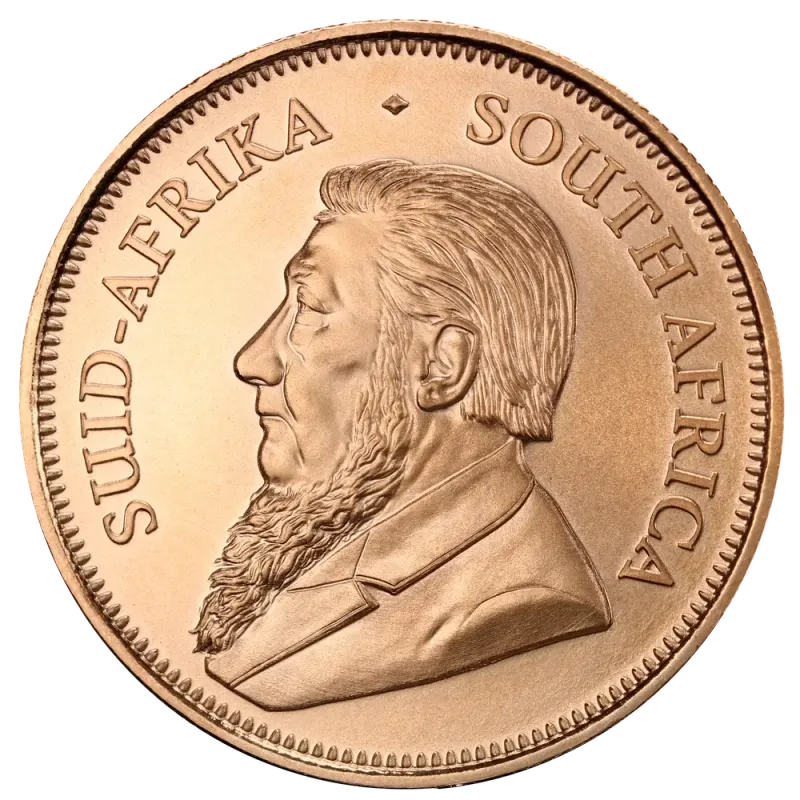
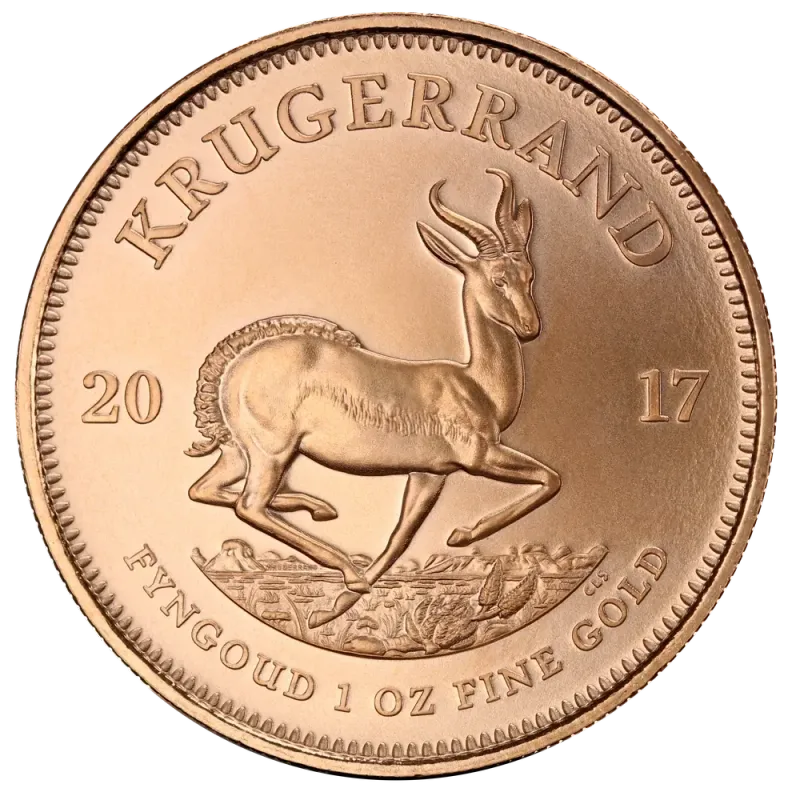
- Otto Schultz (Kruger portrait, 1892); Coert Steynberg (springbok, 1947)
In the hand
The story of the Krugerrand
The Krugerrand is a South African gold coin first struck in 1967. It was the first modern coin made for private investors to own gold, and it set the template for the bullion coins that followed.
The name joins two words. "Kruger" is Paul Kruger, president of the South African Republic in the late 1800s, whose portrait is on the front. "Rand" is South Africa's currency, named after the Witwatersrand, the ridge near Johannesburg where much of the country's gold was mined.
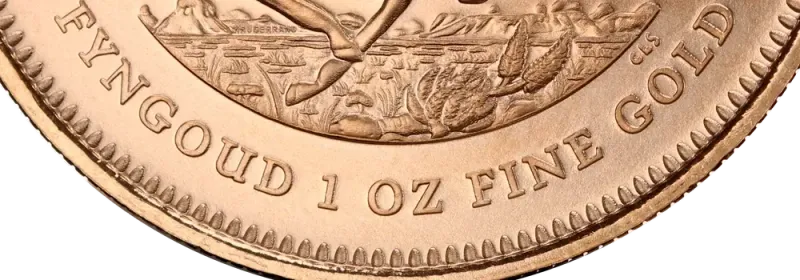
The idea was to sell South African gold to ordinary buyers around the world. Instead of a face value in rand, the coin simply states its gold content: one troy ounce of fine gold. Its price follows the gold market from day to day. It's still legal tender in South Africa, but nobody spends it.
The coin is made of 22-carat gold, about 91.67% gold with the rest copper. The copper makes it harder and more resistant to scratches than pure gold. It also gives the coin its orange-gold colour, and it's why the coin weighs 33.93 g even though it holds exactly one ounce of gold.
Both designs are older than the coin. The portrait of Kruger was designed by Otto Schultz for an 1892 coin. The springbok antelope on the back comes from a 1947 design by Coert Steynberg. The coins are struck by the South African Mint from gold refined by the Rand Refinery.
Sales grew fast. By 1980 the Krugerrand held most of the world's gold coin market, and that year South Africa added half, quarter and tenth-ounce sizes.
Then politics caught up with it. During the 1980s, the coin became a target of the campaign against apartheid. Several Western countries banned imports, including the United States in 1985. Other countries filled the gap with their own bullion coins: Canada's Maple Leaf in 1979, then the American Gold Eagle, the Chinese Panda and others. After apartheid ended, the bans were lifted and the Krugerrand went back on sale around the world.
It's still struck every year. In 2017, for its 50th anniversary, the Mint added a one-ounce silver Krugerrand. The design has stayed almost the same since 1967, so a new coin looks much like the very first.
The story of how the Krugerrand created the modern bullion coin market is told in the history article linked below.
From the encyclopedia
The Krugerrand is a South African coin, first minted on 3 July 1967 to help market South African gold and produced by Rand Refinery and the South African Mint. The name is a compound of Paul Kruger, the former President of the South African Republic, and rand, the South African unit of currency. On the reverse side of the Krugerrand is a pronking springbok, South Africa's national animal.
From Krugerrand on Wikipedia, text under CC BY-SA 4.0. Fetched November 3, 2026.
Questions people ask
How much gold is in a Krugerrand?
A one-ounce Krugerrand holds exactly one troy ounce of fine gold. It weighs 33.93 g in total because it's alloyed with copper.
Why doesn't the Krugerrand have a face value?
It was designed to be valued by its gold content, so the coin states its gold weight instead of an amount in rand.
Who is on the Krugerrand?
Paul Kruger, president of the South African Republic from 1883 to 1900. The back shows a springbok antelope.