Tap the coin to flip it
Flying Eagle Cent (1856–1858)
United States1¢1856 (patterns), 1857–1858
One-cent piece struck by the Mint of the United States
- Issuer
- United States Mint
- Denomination
- 1 cent
- Years minted
- 1856 (patterns), 1857–1858
- Metal
- 88% copper, 12% nickel
- Weight
- 4.67 g
- Diameter
- 19 mm
- Edge
- Plain
- Designer
- James B. Longacre (eagle after Christian Gobrecht)
- Mints
- Philadelphia only (no mint mark)
- Mintage
- 1857: 17,450,000; 1858: 24,600,000
In the hand
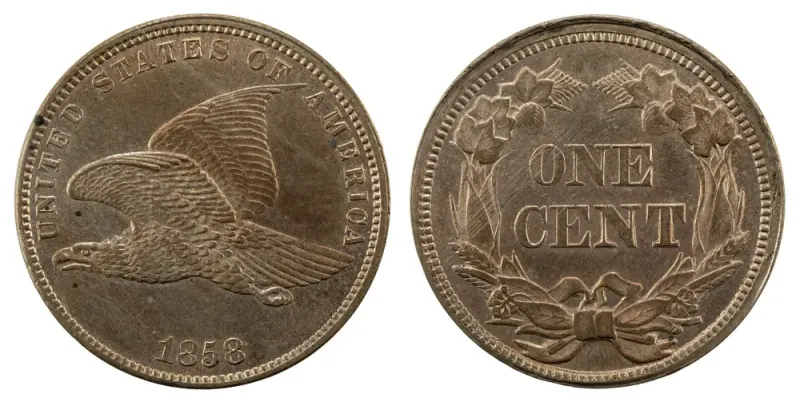
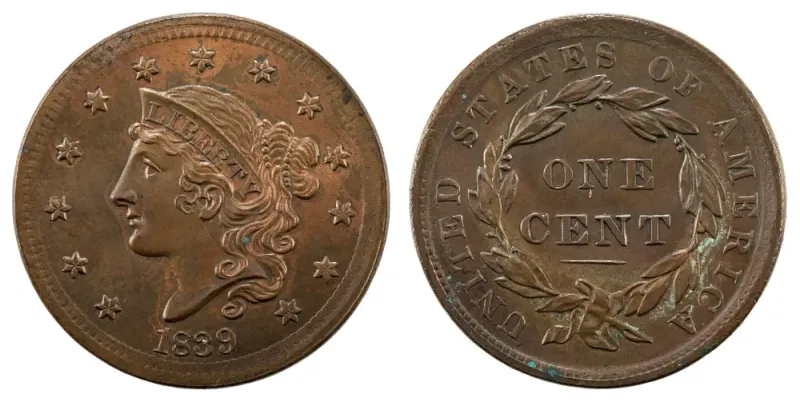
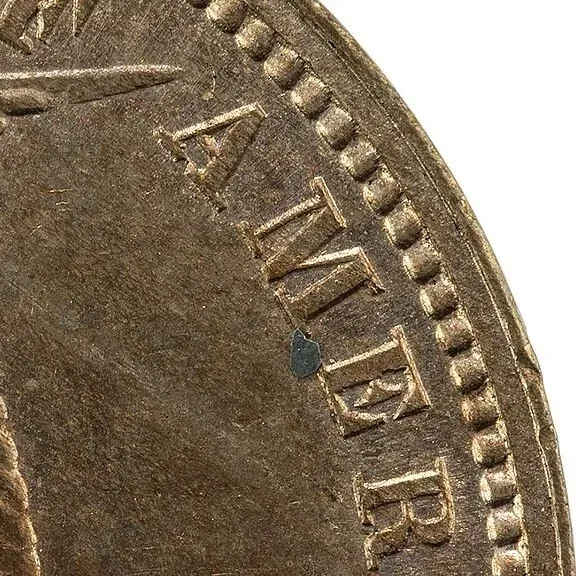
The story of the Flying Eagle cent
The Flying Eagle cent was the first small one-cent coin in the United States. It was struck for only two years, 1857 and 1858, plus a small run of patterns dated 1856. That short life makes it one of the most collected American coins.
It replaced the large cent. By the 1850s the old copper cent, about the size of a half dollar, cost the Mint more to make than it was worth. Congress approved a smaller coin in the Act of February 21, 1857. It was 19 mm across, made of 88% copper and 12% nickel, and much lighter at 4.67 g.
The design came from Chief Engraver James B. Longacre. He borrowed the eagle in flight from Christian Gobrecht's silver dollars of 1836 to 1839. On the back he put a wreath of corn, wheat, cotton and tobacco.
The Mint struck about 1,000 pattern cents dated 1856, and handed hundreds of them to members of Congress and officials to win support. More were restruck later for collectors, perhaps 1,500 to 2,000. The 1856 is the key to the series, and a lot of fakes are altered 1858 coins, so check the date closely.
The new cents went out on 25 May 1857. People lined up at the Philadelphia Mint to swap old large cents and worn Spanish silver for them. The pale alloy earned them the nickname "white cents."
They had a flaw. The eagle sat directly opposite the thick wreath, and the press couldn't push metal into both at once. Many coins came out weak on the eagle's head and tail, or on the wreath. In 1859 Longacre's Indian Head design replaced it.
All Flying Eagle cents were struck at Philadelphia, so none has a mint mark. For 1858 there are two main varieties:
- Large letters: the A and M in AMERICA touch.
- Small letters: the A and M are separate.
There's also an 1858/7 overdate, where an 1857 die was re-punched with an 8.
The full story of how the cent shrank, changed metal and finally stopped in 2025 is in the history article linked below.
From the encyclopedia
The Flying Eagle cent is a one-cent piece struck by the Mint of the United States as a pattern coin in 1856 and for circulation in 1857 and 1858. The coin was designed by Mint Chief Engraver James B. Longacre, with the eagle in flight based on the work of Longacre's predecessor, Christian Gobrecht.
From Flying Eagle cent on Wikipedia, text under CC BY-SA 4.0. Fetched November 3, 2026.
Questions people ask
Why is the 1856 Flying Eagle cent so valuable?
It was a pattern, struck before the coin was approved. Counting later restrikes, only a few thousand exist, against tens of millions of 1857 and 1858 cents.
How do I tell an 1858 large letters from small letters?
Look at AMERICA. On large letters, the A and M touch. On small letters, they're separate.
Why is a Flying Eagle cent lighter in colour than other pennies?
It's 12% nickel, which gives it a pale tone. That's why people called them "white cents."