Tap the coin to flip it
Walking Liberty Half Dollar (1916–1947)
United StatesHalf dollar1916–1947 (none in 1922, 1924–1926, 1930–1932); proofs 1936–1942
- Issuer
- United States Mint
- Denomination
- 50 cents (half dollar)
- Years minted
- 1916–1947 (none in 1922, 1924–1926, 1930–1932); proofs 1936–1942
- Metal
- 90% silver, 10% copper
- Weight
- 12.5 g
- Silver content
- 0.3617 troy oz
- Diameter
- 30.6 mm
- Edge
- Reeded
- Designer
- Adolph A. Weinman
- Mints and marks
- Philadelphia (none), Denver (D), San Francisco (S); on the front 1916–1917, on the back from 1917
In the hand
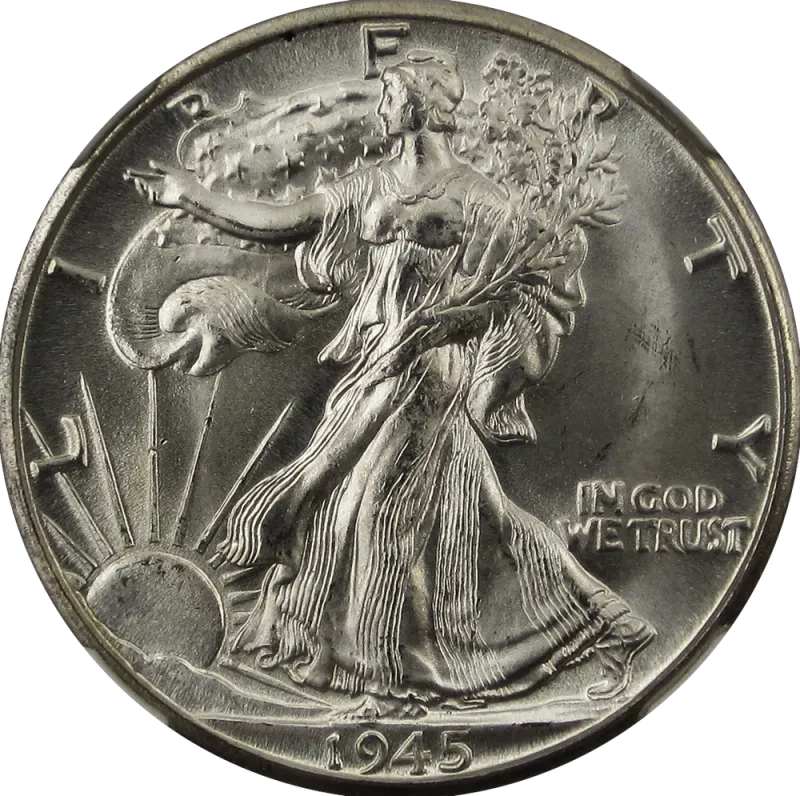
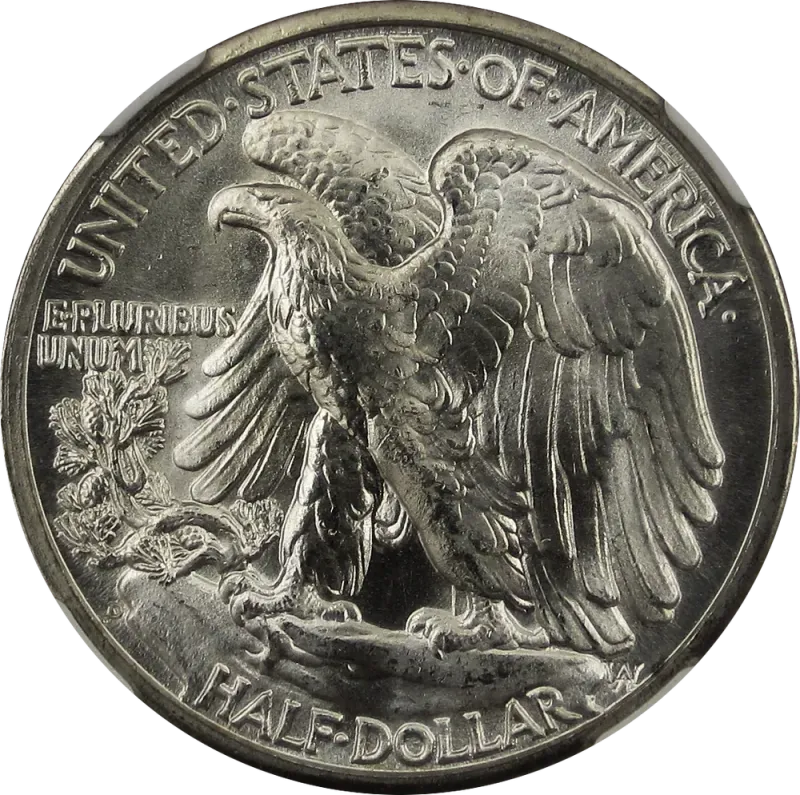
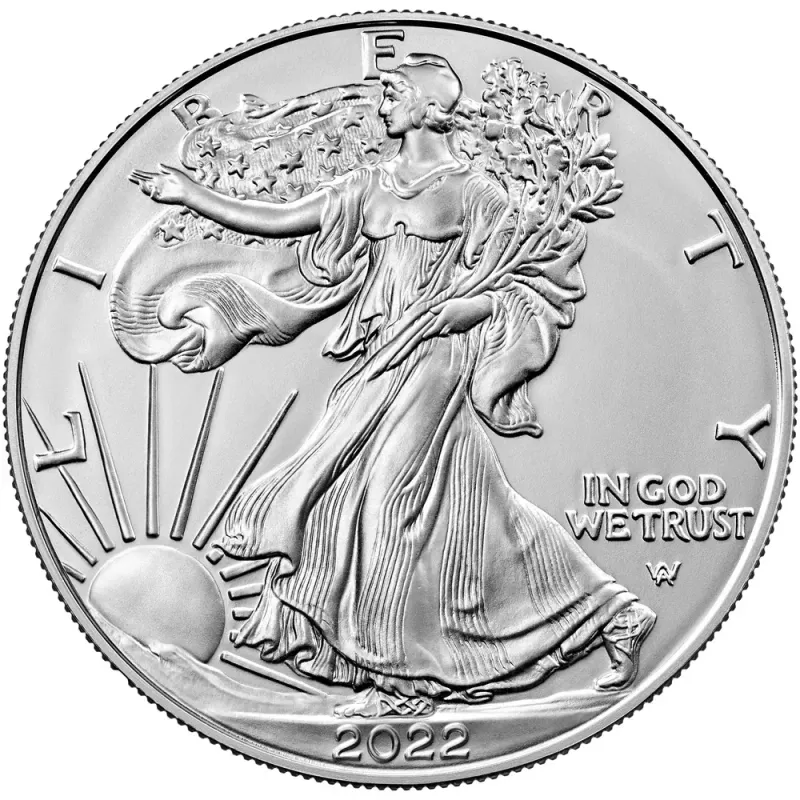
The story of the Walking Liberty half dollar
The Walking Liberty half dollar was struck from 1916 to 1947. Many collectors rank it among the best-looking American coins, and its front design is still used today on the American Silver Eagle bullion coin.
It came out of the 1916 redesign. The Barber dime, quarter and half had been in use since 1892, and by law a coin design could be replaced after 25 years. The Mint ran a competition and chose Adolph A. Weinman, a German-born sculptor who had studied under Augustus Saint-Gaudens. Weinman also won the dime, which became the "Mercury" dime.
On the front, Liberty strides toward the rising sun with the American flag around her shoulders. She carries branches of laurel and oak. On the back, an eagle stands on a rocky crag with its wings half open, and a young mountain pine grows out of the rock.
The coin is 90% silver and 10% copper. It weighs 12.5 grams and holds about 0.36 troy ounces of pure silver, so every Walking Liberty half is worth at least its melt value.
Three mints struck it: Philadelphia (no mint mark), Denver (D) and San Francisco (S). The mint mark moved in 1917. On 1916 coins and some 1917 coins it sits on the front, below IN GOD WE TRUST. After that it's on the back, near the rim at about eight o'clock, just under the pine branch. The 1917-D and 1917-S come in both versions.
The series has gaps. No halves were struck in 1922, from 1924 to 1926, or from 1930 to 1932. The low-mintage years of the early 1920s make the key dates: the 1921, 1921-D and 1921-S, plus the 1916-S and 1938-D. At the other end, the 1940s coins were made in the tens of millions. The 1943, with more than 53 million struck at Philadelphia, is the one most people find.
Weinman's high relief was hard to strike well. On many coins Liberty's head and her left hand are flat, especially on Denver and San Francisco coins from the 1940s. A coin with a full head and hand is worth noticeably more.
The Franklin half replaced it in 1948. Weinman's Liberty came back in 1986 on the American Silver Eagle, and in 2016 the Mint struck a gold version for the coin's centennial. The wider story of America's silver coins is in the history articles linked below.
Questions people ask
How much silver is in a Walking Liberty half dollar?
0.3617 troy ounces. The coin is 90% silver and weighs 12.5 g.
Where is the mint mark on a Walking Liberty half?
On 1916 and some 1917 coins it's on the front, under IN GOD WE TRUST. From 1917 on it's on the back, near the rim at lower left, under the pine branch. Philadelphia coins have no mint mark.
Which Walking Liberty halves are the key dates?
The 1921, 1921-D and 1921-S have the lowest mintages. The 1916-S and 1938-D are also scarce.
Is a 1943 Walking Liberty half dollar rare?
No. More than 53 million were struck at Philadelphia, so it's one of the most common dates. Its value is mostly its silver, unless it's in very high grade.