Colonial Coins and Continental Currency
Part 28 of the Americas series6 min read
Pine Tree shillings, Spanish dollars, wampum and paper bills: what money the American colonies used, and how Continental currency became "not worth a Continental."
The American colonies were always short of coins. Britain sent goods across the Atlantic and expected silver and gold to flow back, so hard money left almost as fast as it arrived. Colonists made do with whatever they could find: tobacco, beaver pelts, shell beads, foreign silver, a few coins of their own, and eventually a lot of paper.
That paper is where the phrase "not worth a Continental" comes from. Here's how the colonies got there.
Paying without coins
In the early colonies, much day-to-day trade ran on commodities. Tobacco served as money in Virginia and Maryland. Rice, sugar and beaver skins changed hands as payment in other places. In New England, wampum (strings of white and purple shell beads made by coastal Native peoples) worked as small change and was legal tender for a time.
Commodity money had obvious problems. Tobacco varied in quality, and wampum was easy to fake with poorly made beads. People wanted coins.
The Spanish dollar and other foreign coins
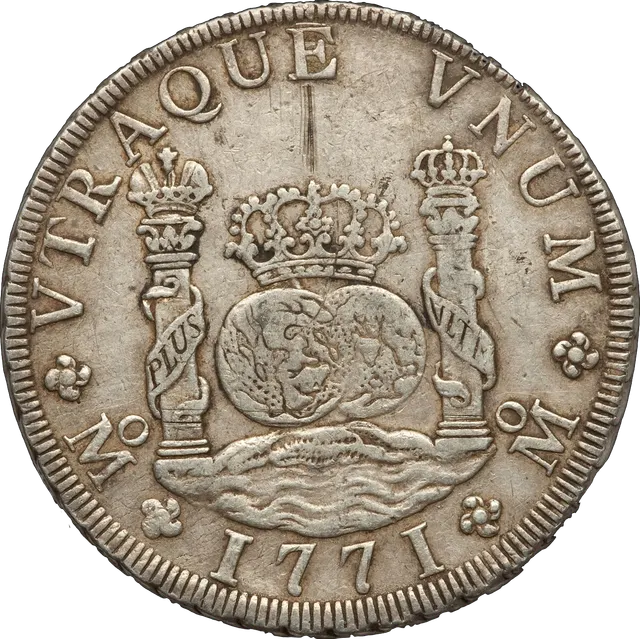
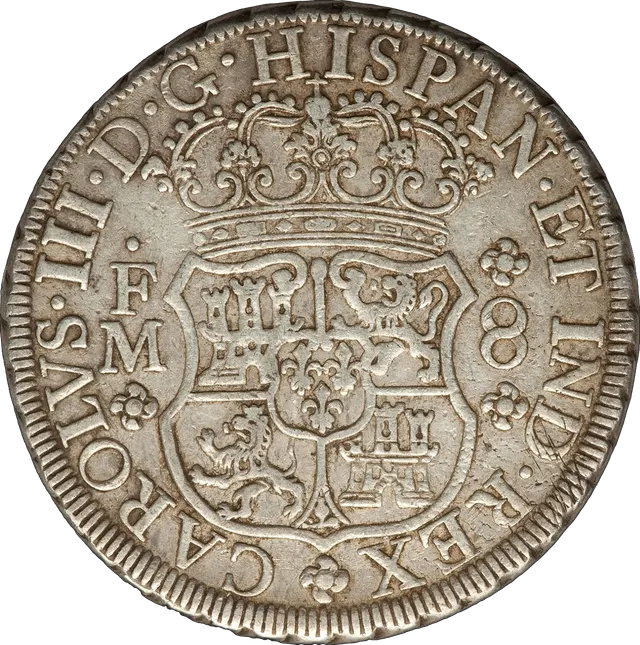
The coins colonists did have mostly came from somewhere else. The most common by far was the Spanish dollar, the silver eight-reales piece minted in Mexico City, Potosí and Lima. Trade, privateering and smuggling brought them north from the Caribbean. Portuguese gold "joes," French louis d'or and Dutch lion dollars turned up too.
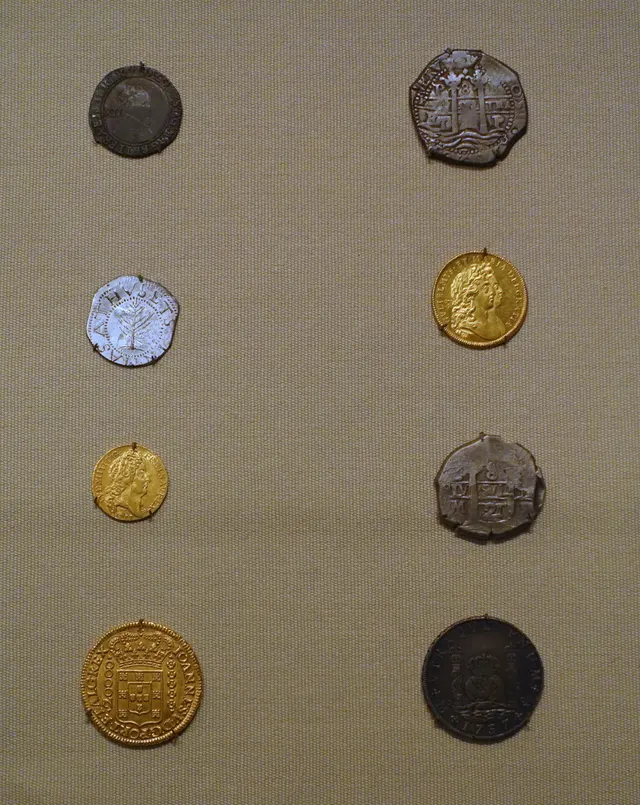
There was a catch. Every colony kept its accounts in pounds, shillings and pence, but each one valued the Spanish dollar differently. By the middle of the 1700s a dollar was worth 6 shillings in New England, 7 shillings 6 pence in Pennsylvania and 8 shillings in New York. A New York shilling and a Boston shilling were not the same amount of money, which made travel and trade between colonies a headache.
The Spanish dollar outlived the colonies. When the United States picked a unit for its own money, it chose the dollar. Read more in Pieces of Eight: The Spanish Dollar, First Global Currency, or flip a Spanish dollar.
Massachusetts makes its own: the tree shillings
In May 1652 the Massachusetts General Court decided to fix the shortage itself. It set up a mint in Boston, without asking London, and named the silversmith John Hull as mint master with Robert Sanderson as his partner.
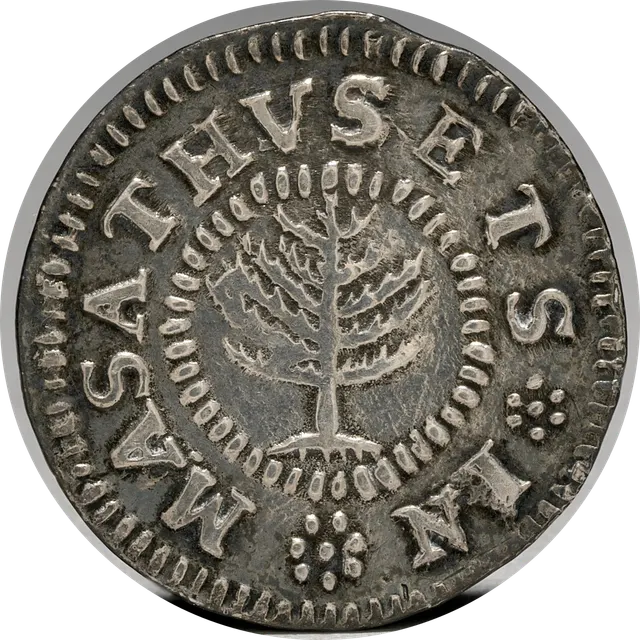
The mint struck shillings, sixpences and threepences. It made them lighter than English coins on purpose: a Massachusetts shilling had about 22 percent less silver than an English one. The idea was to keep the coins at home. If they were worth less abroad, merchants had less reason to ship them out.
The first coins were plain discs stamped "NE" for New England. They were easy to clip, so the mint switched to a fuller design with a tree inside a beaded ring. Collectors name them by the tree:
- Willow Tree coins (about 1652–1660)
- Oak Tree coins (about 1660–1667)
- Pine Tree coins (about 1667–1682)
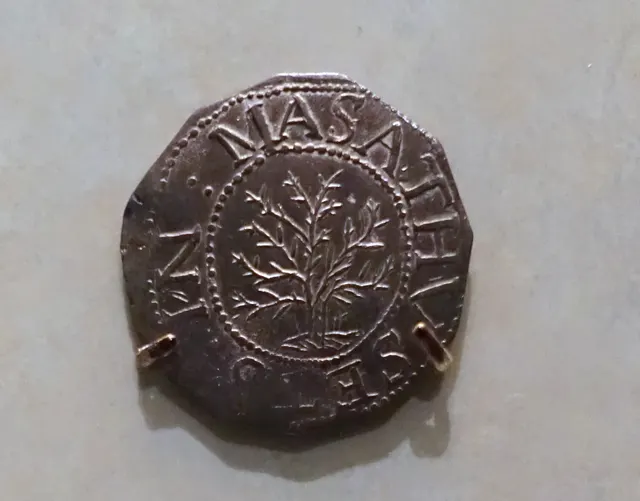
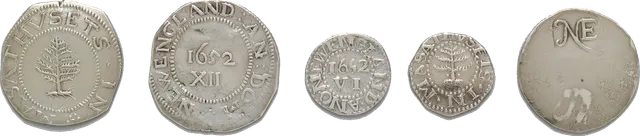
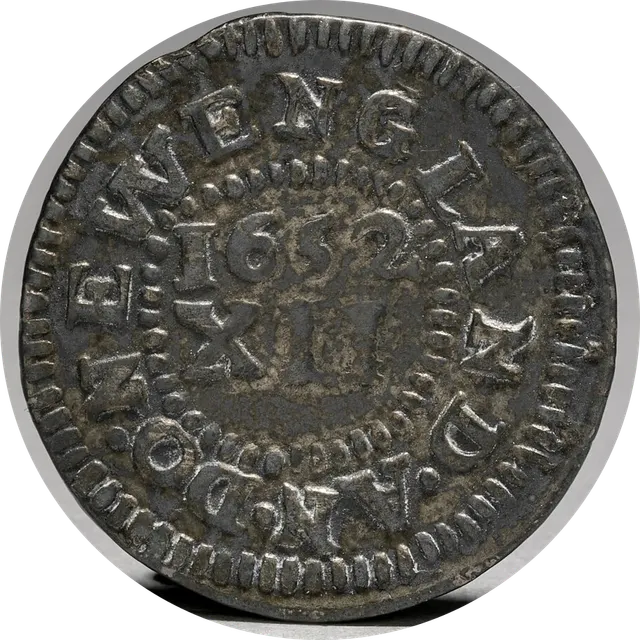
Almost every coin carries the date 1652, no matter when it was struck. The one exception is the Oak Tree twopence, dated 1662. Nobody knows for certain why the date never changed. A popular theory says Massachusetts froze it at 1652 because England had no king that year, so the mint could claim it was operating under rules from the Commonwealth period. That's a guess, not a documented fact.
The Boston mint stopped working in 1682. Two years later England revoked the Massachusetts charter, and the colony's coinage ended for good. Today a Pine Tree shilling is the best-known American colonial coin, and good examples sell for tens of thousands of dollars.
Massachusetts wasn't entirely alone. Lord Baltimore had silver coins struck in London for Maryland around 1659, and over the next century various private and royal copper pieces circulated in small numbers. None of them came close to solving the shortage. If you want to see what an English shilling looked like next to these, flip a shilling.
Paper money arrives (1690)
In 1690 Massachusetts sent an expedition against Quebec. It failed, and the soldiers came home expecting pay that the colony didn't have. In December the government printed £7,000 in bills of credit, promising to accept them for taxes and to redeem them later. These were the first government-issued paper money in the Western world.
Other colonies copied the idea. South Carolina issued bills in 1703, and by 1755 every colony had printed its own. Some managed it well. Others printed far too much and watched the notes lose value. Britain disliked the whole business, and Parliament restricted colonial paper money in the Currency Acts of 1751 and 1764. That restriction became one more grievance in the years before the Revolution.
Continental currency (1775–1779)
When fighting broke out in 1775, the Second Continental Congress had no power to tax and no gold. What it could do was print. On June 22, 1775, Congress voted to issue $2 million in bills of credit. The notes were called Continental currency, or simply "Continentals."
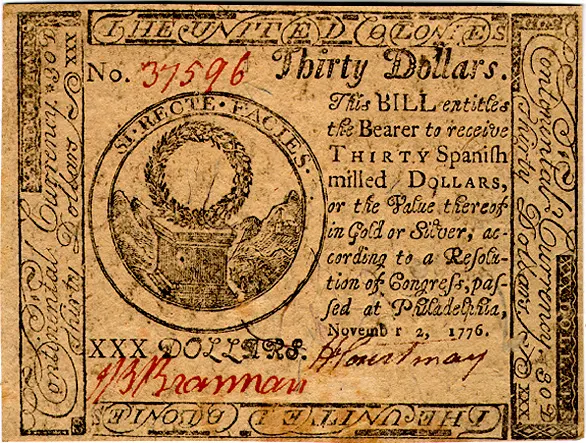
Each note promised the bearer a set number of "Spanish milled dollars, or the value thereof in gold or silver." The Spanish dollar was still the yardstick. Notes carried Latin mottos and small emblems, many of them chosen by Benjamin Franklin. To make counterfeiting harder, the backs of many notes were printed from casts of real leaves, a technique Franklin's printing shop had used on colonial notes for years.
The first $2 million was not the last. Congress kept printing, and by the end of 1779 it had authorized about $241.5 million in Continentals. The states printed their own money on top of that.
"Not worth a Continental"
Prices rose as fast as the presses ran. By late 1777 Continentals were losing value, and British counterfeiting made it worse. The British printed fake Continentals in large numbers and spent them in the colonies, partly to buy supplies and partly to wreck confidence in the money.
In March 1780 Congress admitted the problem and offered to swap old notes for new ones at 40 to 1. It didn't work. By 1781 Continentals traded at 75 to 1 or worse in most states, and in some places at hundreds to one. People stopped taking them, and "not worth a Continental" came to mean something worthless.
The notes didn't vanish completely. Under the Funding Act of 1790, holders could exchange old Continentals for federal bonds at 100 to 1, a cent on the dollar.
The episode had a lasting effect. The Constitution, written in 1787, bars the states from issuing their own paper money or coining money.
The 1776 Continental "dollar"
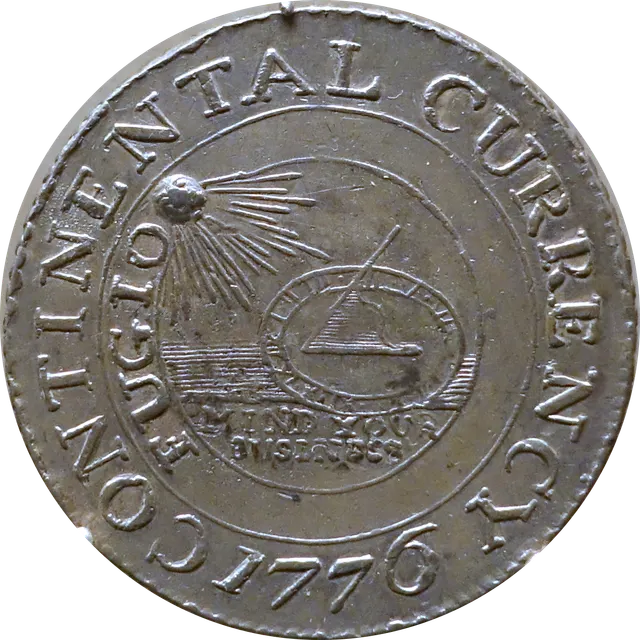
There's also a Continental Currency coin. Pewter pieces dated 1776 show a sundial, the word FUGIO ("I fly," meaning time flies) and the motto MIND YOUR BUSINESS on one side, with thirteen linked rings naming the states on the other. The designs match fractional notes Congress issued in February 1776.
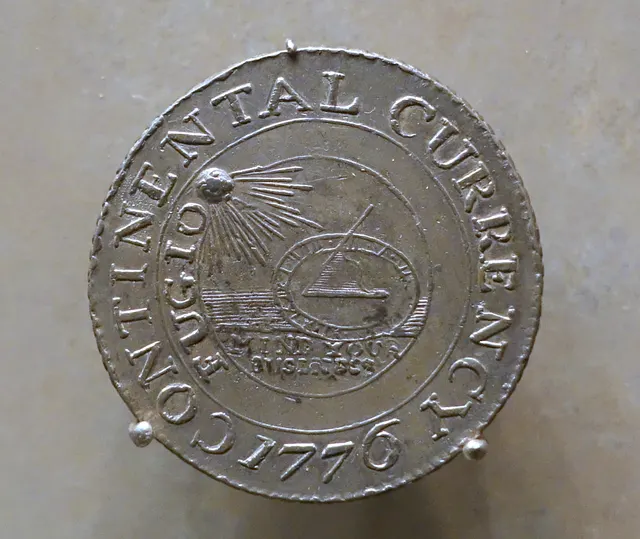
For a long time collectors treated these as pattern coins for a dollar Congress never issued. Recent research, including work published by curators at Colonial Williamsburg, argues they were commemorative medals struck around 1783, probably in London. A contemporary witness, Pierre Eugène du Simitière, described one as "struck in London on type-metal." The debate isn't completely settled, but the case for a medal is strong.
The Fugio cent (1787)
The sundial and chain designs got one more outing. In 1787 the Confederation Congress ordered copper cents with the same FUGIO sundial and MIND YOUR BUSINESS on one side and thirteen linked rings around WE ARE ONE on the other. These Fugio cents were the first coins authorized by the United States government.
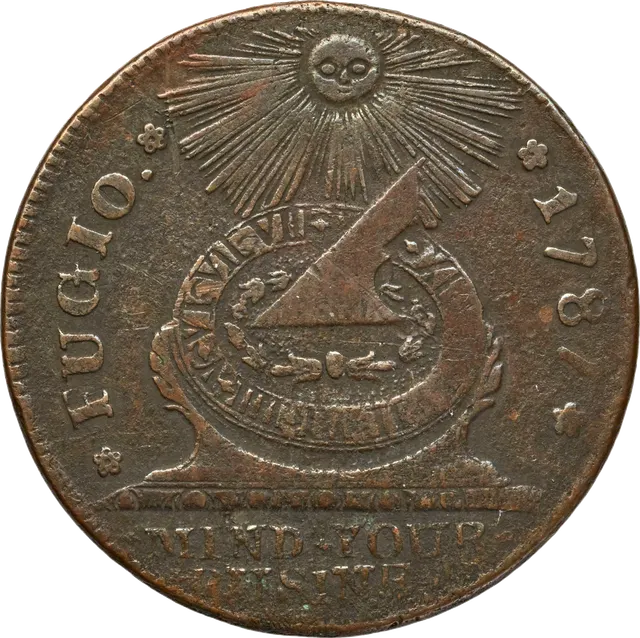
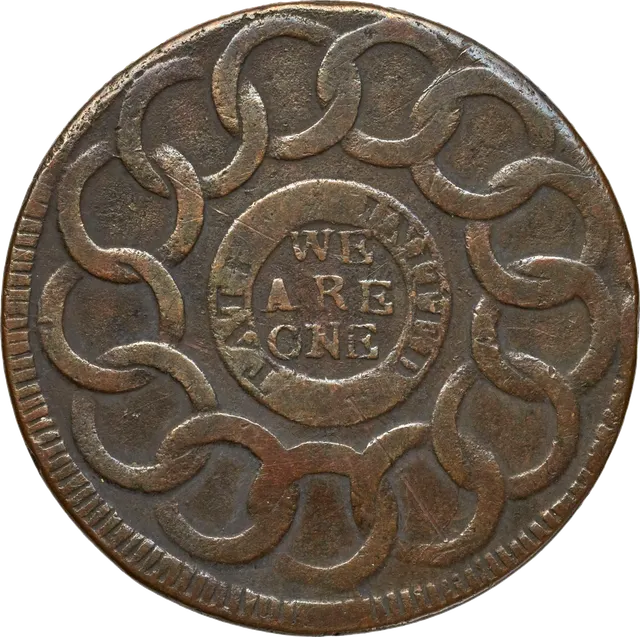
The contractor, James Jarvis of Connecticut, was supposed to strike about 300 tons of copper into cents. He made far fewer, the coins were underweight, and the public didn't want them. The project ended in a mess.
Five years later Congress tried again with the Coinage Act of 1792 and a national mint. The first cent from that mint, the 1793 Chain cent, borrowed the linked-chain idea one last time. That story continues in The History of the Penny.
Want to see how a colonial-era coin lands? Flip a Spanish dollar, flip a shilling, or try the coin flipper.
Questions people ask
What money did the American colonies use?
Mostly foreign coins, above all the Spanish silver dollar, plus commodity money such as tobacco and wampum, a few local coins like the Massachusetts Pine Tree shilling, and from 1690 onward paper bills issued by the colonies themselves.
What was Continental currency?
Paper money issued by the Continental Congress to pay for the American Revolution, starting with $2 million authorized on June 22, 1775. By the end of 1779 Congress had authorized about $241.5 million.
Why does "not worth a Continental" mean worthless?
Congress printed far more Continentals than it could back, and British counterfeiters added more. By 1781 the notes traded at 75 to 1 or worse against silver, and people stopped accepting them.
Why are all Pine Tree shillings dated 1652?
Massachusetts kept the 1652 date on its silver coins for about 30 years, until the mint closed in 1682. The reason was never recorded. One theory links it to England having no king in 1652, but that is unproven.
What was the first coin of the United States?
The Fugio cent of 1787, a copper cent ordered by the Confederation Congress. The US Mint's first circulating cents followed in 1793.
Sources
- CoinWeek, "The 1652 Pine Tree Shilling: The Coin Massachusetts Wasn't Supposed to Make."
- Smithsonian National Museum of American History, Pine Tree shilling object record
- EH.Net Encyclopedia (Economic History Association), Ron Michener, "Money in the American Colonies."
- University of Notre Dame, Colonial Currency, "The Value of Money in Colonial America."
- American Numismatic Association Money Museum, "Currency of the Revolution."
- Encyclopedia.com (Dictionary of American History), "Continental Currency."
- Farley Grubb, "The Continental Dollar: What Happened to It after 1779?" NBER Working Paper 13770
- Colonial Williamsburg collections, "Continental Currency 'Dollar' Medal."
- Smithsonian, 1787 Fugio cent object record
- CoinWeek, "Fugio Cents: The First Regular-Issue United States Coin."
- Massachusetts Historical Society, "Early Paper Money of America, 1691–1796."
- Wikipedia, "Pine tree shilling," "Early American currency," "Fugio cent" (cross-check only)
Coins in this story
- Spanish dollar
- Pine Tree shilling
- Continental $30 note
- Continental dollar
- Fugio cent
More coin pagesShilling