Tap the coin to flip it
The Spanish Dollar (8 Reales)
Spain8 reales
Silver coin
- Issuer
- Spanish Crown, at mints in Spain and Spanish America
- Denomination
- 8 reales (1 peso)
- Years
- From the 1500s (after the 1497 reform of the real) to the 1820s
- Metal
- Silver, .917 fine until 1772, about .903 from 1772, about .896 from the late 1780s
- Weight
- About 27 g (27.07 g standard for milled coins)
- Diameter
- About 38–39 mm for milled coins; cobs vary
- Main mints
- Mexico City (Mº), Potosí (PTS), Lima, Santiago, Guatemala, Seville, Madrid
- Edge
- Milled coins: decorated edge from 1732; cobs: none
In the hand
The story of the Spanish dollar
The Spanish dollar is the silver 8 reales coin of the Spanish Empire, the real de a ocho. English speakers also called it a piece of eight. For about three centuries it was the most widely used silver coin in the world, and it was the model for the US dollar.
The coin grew out of Spain's coinage reform of 1497, which fixed the silver real. The big 8 reales multiple took off in the 1500s, once American silver arrived. The Mexico City mint opened in 1535, the first in the Americas, and later mints at Potosí, Lima and elsewhere turned the silver of Bolivia, Peru and Mexico into coins. One 8 reales equalled one peso. It weighed about 27 grams, close to a thaler, which is how it got the name "dollar" in English.
Three types to know:
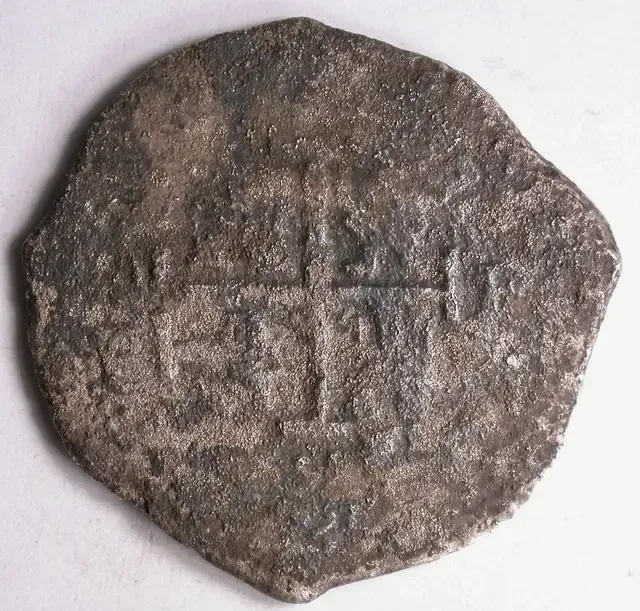
- Cobs (to the 1730s, and at Potosí to 1773). Hand-struck from rough slices of silver, so they're irregular in shape and often show only part of the design. The usual design is a crowned shield on one side and a cross with lions and castles on the other.
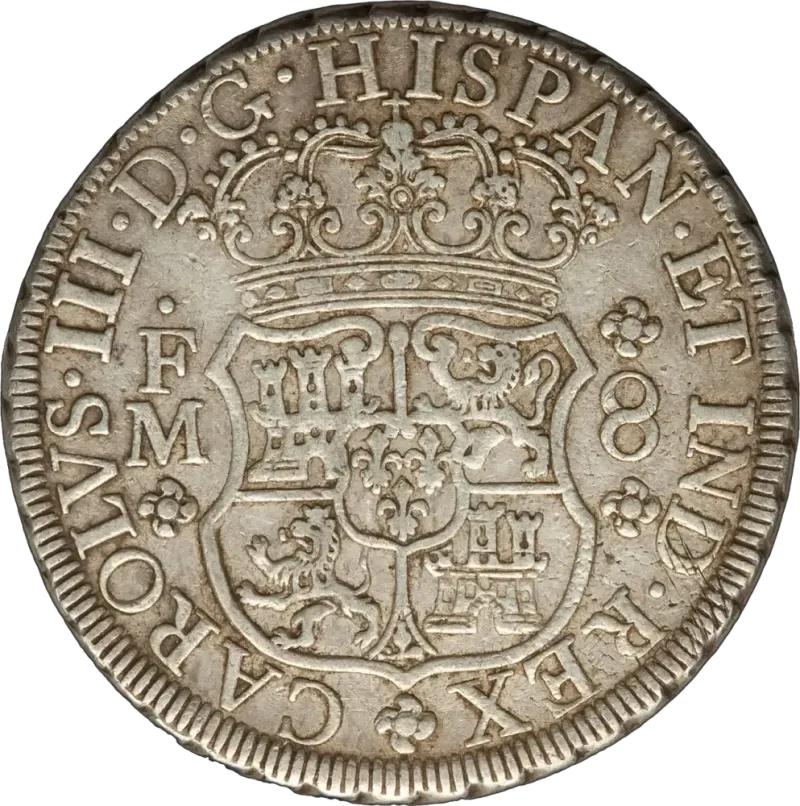
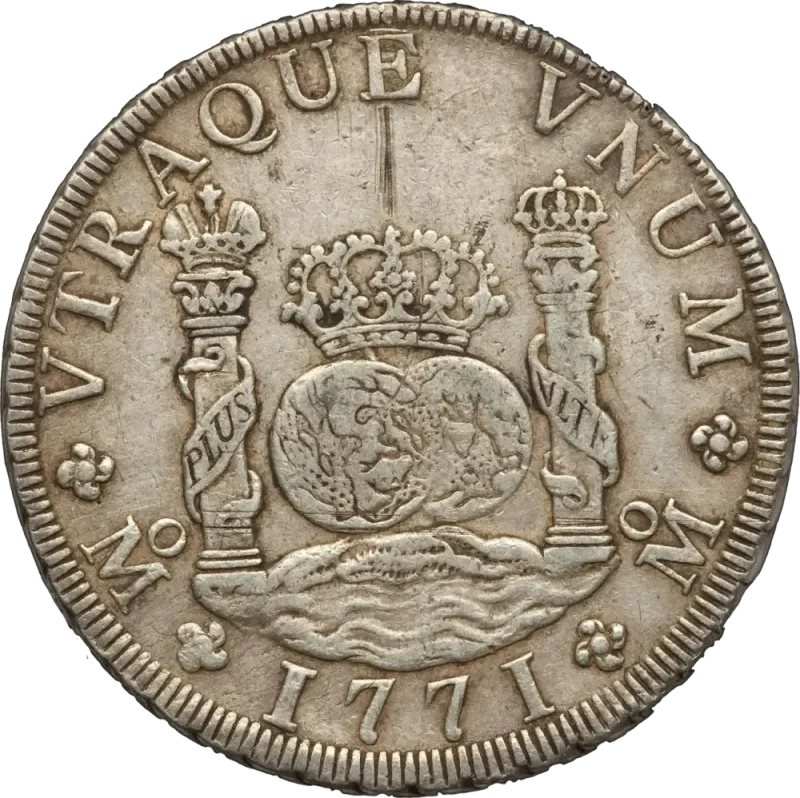
- Pillar dollars (1732–1772). Struck by machine at Mexico City from 1732, with a round shape and a milled edge to stop clipping. The reverse shows two globes between the Pillars of Hercules, with PLUS ULTRA banners. This is the "Spanish milled dollar".
- Portrait dollars (1772 to the 1820s). The king's bust on the front and the crowned arms between the pillars on the back. These are the "Carolus dollars" that Chinese merchants favoured.
Mint marks. Look near the shield or in the legend. Mexico City used an M with a small o above it (Mº). Potosí used a PTS monogram. A pair of assayers' initials usually sits alongside the mint mark.
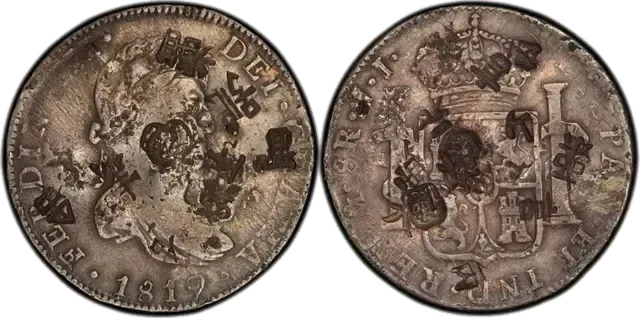
The coin was money almost everywhere. It paid for Chinese silk and porcelain by way of the Manila galleons, and coins that passed through China often carry small merchants' chop marks. In the American colonies it was the everyday silver coin. Cut into pieces, it gave Americans the phrase "two bits" for a quarter dollar.
The United States based its own dollar on it. The Coinage Act of 1792 defined the dollar as having "the value of a Spanish milled dollar", and Spanish coins stayed legal tender in the US until 1857.
After the Spanish colonies won independence in the 1820s, Mexico and others kept striking 8 reales and then pesos to the same standard. The Mexican peso carried on as a trade coin in Asia well into the 1900s.
From the encyclopedia
The Spanish dollar, originally known as the piece of eight, and much later also dólar, is a silver coin of about 38 mm (1.5 in) diameter worth eight Spanish reales. It was minted in the Spanish Empire, following a monetary reform in 1497, with content 25.563 g (0.8219 ozt) fine silver. It was widely used as the first international currency because of its uniformity in standard and milling characteristics. Some countries countermarked the Spanish dollar so it could be used as their local currency.
From Spanish dollar on Wikipedia, text under CC BY-SA 4.0. Fetched November 3, 2026.
Questions people ask
What's the difference between a cob and a milled Spanish dollar?
A cob was hammered by hand from a rough piece of silver, so it's irregular and the design is often off-centre. A milled dollar, from 1732 at Mexico City, was struck by machine, so it's round with a full design and a decorated edge.
Was the Spanish dollar legal tender in the United States?
Yes. Spanish and Spanish-American silver dollars circulated freely and stayed legal tender in the US until the Coinage Act of 1857.
Why do some Spanish dollars have small marks stamped on them?
Those are chop marks. Chinese merchants stamped coins they had tested for silver content, so a heavily chopped dollar spent time in the China trade.