Pieces of Eight: The Spanish Dollar, First Global Currency
Part 23 of the Trade empires series6 min read
Pieces of eight were Spain's silver dollars, struck from Andean and Mexican silver and spent from Boston to Canton. Here's how one coin became the world's money.
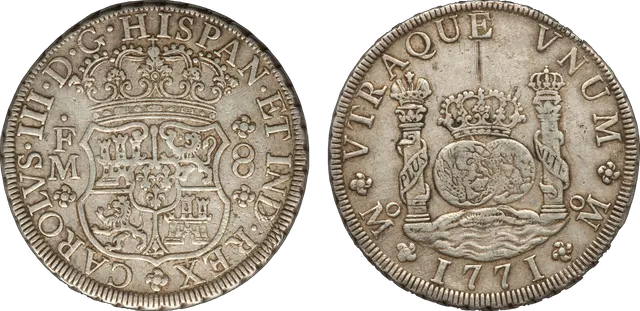
If you had a silver coin in your pocket in 1700, there's a fair chance it was Spanish. It didn't matter much whether you were a tobacco planter in Virginia, a tea merchant in Canton or a sailor on a Dutch ship. The coin was the real de a ocho, worth eight Spanish reales. English speakers called it a piece of eight, or simply a Spanish dollar.
For about three centuries it was the closest thing the world had to a common currency. It paid for Chinese silk and filled pirate chests, and it gave the United States the model for its own dollar.
Here's how one coin got that far.
What "pieces of eight" means
The real was Spain's standard silver coin. The big coin was worth eight of them, hence the name. Spain first struck it around 1500, and it weighed about 27 grams, most of it fine silver. That's roughly the size of a modern US silver dollar, give or take a millimetre.
The "eight" also had a practical side. People sometimes cut the coin into pieces to make change. Each eighth was a "bit", which is why Americans still call a quarter "two bits". The habit of counting in eighths lasted a remarkably long time. The New York Stock Exchange quoted share prices in fractions like 1/8 and 1/16 until it switched to decimals in 2001.
Silver from a mountain: Potosí
Spain didn't have the silver to make all these coins. The Americas did.
In 1545 the Spanish found silver at Cerro Rico, the "rich hill" above what became the city of Potosí, in today's Bolivia. The ore was unusually rich. Within a few decades Potosí was one of the largest cities in the Americas, and by many estimates the mountain produced more silver than anywhere else on earth for the next two centuries.
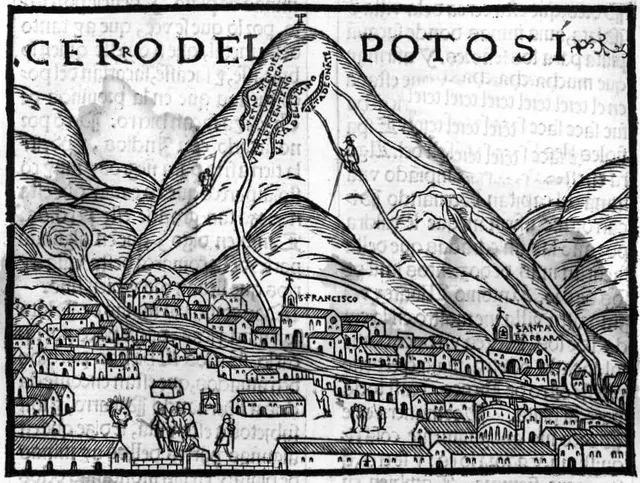
The human cost was enormous. In the 1570s Viceroy Francisco de Toledo adapted an Inca labour draft, the mita, to supply the mines. Communities across the southern Andes had to send roughly one adult man in seven to Potosí each year. Many never came home. Any honest history of the Spanish dollar has to start here, with the people who dug the metal out.
Toledo also opened a mint at Potosí in 1574. Mexico had already had one since 1535, when the Casa de Moneda in Mexico City became the first mint in the Americas. Mexico's own silver mines, at Zacatecas and Guanajuato, kept it busy. Mints at Lima and elsewhere joined in later. Between them, these workshops struck pieces of eight by the millions.
Cobs: rough coins made in a hurry
The early coins look nothing like the neat round dollar on this page's hero image. They're called cobs, and they were made fast.
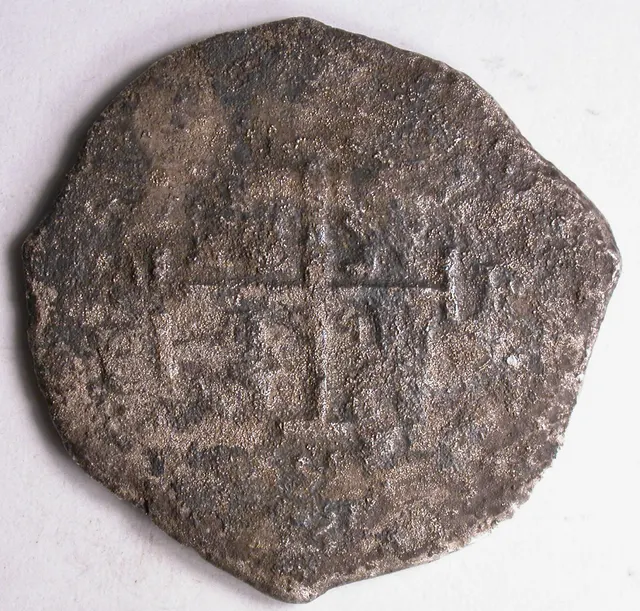
Mint workers poured silver into long bars, sliced off chunks, and trimmed each chunk until it weighed the right amount. Then they hammered it between two dies. The result was lumpy and often only half stamped, but the weight and the silver were right, and that's what traders cared about. Collectors who want to know more about hand striking can read our article on how the first coins were made.
The Potosí cobs show the Pillars of Hercules over ocean waves, with the motto PLUS ULTRA, "further beyond". It was Spain's boast that its empire reached past the old edge of the known world.
Cobs had one big weakness: their irregular edges were easy to shave. Someone could clip a sliver of silver from each coin and pass it on at full value. (That trick has a long history of its own; see coin clipping and Gresham's law.)
The pillar dollar: a coin you could trust at a glance
In 1732 the Mexico City mint began striking round coins on screw presses. These milled dollars had a decorated edge, so clipping showed straight away.
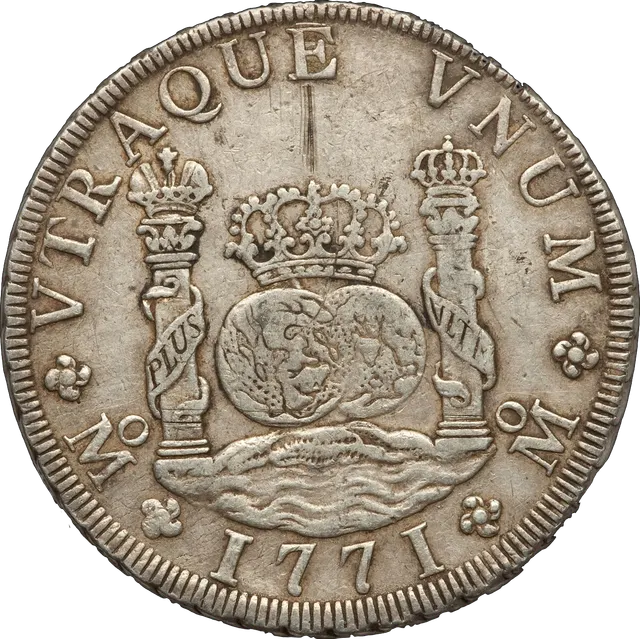
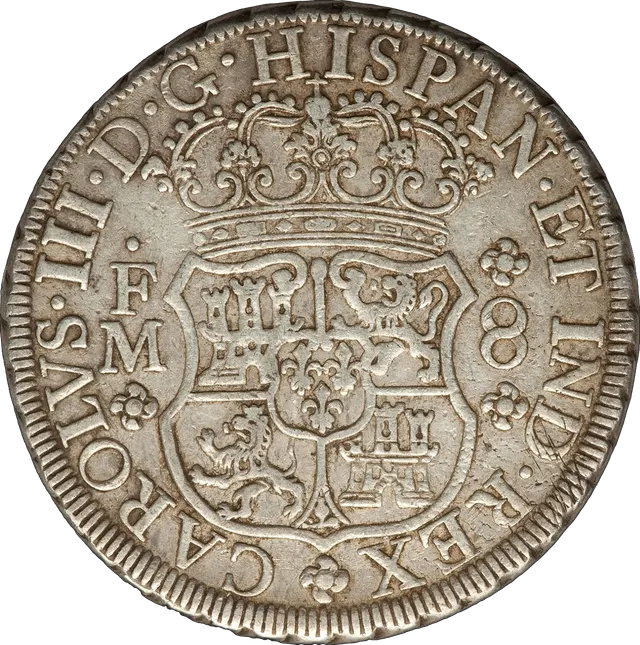
The new design put two globes between the Pillars of Hercules, crowned and wrapped in banners reading PLUS ULTRA. English speakers called it the pillar dollar. From 1772 a portrait of the king replaced the globes on one side, and those "portrait dollars" kept circulating long after Spain lost its American mints.
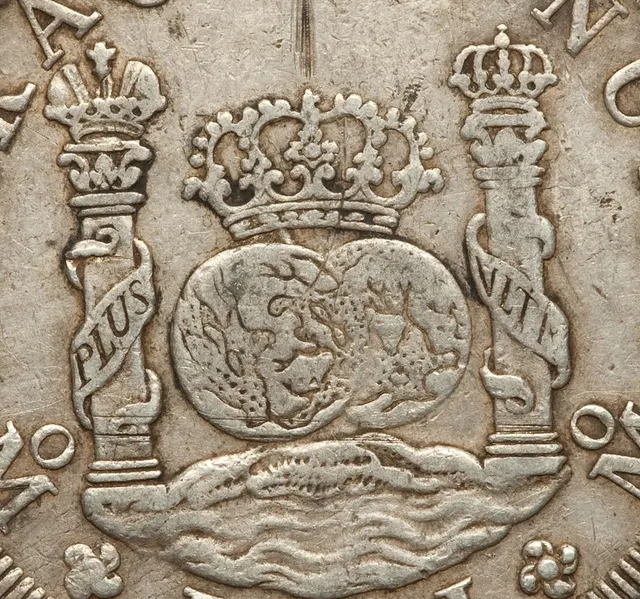
Potosí kept making cobs until 1773. After that, the Spanish milled dollar was the coin most of the world knew.
Across the Pacific: the Manila galleons
Some of the silver sailed east to Seville. A huge share went the other way.
From 1565 to 1815, Spanish galleons crossed the Pacific between Acapulco in Mexico and Manila in the Philippines, usually once or twice a year. They went west loaded with pieces of eight and came back with Chinese silk and porcelain, along with spices and other Asian goods.
China wanted silver badly. The Ming government had started collecting taxes in silver, and China's own mines couldn't keep up. Spanish dollars filled the gap, so much so that historians sometimes describe the Pacific route as a silver road rather than a silk road.
Chinese merchants checked each coin before accepting it. A trusted money-changer would test the silver and stamp the coin with his own small mark, called a chop. Some well-travelled dollars carry dozens of them.
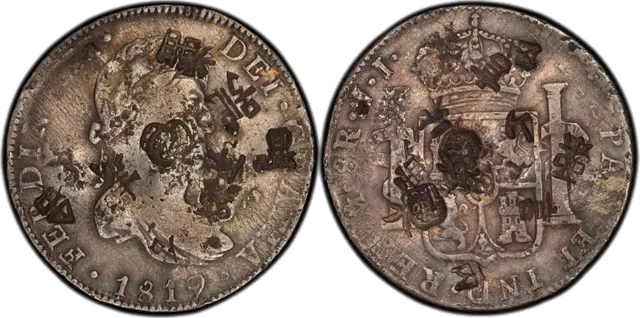
Portrait dollars of Charles III and Charles IV, struck from 1772 to about 1810, were a particular favourite in southern China. Merchants there called them "Carolus" dollars and kept asking for them by name for decades, even after newer coins were available.
Pirates, shipwrecks and treasure fleets
Most people first hear about pieces of eight from pirates, and the connection is real. Spanish treasure fleets carried silver from the Americas to Spain every year, and that made them targets for privateers and buccaneers in the Caribbean.
Storms did more damage than pirates. In 1622 the galleon Nuestra Señora de Atocha sank off the Florida Keys with tons of silver aboard, much of it Potosí cobs. Treasure hunter Mel Fisher found the main wreck in 1985. Coins from wrecks like this are why cobs are still fairly easy for collectors to buy today. The gold side of these fleets has its own story in The Doubloon.
The phrase got its permanent place in pop culture in 1883, when Robert Louis Stevenson gave Long John Silver a parrot in Treasure Island that screamed "Pieces of eight!"
The coin behind the US dollar
In the British American colonies, the Spanish dollar was everywhere. Britain sent few coins to its colonies, so people used whatever silver they could get, and most of it came from Spanish mints. Colonial prices and debts were often written in Spanish dollars. More on that period in Colonial Coins and Continental Currency.
The name "dollar" itself came from the German thaler, a big silver coin of similar size (we cover that in The Thaler: The Coin That Named the Dollar). English speakers simply applied it to the Spanish coin.
When Congress set up the US Mint in 1792, it defined the new dollar as having "the value of a Spanish milled dollar as the same is now current." Alexander Hamilton had worn Spanish dollars assayed to find out how much silver they actually held, and the US dollar was set at 371¼ grains of pure silver to match. The full story is in The Coinage Act of 1792.
Even then, the young US Mint couldn't make enough coins, so Spanish dollars kept circulating as legal money. They stayed legal tender in the United States until the Coinage Act of 1857.
The dollar sign may come from the same coin. The most widely accepted explanation is that it grew out of "ps", the scribal shorthand for pesos, with the s written over the p.
How far did it go?
After Mexico won independence in 1821, it kept striking 8-reales coins on the old standard, and the "Mexican dollar" took over much of the Spanish dollar's role in Asia. Between them, the Spanish and Mexican dollars became the model for currencies across Asia and the Americas. The Chinese yuan and the Japanese yen both trace their origins to this standard, and so do the Philippine peso and the old Straits dollar of Malaya and Singapore.
A coin first struck in Spain around 1500 ended up shaping money on four continents.
Flip the coin you just read about
We have a Spanish dollar coin page with the details collectors look for. You can also flip one in our coin flipper and see which side lands up: the shield or the pillars. Next in the series: The Doubloon: Spanish Gold and Pirate Legend.
Questions people ask
What were pieces of eight?
Pieces of eight were Spanish silver coins worth eight reales, properly called the real de a ocho. They weighed about 27 grams and were mostly minted in Mexico and Potosí (now Bolivia) from Andean and Mexican silver. English speakers also called them Spanish dollars.
Why are they called pieces of eight?
Because each coin was worth eight reales, Spain's standard silver unit. The coins were sometimes cut into eight pieces to make change, and each piece was called a "bit". That's where "two bits" for 25 cents comes from.
How much silver is in a piece of eight?
A Spanish dollar weighed about 27 grams, and early coins were roughly 93% silver. Spain lowered the fineness slightly in the 18th century, to about 90%. The US dollar of 1792 was set at 371¼ grains (about 24 grams) of pure silver to match worn Spanish dollars in circulation.
Were Spanish dollars legal in the United States?
Yes. Spanish dollars and their fractions were legal tender in the US until the Coinage Act of 1857 ended the legal-tender status of foreign coins.
Are pieces of eight valuable today?
It depends on the coin. Common cobs and later milled dollars in worn condition sell for well above their silver value, while rare dates, early Mexico City coins and well-documented shipwreck pieces can sell for far more. Condition, mint, date and provenance all matter, so check recent auction records before buying or selling.
Sources
- American Numismatic Association Money Museum, "Wealth of the New World" virtual exhibit.
- The Metropolitan Museum of Art, "The Manila Galleon Trade (1565–1815)", Heilbrunn Timeline of Art History.
- Smithsonian National Museum of American History, "8 Reales, Mexico, 1770" (National Numismatic Collection).
- United States Mint, "History of U.S. Circulating Coins."
- International Institute of Social History, "Potosí silver mines."
- Sewall Menzel, Cobs, Pieces of Eight and Treasure Coins: The Early Spanish-American Mints and Their Coinages, 1536–1773 (American Numismatic Society, 2004).
- Daniel Frank Sedwick and Frank Sedwick, The Practical Book of Cobs, 4th ed. (2007).
- Charles C. Mann, 1493: Uncovering the New World Columbus Created (Vintage, 2012).
- CoinWeek, "Chopmarked Coins: A History; the silver coins used in China 1600–1935."
Coins in this story
More coin pagesDoubloon