The Coins of Alexander the Great
Part 7 of the ancient world series6 min read
Herakles in a lion skin, Zeus on his throne, and coins struck in Alexander's name for 250 years after he died. How to read them and why there are so many.
Alexander III of Macedon became king in 336 BC, at the age of 20. He died in Babylon in 323 BC, aged 32. In the 13 years between, he conquered the Persian Empire and ruled land from Greece to Egypt to the edge of India.
His coins outlived him by a long way. Cities and kings kept striking silver in his name for more than 250 years after his death. That's why an Alexander tetradrachm is one of the ancient coins you're most likely to come across today, and why so many of them were made after he was dead.
His father's money
Alexander inherited a working coinage from his father, Philip II. Philip's silver tetradrachms showed the head of Zeus on one side and a horseman on the other. His gold staters, which Greeks called philippeioi, showed Apollo and a two-horse chariot.
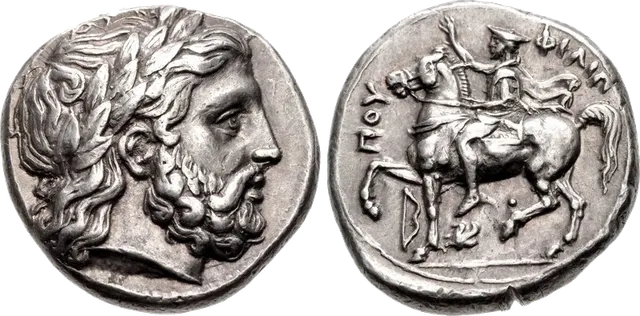
Philip struck his silver on the local Thraco-Macedonian weight standard, a tetradrachm of about 14.4 grams. His gold followed the Attic standard used in Athens.
Herakles and Zeus
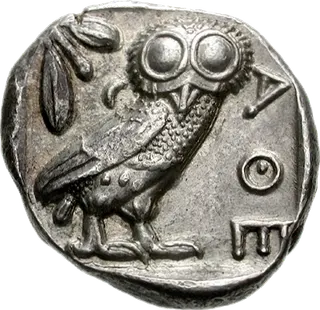
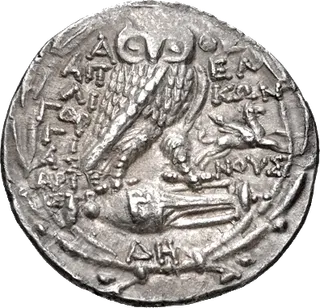
Alexander changed the silver. He moved it onto the Attic standard as well, so his tetradrachm weighed about 17.2 grams, the same as an Athenian owl. (Our guide to ancient Greek coins tells the owl's story.) That one change meant his coins could pass anywhere Athenian silver already did.
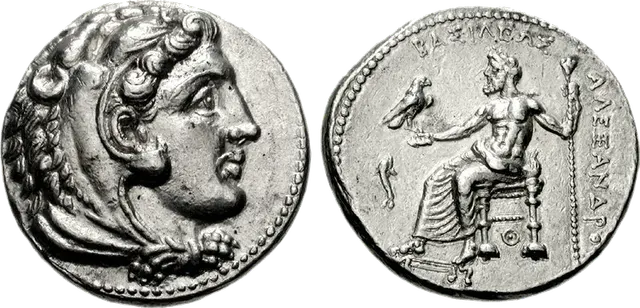
The design he chose is easy to recognise:
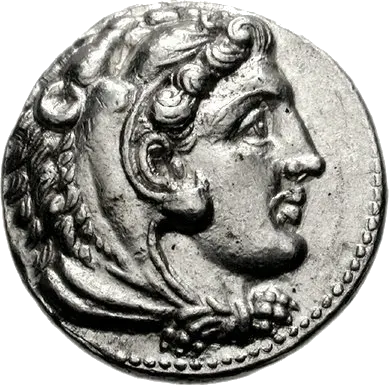
- Front: the young hero Herakles, wearing the skin of the Nemean lion as a hood, its jaws over his forehead and its paws knotted under his chin.
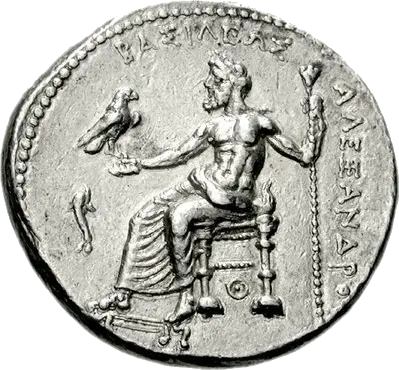
- Back: Zeus seated on a throne, holding an eagle in his outstretched right hand and a long sceptre in his left.
- Legend: ΑΛΕΞΑΝΔΡΟΥ, "of Alexander", running down the right side. Later issues often add ΒΑΣΙΛΕΩΣ, "King".
The Macedonian royal family claimed descent from Herakles, and Zeus was Herakles' father, so the two sides make a family statement. Numismatists have also pointed out that the seated Zeus looks a lot like Baal, the god on the earlier silver of Tarsus in Cilicia, so the design would have looked familiar in the east too.
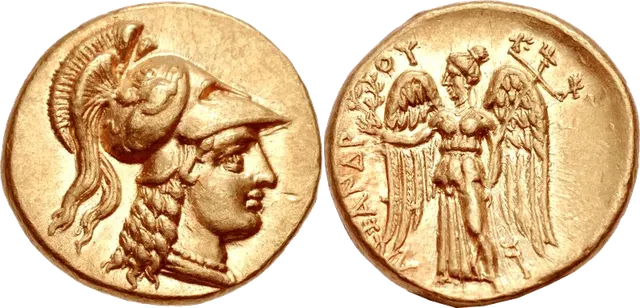
Alexander's gold stater, about 8.6 grams, used a different pair: Athena in a crested Corinthian helmet on the front, and a winged Nike, the goddess of victory, holding out a wreath on the back.
When did the coins start?
Numismatists still argue about this. Martin Price, who catalogued the whole series for the British Museum in 1991, thought Alexander began striking his new silver in 336 BC, as soon as he became king, at mints in Macedonia. Hyla Troxell of the American Numismatic Society argued for a later start, around 333 to 332 BC, after his victory over the Persians at Issus. On her reading, the mint at Tarsus in modern Turkey may have struck Alexander's silver before Macedonia did. Many specialists, including the French numismatist Georges Le Rider, came round to the later dates.
Persian gold, Greek coins
Alexander's armies took the treasuries of the Persian kings at Susa, Persepolis and elsewhere. The Bundesbank's money museum puts the total haul at about 180,000 talents, around 4,700 tonnes of gold and silver.
Much of that metal ended up as coins. By the end of his life, about 25 mints were striking his types: two in Macedonia, one in Egypt and 23 across Asia, from Asia Minor through Syria and Phoenicia to Babylon. This was the first time one design and one weight standard ran across so much of the world.
How to read an Alexander coin
With so many mints, how do you tell where a coin came from? Look at the small details on the Zeus side.
Most Alexanders carry a little symbol in the field by Zeus's arm or under his throne, such as a torch, a prow, a bee, a crescent or the forepart of a lion. Many also have a monogram, two or three letters combined into one mark. These were control marks for the mint and the officials who ran each issue. CoinWeek counts well over a thousand combinations of symbol and monogram.
Collectors identify Alexanders by those marks, using the numbers in Price's 1991 catalogue ("Price 3964", for example). The American Numismatic Society's free online database, PELLA, lists every Price type with photos of real examples, so you can match your coin there.
The elephant medallions
One small group of coins stands apart. These large silver decadrachms show a horseman with a lance attacking two men on a war elephant. Most scholars read the scene as Alexander against the Indian king Porus at the battle of the Hydaspes in 326 BC. The other side shows a standing figure holding a thunderbolt, being crowned by a flying Nike.
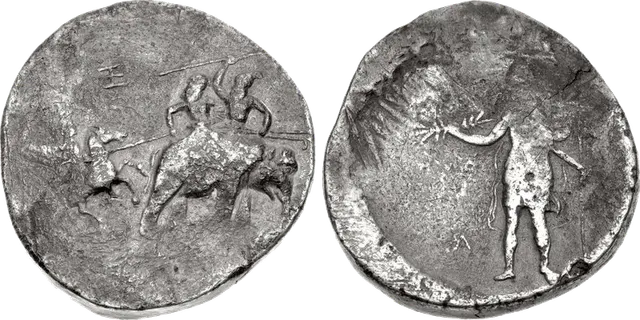
Neither side names Alexander, and nobody knows for certain where they were struck. The usual guess is Babylon, around 324 BC, after he came back from India. If that's right, they may be the only coins made in his lifetime that show Alexander himself. The historian Frank Holt wrote a whole book about them.
Is that Alexander's face?
People often call the Herakles head a portrait of Alexander. Most numismatists say it isn't, at least not on the coins struck while he was alive. The head is a standard Herakles, and it looks much the same as the one on older Greek coins.
On some later issues the face gets younger and more individual. Some writers see Alexander's features there. It's still debated.
Coins in a dead man's name
When Alexander died in 323 BC, he left no adult heir. His half-brother Philip III and his infant son Alexander IV became joint kings, and his generals, the "successors", began dividing up the empire.
At first they changed nothing. The mints kept striking Herakles and Zeus, with Alexander's name, and the generals didn't even add their own names. Philip III's coins kept the same types and put ΦΙΛΙΠΠΟΥ, "of Philip", in place of Alexander's name.
Then the successors started putting Alexander's own face on their coins, styled as a god:
- Ptolemy I in Egypt showed him wearing an elephant scalp as a headdress, a reminder of the conquest of India, with the ram's horn of Zeus Ammon curling round his ear.
- Seleucus I, ruling from Babylon, kept the Alexander types going on his coins for years.
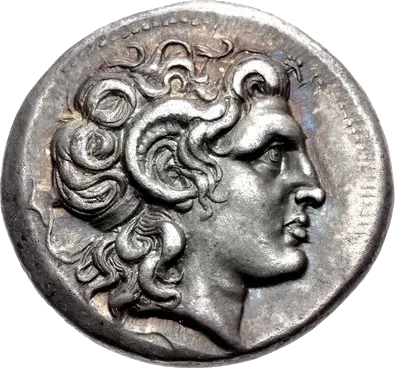
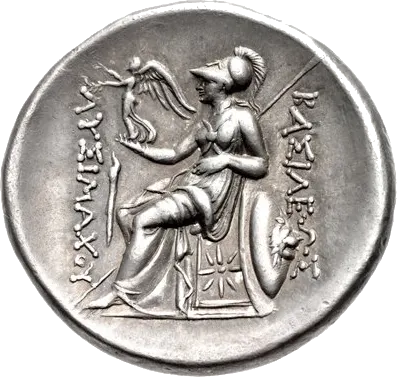
- Lysimachus, king of Thrace, from about 297 BC struck tetradrachms with a deified Alexander wearing the ram's horns of Ammon, and Athena seated on the back. These are some of the best-known ancient portraits of Alexander.
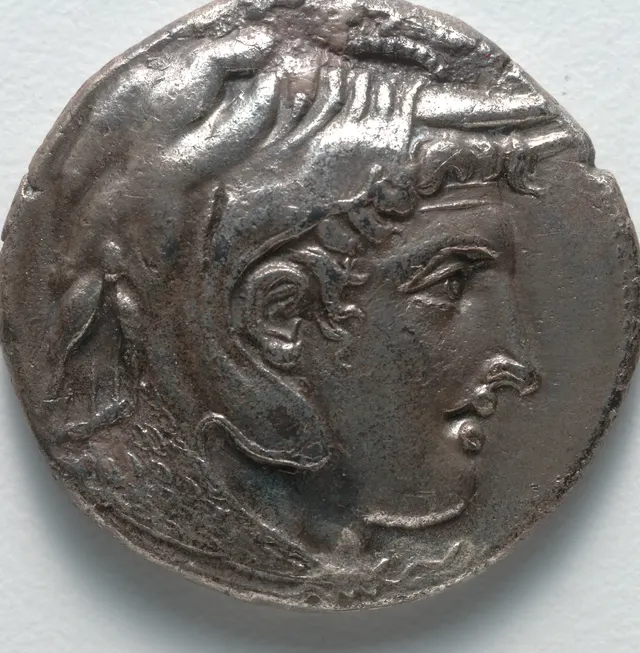
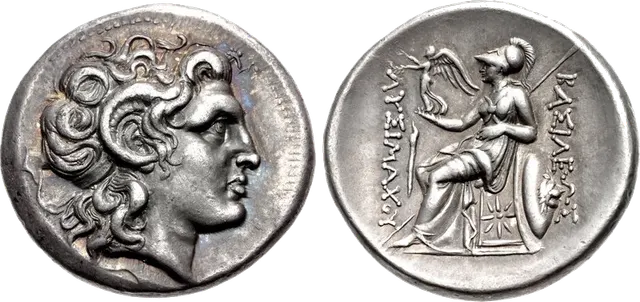
Once the successors had their own portraits on their coins, you might expect Alexander's to disappear. They didn't. Herakles-and-Zeus tetradrachms stayed the trade coin of the eastern Mediterranean. More than a century after his death, 51 mints were still striking them. In total, more than 120 mints made coins of Alexander's type.
The last Alexanders
The late issues are easy to tell apart. They were struck on wide, thin blanks, and the Herakles head is often bigger and more stylised. Many came from Greek cities in Asia Minor and around the Black Sea, such as Odessos and Mesembria, in modern Bulgaria.
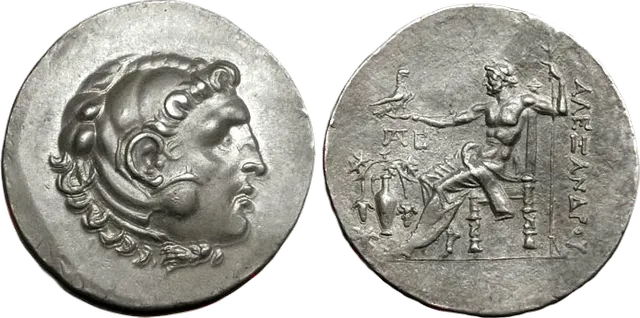
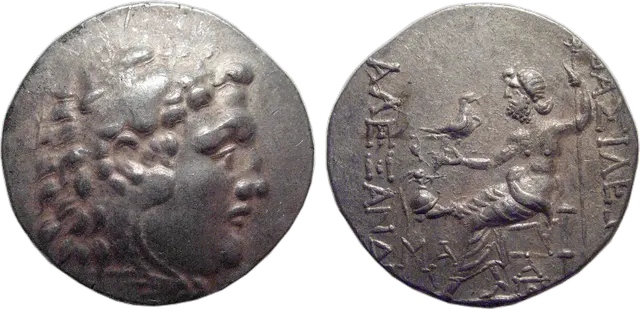
Mesembria probably struck the very last ones, perhaps as late as 65 BC, when Rome was already the main power in the region. That's more than two and a half centuries after Alexander died.
Collecting Alexander's coins
Because so many were struck, Alexander tetradrachms and drachms are among the easier large Greek silver coins to buy. Posthumous coins are the most common. Lifetime issues, gold staters and the elephant medallions are much scarcer.
What a coin is worth comes down to whether it's a lifetime or posthumous issue, its mint and type, how well it's preserved and how attractive its style is. Alexanders are also faked a lot, so buy from a dealer who guarantees authenticity, and check the type in PELLA before you pay.
Alexander on modern money
Greece put Alexander back on its money in 1990. The new 100-drachma coin showed his head and the sixteen-pointed star of Vergina, the symbol found on the royal Macedonian tombs. It circulated until Greece adopted the euro in 2002. The next article in this series, the drachma's 2,500-year history, follows that coin from ancient Athens to the euro.
Flip a piece of Greek history
You can flip the coins Alexander's tetradrachm was modelled on in our coin gallery: the Athenian tetradrachm and the drachma. Or flip a coin of your own on the coin flipper.
Questions people ask
Whose face is on Alexander the Great's coins?
On his silver tetradrachms and drachms, the head is the hero Herakles wearing a lion-skin hood. On his gold staters it's the goddess Athena. Most numismatists don't think the Herakles head was meant as a portrait of Alexander, though some later issues look more like him. His actual portrait appears on coins struck after his death by his successors, such as Lysimachus and Ptolemy I.
Are Alexander the Great coins real?
Yes. They were struck in huge numbers in silver and gold, starting during his reign (336 to 323 BC) and continuing in his name until the 1st century BC. Genuine examples are easy to find. Fakes are common too, so buy from a dealer who guarantees authenticity.
How can you tell if an Alexander coin was struck in his lifetime?
Look at the mint symbol and monogram on the Zeus side, then match them to a type in Martin Price's catalogue or the American Numismatic Society's free PELLA database. Each Price type is dated to a mint and a period. Very wide, thin coins with large, stylised heads are late posthumous issues.
How much is an Alexander the Great coin worth?
It depends on whether it's a lifetime or posthumous issue, the mint and type, its condition and its style. Common posthumous tetradrachms and drachms are among the more affordable large Greek silver coins. Lifetime issues, gold staters and rare mints cost much more. Check recent auction results for the same Price type before you buy.
What does ΑΛΕΞΑΝΔΡΟΥ mean on a coin?
It's Greek for "of Alexander", meaning the coin is Alexander's money. Some issues add ΒΑΣΙΛΕΩΣ, "of King". Coins with ΦΙΛΙΠΠΟΥ, "of Philip", in the same position were struck for his father Philip II or for his half-brother Philip III.
Sources
- Hyla A. Troxell, Studies in the Macedonian Coinage of Alexander the Great (ANS Numismatic Studies 21, 1997), and the summary of the dating debate at Brown University's Joukowsky Institute. (Price vs. Troxell start dates; 25 lifetime mints, 31 after his death, 51 a century later)
- Martin J. Price, The Coinage in the Name of Alexander the Great and Philip Arrhidaeus (British Museum / Swiss Numismatic Society, 1991). (Type catalogue, "Price" numbers)
- American Numismatic Society, PELLA: Coins of the Kings of Macedonia. (Herakles/Zeus types, Price types with examples)
- Deutsche Bundesbank, Money Museum, "In Alexander's name". (180,000 talents, Attic standard, gold types, successors continuing his coinage, Seleucus' Babylon stater)
- CoinWeek, "Tetradrachms of Alexander the Great". (More than 120 mints, over a thousand symbol/monogram combinations, posthumous attribution, portrait debate)
- CoinWeek, "Ancient Coin Profiles: Portrait of Alexander the Great". (Succession of 323 BC, Philip III's ΦΙΛΙΠΠΟΥ coinage)
- Museum of Fine Arts, Boston, collection record for the Lysimachus tetradrachm. (Deified Alexander with Ammon horns)
- Museum of Fine Arts, Boston, collection record for the Ptolemy I tetradrachm. (Elephant-scalp headdress)
- Frank L. Holt, Alexander the Great and the Mystery of the Elephant Medallions (University of California Press, 2003), and The Treasures of Alexander the Great (Oxford University Press).
- Otto Mørkholm, Early Hellenistic Coinage from the Accession of Alexander to the Peace of Apamaea (Cambridge University Press, 1991). (Successor coinages, late civic Alexanders)
- Bank of Greece, "Drachma coins". (1990 100-drachma coin with Alexander and the Vergina sun)