Ancient Greek Coins: Owls, Turtles and Tetradrachms
Part 6 of the ancient world series6 min read
Aegina's turtles, Athens' silver owls and the obols Greeks kept in their mouths: how ancient Greek coins worked, what they were worth, and how to tell them apart.
The first coins were struck in Lydia, in what is now western Turkey, some time around 630 to 600 BC. Within a couple of generations the idea had crossed the Aegean, and the Greeks took it further than anyone. Hundreds of Greek cities ended up minting their own money, each with its own badge.
Three of those badges matter most if you want to understand Greek coins: a sea turtle from a small island, a winged horse from Corinth, and an owl from Athens. The owl became the most widely used silver coin of its time.
Aegina's turtles: the first coins of mainland Greece
Aegina is a small island in the Saronic Gulf, a short sail from Athens. In the 6th century BC it was a trading power, and it was the first state in European Greece to strike coins. Its silver staters carried a sea turtle on one side. The other side had no picture at all, only a rough square punch mark divided into triangles.
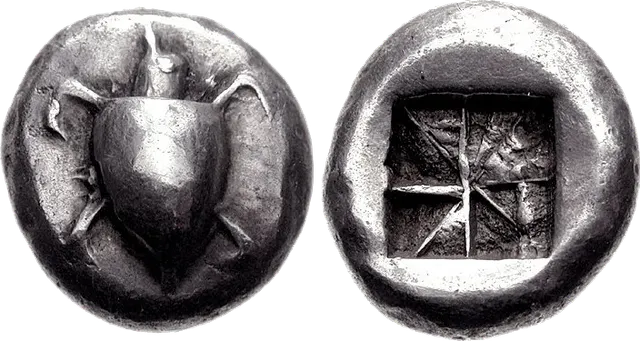
Modern scholars usually date the first turtles to around 550 BC. Older references, including Barclay Head's Historia Numorum, put them earlier. Either way, they predate every other coin minted in Europe.
The turtle stater weighed about 12.2 grams. That weight became the "Aeginetan standard", used across the Peloponnese, Crete and the Cyclades. Traders called the coins simply "turtles".
In the 5th century BC Aegina lost its long war with Athens, and the sea turtle on its coins was replaced by a land tortoise with a segmented shell. Most modern catalogues date the change to around 456 BC, when Athens took the island. Head dated it later, to after 404 BC. The usual story is that the switch to a land animal marked the end of Aegina's sea power, but nobody wrote down why it happened.
Corinth's colts
Corinth, on the isthmus between mainland Greece and the Peloponnese, began striking coins around the same time as Aegina. Its staters showed Pegasus, the winged horse of local legend, above the old Corinthian letter koppa (Ϙ), the city's initial. People called them pōloi, "colts".
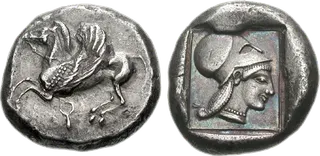
From about 515 BC the reverse showed the head of Athena in a Corinthian helmet. Corinth used a lighter stater of about 8.6 grams, which split neatly into three drachmas. Its colts travelled west with Corinthian colonists to Sicily and southern Italy.
Athens before the owls
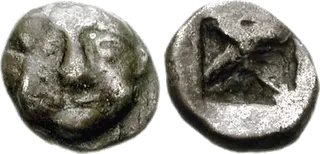
Athens's first coins looked nothing like its later ones. From about 545 BC the city struck a series that German scholars named Wappenmünzen, "heraldic coins". The design kept changing: an amphora, a horse, a wheel, a beetle, the face of the Gorgon. Researchers once read these as the crests of noble families. Most now think the devices belonged to the officials who ran each issue under the tyrant Peisistratos and his sons.
The owl of Athena
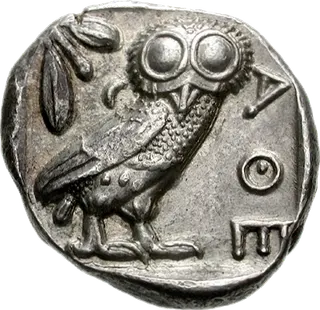
Around 515 to 510 BC Athens started striking something new. It was a large, heavy silver coin worth four drachmas, the tetradrachm, at about 17.2 grams of nearly pure silver. That weight became known as the Attic standard.
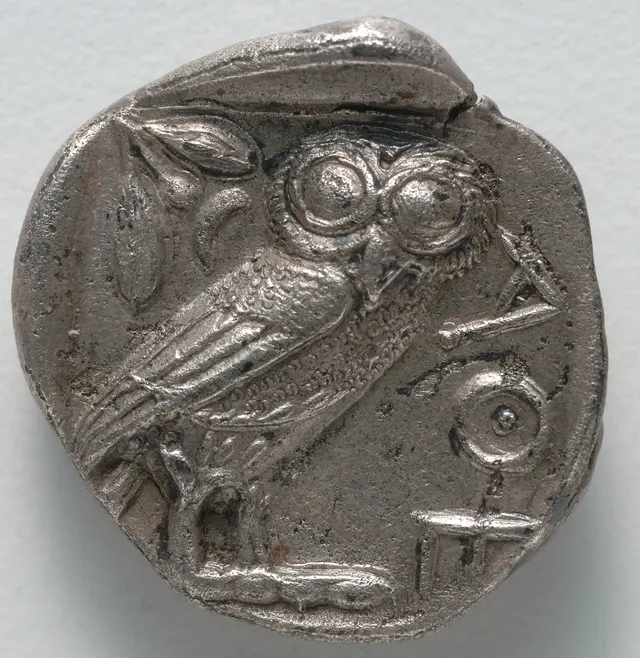
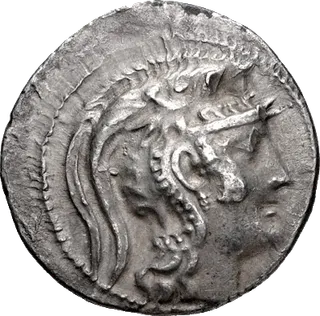
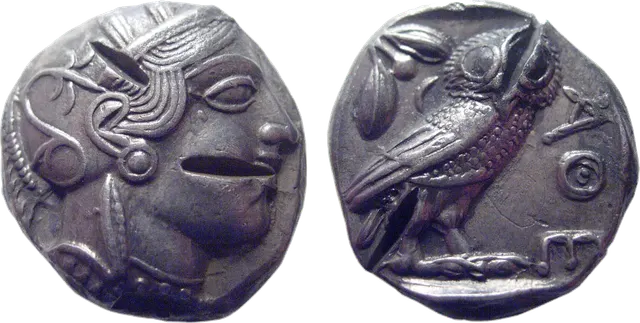
The design stayed almost the same for the next two centuries. On the front is the head of Athena, the city's patron goddess, in a crested helmet decorated with olive leaves. On early coins she has the faint "archaic smile" of Greek sculpture from the period.
On the back is her owl, standing and facing you with huge round eyes. Behind it are a sprig of olive and a small crescent moon. Beside it are the letters ΑΘΕ, short for Athenaiōn, "of the Athenians".
Nobody has pinned down exactly when the first owls appeared. Hoards place them close to two big political events: the fall of the tyrants in 510 BC and the democratic reforms of 508/7 BC. Writing for the American Numismatic Society, Peter van Alfen points out that there is still no conclusive evidence tying the coin to either one.
Athens kept the design even after other cities had moved on to newer styles. The old-fashioned look was part of the point: traders knew what a real owl looked like, and they trusted it.
Silver from Laurion, and the ships it paid for
The owls were made possible by silver. The mines at Laurion, in the hills of southern Attica, had been worked for centuries. Under Peisistratos, Athens began working them in earnest, and turning that silver into coins added value to one of the city's main exports.
In 483/2 BC miners struck a rich new vein at a place called Maroneia. The Athenians planned to share the windfall out, ten drachmas each. The politician Themistocles talked them into spending it on warships for their war with Aegina. Herodotus says the money built 200 ships. Three years later that fleet beat the Persian navy at Salamis.
So the silver in the owls paid for the ships that saved Athens, in a war that started with Aegina, the city of the turtles.
Owls everywhere
Through the 5th century BC, when Athens led the Delian League, owls were struck in enormous numbers. They turn up in hoards across the eastern Mediterranean, from Egypt to the Levant to Mesopotamia.
In 2007 a small hoard found at Pushkalavati, near Peshawar in modern Pakistan, included an Athenian tetradrachm from about 500 to 485 BC. The Classical Numismatic Group describes it as the earliest owl of its type found so far east.
Far from Athens, people didn't take a coin's word for it. Merchants often cut a notch into an owl to check that it was silver all the way through, and some coins carry several of these "test cuts". Mints in Egypt, the Levant and Arabia also struck their own copies of the owl, because traders there already knew and accepted it.
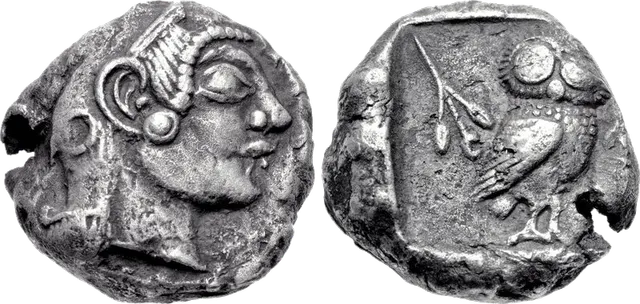
There were so many owls in Athens that "bringing owls to Athens" became a joke. In Aristophanes' comedy Birds (414 BC), one character asks who brought an owl to Athens. It meant the same thing as "carrying coals to Newcastle".
What was a Greek coin worth?
Greek money counted in obols and drachmas. Six obols made one drachma. The names go back to the days before coins: an obolos was an iron spit used for roasting meat, and a drachmē was a "handful" of them, six spits being as many as you could hold.
| Coin | Value | Typical Attic weight |
|---|---|---|
| Tetartemorion | ¼ obol | about 0.18 g |
| Obol | ⅙ drachma | about 0.72 g |
| Drachma | 6 obols | about 4.3 g |
| Didrachm | 2 drachmas | about 8.6 g |
| Tetradrachm | 4 drachmas | about 17.2 g |
| Decadrachm | 10 drachmas | about 43 g |
To get a sense of value: building accounts for the Erechtheion on the Acropolis, from 409/8 BC, show skilled workers earning about a drachma a day. A tetradrachm was roughly four days' pay. Day-to-day shopping happened in obols and their fractions.
Some of those fractions were tiny. A quarter-obol is about the size of a lentil. With no pockets, people carried small change in their mouths, and Aristophanes jokes about it in Wasps.
Athens only struck large decadrachms in one short burst, in the 460s BC. The most famous ten-drachma coins came from Syracuse in Sicily instead.
Syracuse and the coins as art
Some of the finest Greek coins were struck not in Greece itself but in Sicily. Syracuse put the water nymph Arethusa on its coins, with dolphins swimming around her head, and a racing four-horse chariot on the other side.
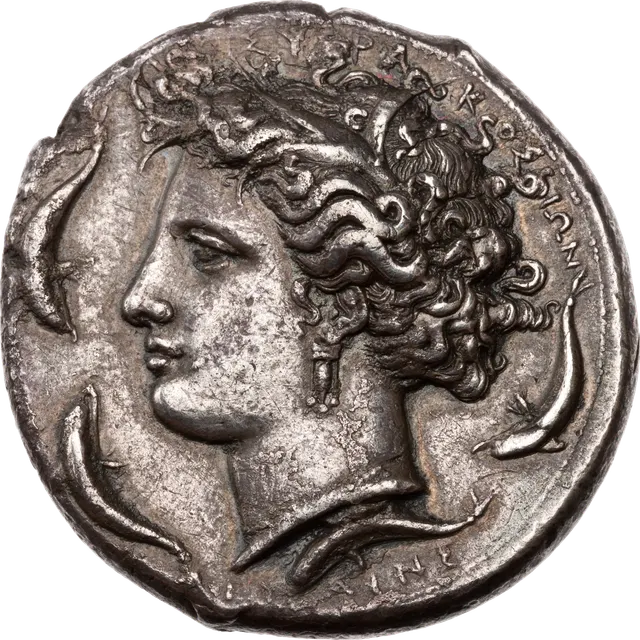
Around 405 to 400 BC two die engravers, Kimon and Euainetos, cut decadrachm dies for Syracuse and signed their work in tiny letters. That was unusual for coins, and it tells you the engravers saw them as works of art.
Late owls and the end of the story
Athens lost the Peloponnesian War in 404 BC. In its last years, short of silver, it issued emergency coins of bronze, some of them silver-plated. Aristophanes complained about them in Frogs (405 BC). (We look at what happens when money is cheapened in our article on coin clipping and debasement.)
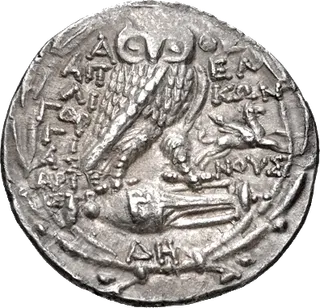
The owls came back. From the 2nd century BC Athens struck a "New Style" tetradrachm on a wider, thinner blank. The owl stands on an amphora lying on its side, inside an olive wreath, and the names of the officials responsible are written around it.
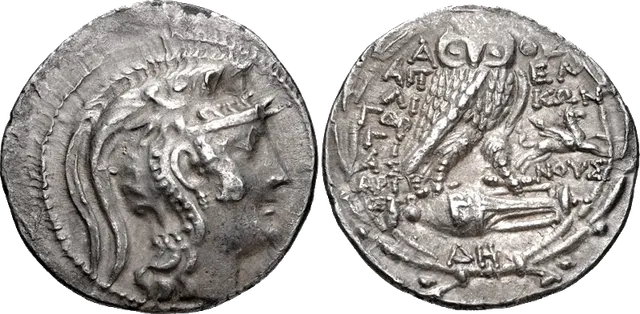
By then Alexander the Great had spread the Attic standard across his empire, and his own tetradrachms, with Herakles on the front and Zeus on the back, had become the common silver coin of the Greek world. That is the next part of this series: the coins of Alexander the Great.
The owl has never really gone out of circulation. Greece's one-euro coin carries the owl from the Athenian tetradrachm, so you can still pay for a coffee in Athens with it.
Flip a piece of Greek history
Every coin in this story has a page in our coin gallery, where you can read its specs and flip it. Try the Athenian tetradrachm or the drachma, or flip a coin of your own on the coin flipper.
Questions people ask
What is an ancient Greek tetradrachm?
A tetradrachm is a silver coin worth four drachmas. The best-known ones are the "owls" of Athens, which weighed about 17.2 grams and were struck from around 510 BC. Alexander the Great and the kingdoms that followed him also struck tetradrachms on the same weight standard.
Why is there an owl on Athenian coins?
The owl was the bird of Athena, the patron goddess of Athens, whose head appears on the other side of the coin. The olive sprig is her tree. The letters ΑΘΕ mean "of the Athenians".
What were the first Greek coins?
The first coins in mainland Greece were the silver "turtles" of the island of Aegina, usually dated to around 550 BC. Coins themselves started a little earlier, in Lydia and the Greek cities of Ionia (in modern Turkey), around 630 to 600 BC.
How much was a drachma worth in ancient Athens?
Around 400 BC, a drachma was roughly a day's pay for a skilled worker. Building records from the Erechtheion on the Acropolis show craftsmen earning about one drachma a day. A drachma was split into six obols, which people used for everyday purchases.
Are Athenian owl coins rare?
Classical owls were struck in huge numbers, so they're among the easier ancient Greek coins to find today. Condition, style and authenticity drive value, and fakes are common, so buy from a reputable dealer who guarantees authenticity.
Sources
- Peter van Alfen, "The First Athenian Owls: Symbols of What, Exactly?", American Numismatic Society Pocket Change blog. (Wappenmünzen, owl dating, 17.2 g weight, Laurion)
- Barclay V. Head, Historia Numorum (2nd ed., 1911), Attica and Aegina entries, online at snible.org. (Aeginetan standard, incuse reverse, turtle-to-tortoise change)
- Colin M. Kraay, Archaic and Classical Greek Coins (1976). (Early mints, Corinthian staters, Athenian chronology)
- John H. Kroll and Nancy M. Waggoner, "Dating the Earliest Coins of Athens, Corinth and Aegina", American Journal of Archaeology 88.3 (1984). (Dating of the first turtles, colts and owls)
- Herodotus, Histories 7.144; Aristotle, Constitution of the Athenians 22.7. (Maroneia silver strike and Themistocles' fleet)
- Aristophanes, Birds line 301, Wasps 787-791, Frogs 718-733. ("Owls to Athens", small change in the mouth, the bad coins of 405 BC)
- Classical Numismatic Group, catalogue notes for the Pushkalavati owl and the coins in images 2, 3, 4 and 7 (via the Wikimedia Commons file pages listed above).
- American Numismatic Society collection record 1997.9.64 (Syracuse decadrachm by Euainetos).
- Cleveland Museum of Art, Open Access record 1941.296 (hero tetradrachm).
- Erechtheion building accounts (IG I³ 474-479), as summarised in Kraay and in von Reden, Money in Classical Antiquity (2010). (A drachma a day for skilled workers)