Tap the coin to flip it
The Drachma: Ancient Greece's Silver Coin
Ancient GreeceAthenian owls c. 510s BC onward; the drachma as a unit lasted to AD 2002
Ancient Greek currency
Specs (classic Athenian drachm, 5th century BC)
- Issuer
- City-state of Athens (other Greek cities struck their own drachms)
- Denomination
- 1 drachma = 6 obols
- Years minted
- Athenian owls c. 510s BC onward; the drachma as a unit lasted to AD 2002
- Metal
- Silver, nearly pure
- Weight
- About 4.3 g (Attic standard); Aeginetan standard about 6 g
- Diameter
- About 13–16 mm (hand-struck, so it varies)
- Designs
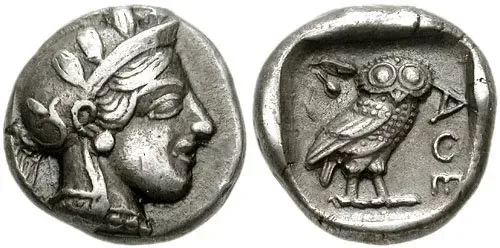
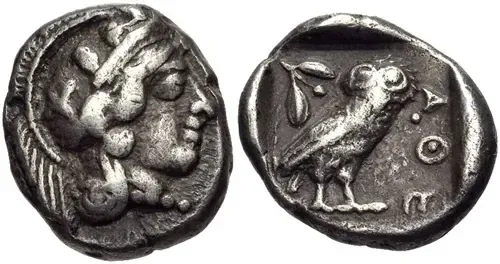
- Front: helmeted Athena. Back: owl, olive sprig, ΑΘΕ
- Production
- Hand-struck between two engraved dies
In the hand
The story of the Drachma
The drachma was the standard silver coin of ancient Greece. Hundreds of Greek city-states struck their own, from the 500s BC onward, and the name lasted until 2002 as the currency of modern Greece.
The word comes from the Greek verb drassomai, "to grasp." Before coins, small iron spits called obeloi were used as a kind of money, and a handful of six made a "drachma," a grasp. That's why the smaller coin was called an obol, and why six obols made one drachma.
The best-known drachm is the one from Athens. Athenian coins show the goddess Athena wearing a crested helmet on one side. On the other is her symbol, the owl, with an olive sprig and the letters ΑΘΕ, short for "of the Athenians." People called them "owls." Athens had its own silver mines at Laurion, so it could strike huge numbers of them. That's why so many survive today.
A drachma's weight depended on which standard a city used. The Athenian (Attic) drachm weighed about 4.3 g of nearly pure silver. The standard used by the island of Aegina was heavier, about 6 g. Cities also struck multiples and fractions:
- the obol, one-sixth of a drachma
- the didrachm, two drachmas
- the tetradrachm, four drachmas, the big coin of trade
- the dekadrachm, ten drachmas, rare and mostly ceremonial
What could a drachma buy? In Athens in the late 400s BC, a skilled worker on a public building earned about a drachma a day. Rowers in the Athenian fleet were paid a similar rate.
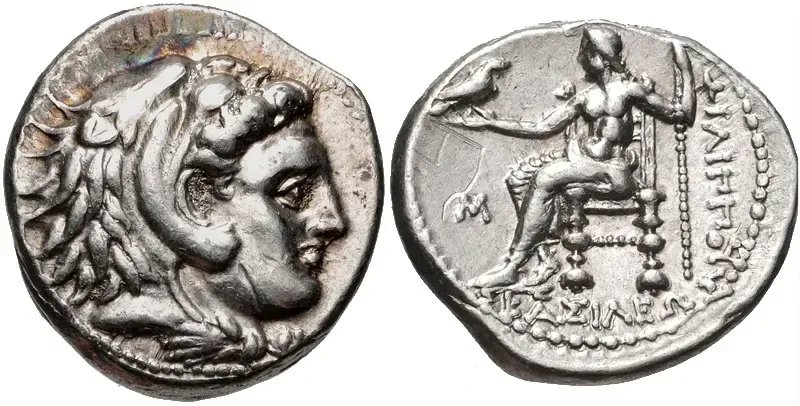
After Alexander the Great, his coins were struck on the Attic standard across a huge empire, from Greece to Egypt and Persia, so the drachma spread far beyond Greece itself. The drachm of his half-brother Philip III, shown below, is a typical example. Roman rule eventually brought the denarius, but drachms kept being struck in the Greek-speaking east for centuries.
The name came back in 1832, when the new Kingdom of Greece adopted the drachma as its currency. It went through several revaluations and was finally replaced by the euro in 2002, at 340.75 drachmas to one euro.
For the full 2,500-year story, from the first owls to the switch to the euro, read the history article linked below.
From the encyclopedia
In ancient Greece, the drachma was a currency unit and coin used by many city-states. The drachma originated in around the 6th century BC and continued in use into the Roman period. The coin, usually made of silver or sometimes gold had its origins in a bartering system that referred to a drachma as a handful of wooden spits or arrows. The drachma was unique to each city state that minted them, and were sometimes circulated all over the Mediterranean. The coinage of Athens was considered to be the strongest and became the most popular.
From Ancient drachma on Wikipedia, text under CC BY-SA 4.0. Fetched November 3, 2026.
Questions people ask
How much was a drachma worth in ancient Greece?
In late 5th-century BC Athens, a skilled building worker earned about one drachma a day.
What is on an Athenian drachma?
The goddess Athena in a crested helmet on the front, and her owl with an olive sprig and the letters ΑΘΕ on the back.
When did Greece stop using the drachma?
In 2002, when Greece adopted the euro at 340.75 drachmas per euro.