The First Coins Ever Made: Lydia's Electrum Lion
Part 1 of the Origins series5 min read
The world's oldest coins were struck in Lydia (modern Turkey) about 2,650 years ago from electrum. Meet the Lydian Lion and see how we know when coins were invented.
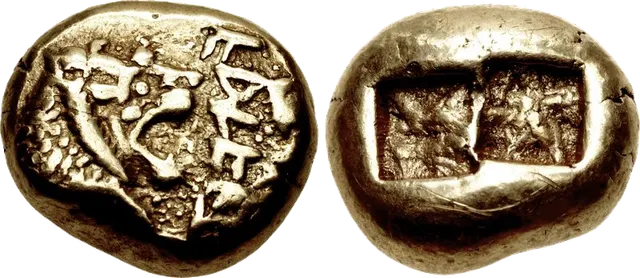
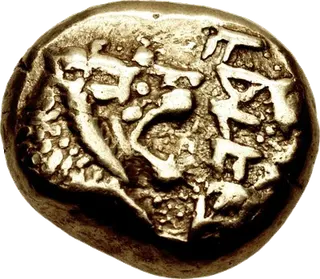
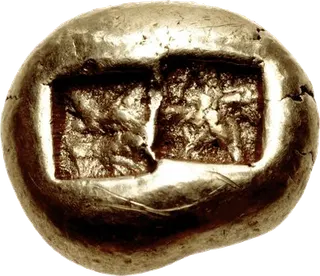
The oldest coins in the world are small, lumpy pieces of pale gold, each about the size of a fingernail. On one side a lion roars with its mouth open. The other side has no picture at all, just a pair of rough square dents.
They were made in Lydia, a kingdom in what is now western Turkey, roughly 2,650 years ago. Collectors call the best-known type the Lydian Lion. Every coin in your pocket goes back to it.
Where was Lydia?
Lydia sat inland from the Aegean coast. Its capital, Sardis, stood beside the Pactolus, a river that carried flakes of electrum down from the mountains. Electrum is a natural mix of gold and silver, and the Lydians had a lot of it.
Greek cities lined the coast to the west: Ephesus, Miletus, Phocaea. Lydia traded with them, fought them and eventually ruled most of them. Coinage grew up in that mix of a rich inland kingdom and busy Greek ports.
The first coin ever made: what a Lydian Lion looks like
A typical Lydian Lion is a trite, or "third", worth a third of a full stater. It weighs about 4.7 grams and measures around 13 millimetres across. That's a little smaller than a US dime but heavier.
The obverse shows the head of a roaring lion facing right. On its forehead is a knob with rays coming off it, which numismatists usually call the "sun". The reverse has two square punch marks and nothing else.
Some of these coins carry writing in the Lydian script. One group reads walwet, which scholars generally take to be the name of King Alyattes. Another reads kukalim, "I am of Kukas", a name whose owner is still debated.
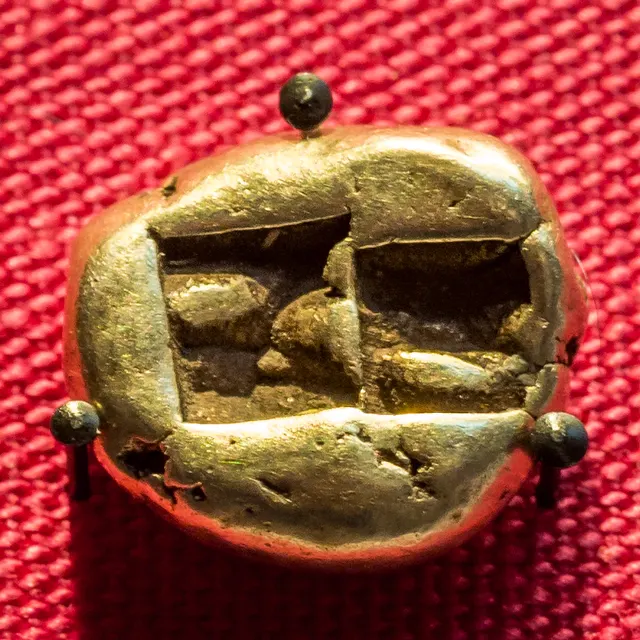
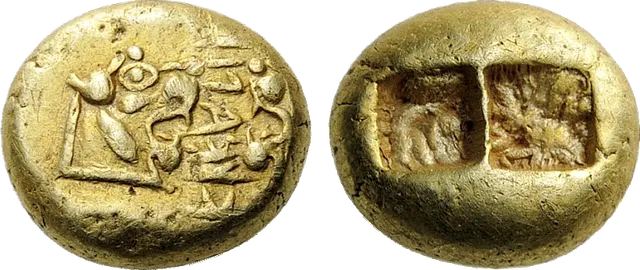
The lion coins are usually dated to the reign of Alyattes, who ruled from about 610 to 560 BC. Some may be a little earlier.
Electrum: the metal that made money possible
An electrum coin has a problem built into it. Two lumps of electrum can weigh the same and still be worth different amounts, because one may hold more gold than the other.
The Lydians dealt with this in a clever, and quite profitable, way. Natural electrum from around Sardis is roughly 73% gold. The coins average about 54% gold, 44% silver and 2% copper. In other words, the mint added silver to the metal and kept the difference. The royal lion stamp told users not to worry about it: this piece is worth a third of a stater, whatever is inside.
That stamp is what turns a lump of metal into a coin. People had weighed out silver to pay for things for centuries. A coin skipped the scales, because the issuer guaranteed both the weight and the value.
A whole system of small change
The Lydians didn't stop at one size. A full stater weighed about 14.1 grams. Below it came the trite, the sixth (hekte) and smaller fractions, all the way down to a 1/96 stater of about 0.15 grams, barely bigger than a sesame seed.
Those tiny pieces matter. They suggest coins were already used for everyday buying, not only for royal gifts or paying soldiers.
When were coins invented? The clue under a temple
Most of what we know about dates comes from Ephesus. In 1904 and 1905, a British Museum excavation led by David Hogarth dug beneath the Temple of Artemis, the Artemision. In the earliest building layers they found 93 coins. Nineteen of them were still sealed in a small clay jug, buried as an offering when an early shrine was built.
The deposit included blank electrum lumps, lumps with lined surfaces, and fully stamped coins, so it captures coinage in its first stages. A recent restudy by the archaeologists Michael Kerschner and Koray Konuk dates the jug to about 640 to 625 BC.
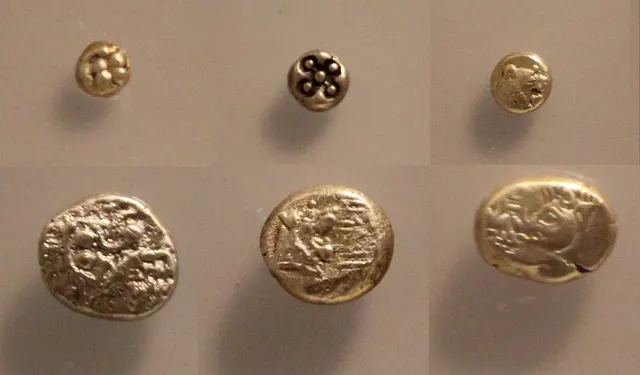
Finds at Sardis point the same way. Excavators there found a "kukalim" lion coin in a deposit from the last third of the 7th century BC. So when were coins invented? The best answer today is the second half of the 7th century BC, probably around 630 BC.
Who invented coins: Lydians or Greeks?
The ancient Greek historian Herodotus had no doubt. In Book 1 of his Histories he wrote that the Lydians were the first people known to strike and use coins of gold and silver, and the first to run retail shops.
The real picture is a bit more crowded. The Ephesus deposit also holds coins from Greek cities on the coast. One electrum coin from Ephesus shows a grazing stag and the name of a certain Phanes. Lydian kings and Ionian Greek cities seem to have taken up coinage within a few decades of each other.
China developed bronze spade and knife money independently, and India its own punch-marked silver coins. On current evidence, neither is securely dated earlier than the electrum coins of Lydia and Ionia. That's why the Lydian Lion usually gets the title of the world's oldest coin.
Croesus and the first gold and silver coins
Alyattes' son Croesus (about 560 to 546 BC) became so rich that "rich as Croesus" is still a saying. His mint stopped using electrum. Instead it struck separate coins of fairly pure gold and pure silver, showing the front half of a lion facing the front half of a bull.
These coins, called Croeseids, gave the world its first two-metal coinage. Gold coins came in a heavy series of about 10.7 grams and a lighter one of about 8.1 grams. The silver stater also weighed about 10.7 grams.
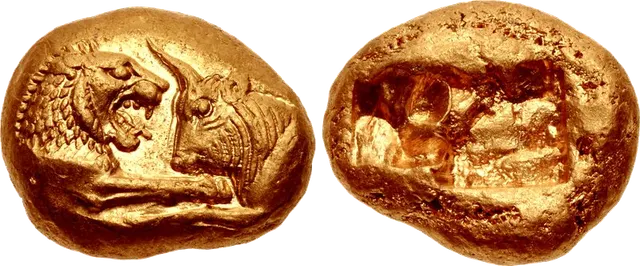
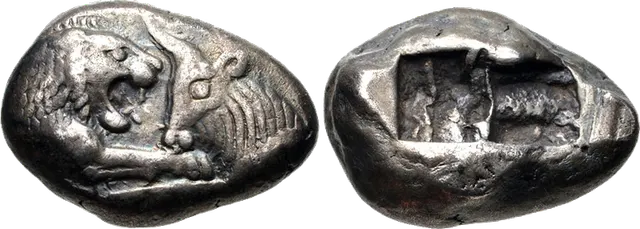
For years historians argued that Croeseids might have been made only after Persia conquered Lydia. Recent digs at Sardis settled much of that. Silver Croeseids turned up on the destruction floor from the Persian capture of the city, around 547 BC, so at least some were struck under Croesus himself. The Persians then kept making the same lion-and-bull coins for another 25 years or so.
Where the story goes next
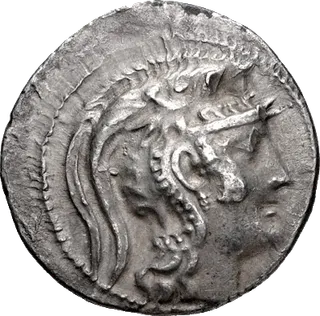
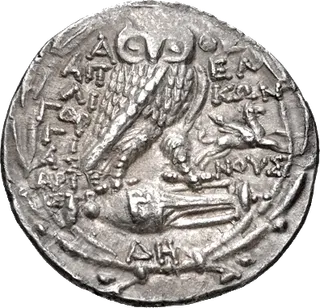
Within a century, Greek cities from Asia Minor to Sicily were striking their own silver coins. The Athenian owl and the drachma come straight out of this Lydian start, and we cover them in Ancient Greek Coins.
If you want to know how the lion got onto the metal, read How the First Coins Were Made. It covers the anvil die, the punch and the hammer.
You can also see the Lydian stater up close and give it a flip. A lion on one side and a punch mark on the other makes for a fair coin toss. That's how coins started, and it's still how our coin flipper works.
Questions people ask
What is the oldest coin in the world?
The oldest known coins are electrum coins from Lydia and the neighbouring Greek cities of Ionia, in what is now western Turkey. The best known is the Lydian Lion, a lion-head coin usually dated to around 630 to 600 BC.
When were coins invented?
Coins were invented in the second half of the 7th century BC. The earliest coins found in a datable context, from the foundations of the Temple of Artemis at Ephesus, are dated to about 640 to 625 BC.
Who invented coins?
The Lydians are usually credited, and Herodotus named them as the first people to strike coins of gold and silver. Greek cities on the Ionian coast began making coins at about the same time, so coinage probably grew out of the contact between the two.
What is an electrum coin?
An electrum coin is made from electrum, a pale yellow mix of gold and silver. Lydia's rivers carried natural electrum. The Lydian mint added silver to it, so the coins held about 54% gold.
How much did the first coins weigh?
The full Lydian stater weighed about 14.1 grams. The common Lydian Lion trite, a third of a stater, weighs about 4.7 grams. The smallest fraction, a 1/96 stater, weighed only about 0.15 grams.
Sources
- Sardis Expedition (Harvard / Cornell), "Electrum Third-Stater with Lydian Inscription, 'kukalim'?", object LATW-21
- M. Kerschner and K. Konuk, "Electrum Coins and Their Archaeological Context: The Case of the Artemision of Ephesus", in P. van Alfen and U. Wartenberg (eds.), White Gold: Studies in Early Electrum Coinage, American Numismatic Society, 2020
- ANAMED (Koç University Research Center for Anatolian Civilizations), "A Tale of Early Coinage Through Two Exhibitions"
- NGC Ancients, "What Does It Mean to Be 'As Rich as Croesus'?"
- Classical Numismatic Group, catalogue descriptions of the walwet and kukalim trites pictured above
- Herodotus, Histories 1.94 (Perseus Digital Library)
- N. Cahill et al., "A New Find of Croeseid Coins from Sardis", Hesperia 94 (2025); N. Cahill and J. Kroll, "New Archaic Coin Finds at Sardis", American Journal of Archaeology 109 (2005)
- Wikipedia, "Croeseid"