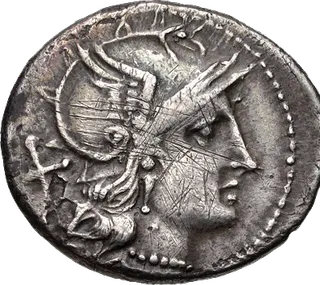
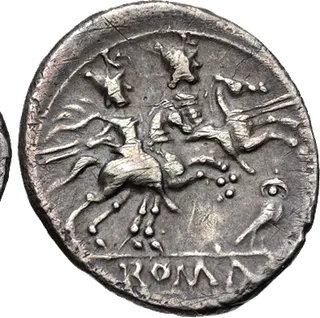
How the First Coins Were Made: Dies, Hammers and Fire
Part 3 of the Origins series5 min read
Ancient coins were struck by hand: a hot metal blank, two engraved dies and one hammer blow. See how the first coins were made, from Lydia to hammered pennies.
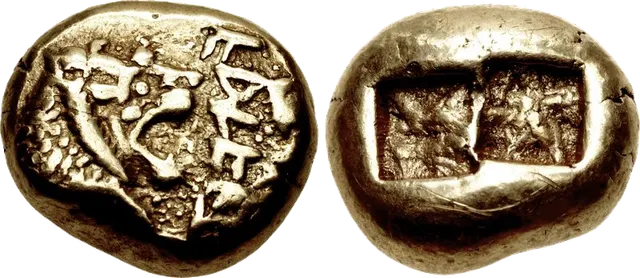
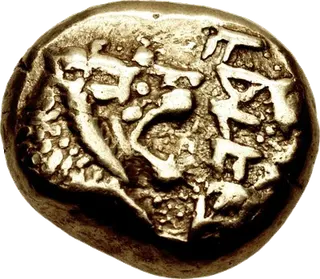
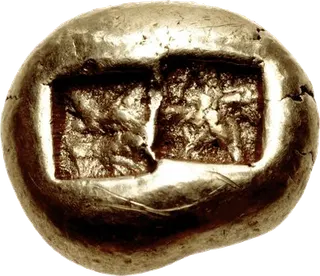
Pick up a Lydian coin from about 600 BC and you can still see how it was made. The lion on the front is crisp. The back is just two rough square dents. Those dents are the marks of the tool that hit it.
Almost every coin in the ancient Mediterranean world was made the same basic way. A worker put a small lump of metal between two hard tools and hit the top one with a hammer. The method lasted more than two thousand years, and in England it only ended in the 1660s.
It started with a lump of electrum
The first coins appeared in western Asia Minor (modern Turkey) in the 7th century BC. According to the American Numismatic Association, they were lumps of electrum, a natural mix of gold and silver found in the region's rivers. Each lump had a set weight. One side carried a pattern, and the back had one or more square dents.
The kingdom of Lydia put a lion's head on its coins, the badge of its ruling family. Those lion coins are the first we can tie to a specific state. You can read their full story in The First Coins Ever Made: Lydia's Electrum Lion.
The dent on the back is the important clue. It came from a plain punch. A worker set the lump on an engraved die, put the punch on top and hammered it. The punch drove the metal down into the die, so the design came up on one side and the punch left its square print on the other.
Step 1: Make the blank
Before anyone could strike a coin, they needed a blank. Coin specialists call it a flan or a planchet.
Mint workers melted silver, gold or an alloy and poured it into a mould with a dozen or two small round hollows. When the metal cooled, they had a tray of smooth little discs. Each blank was then weighed. The weight mattered more than the look, because a coin's value came from the metal in it.
This is why ancient coins are rarely perfect circles. A blank that came out a bit oval, or with a lumpy edge, was still good money if it weighed right.
Step 2: Cut the dies
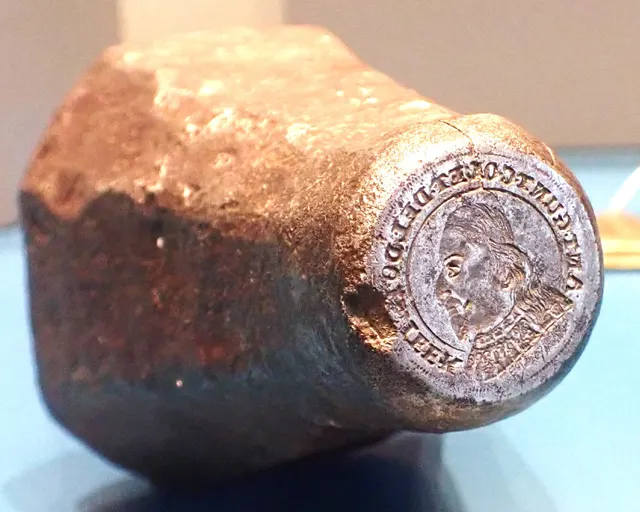
A die is a block of hard metal with the design cut into its face. The engraver carved it in reverse, like a seal, so the struck coin would read the right way round. Every letter and every curl of hair had to be cut backwards, by hand, at the size of a fingernail.
Ancient dies were made of bronze or iron, and each coin needed two of them. The anvil die carried the front design (the obverse) and was fixed into an anvil or a heavy block. The punch die carried the back design (the reverse), and a worker held it on top of the blank.
Very few ancient dies have survived. Mints probably melted worn-out dies for security, so nobody could use them to make fakes.
Step 3: Heat, place, strike
In a Roman mint the striking was a two-person job. One worker held a heated blank on the anvil die with tongs. The other set the punch die on top and brought the hammer down.
Heating the blank softened the metal, so it filled the die more easily. One modern estimate puts the force of a two-pound hammer at about seven tons at the face of the die. That's enough to push metal into fine engraved lines in one blow.
A good team is thought to have struck around 1,000 coins a day.
Step 4: Wear out the dies, then cut new ones
Dies didn't last forever. The punch die took the hammer blow directly, so it wore out faster than the anvil die below. With harder metals, an anvil die might last for around 10,000 coins. With softer gold, the figure could pass 30,000. Some dies cracked on the very first strike.
Because every die was cut by hand, no two were exactly alike. Today, researchers match coins struck from the same die to work out how many dies a mint used, and from that, roughly how many coins it made.
A Roman coin that shows the tools
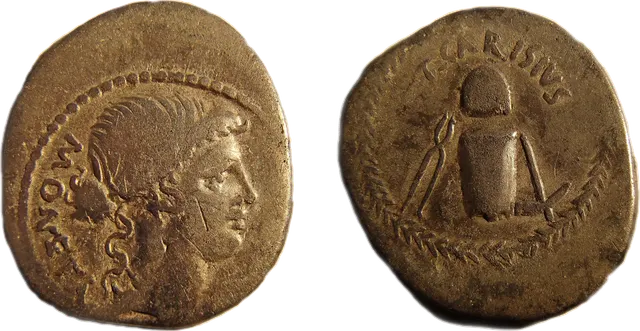
Around 46 BC, a Roman mint official named Titus Carisius issued a silver denarius with an unusual design. The front shows Moneta, the goddess linked to Rome's mint. The back shows a set of tools: an anvil with a die on it, a hammer and a pair of tongs, with a cap above them.
It's one of the few ancient pictures of the minting kit. Scholars still debate one detail. The cap may be a punch die, or it may be the cap of Vulcan, the smith god. Either way, the coin is the mint showing off its own trade. There's more on Rome's coins in Roman Coins: A Guide to Every Denomination, and you can flip a denarius yourself.
How the punch mark grew into a design
Early punches were plain, so early coins had a blank, dented back. Over time, mints began engraving the punch too, which gave coins a picture on both sides.
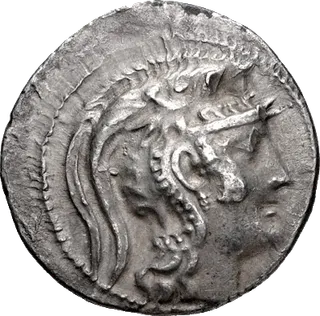
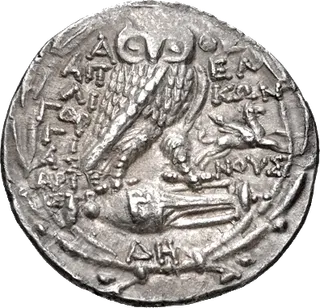
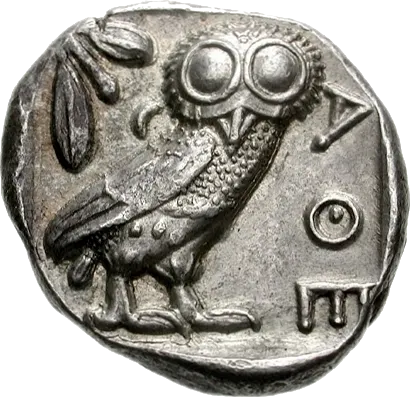
You can see this stage on the famous owl coins of Athens. Look closely at an Athenian tetradrachm and the owl sits inside a sunken square. That square is the outline of the punch, now carrying a full design. There's more on these coins in Ancient Greek Coins: Owls, Turtles and Tetradrachms.
Mistakes you can still see
Striking by hand produced mistakes, and collectors love them. They're the best proof of how the coins were made.
An off-centre strike happened when the blank slipped, so part of the design ran off the edge. A double strike happened when the coin moved between two hammer blows and the design printed twice.
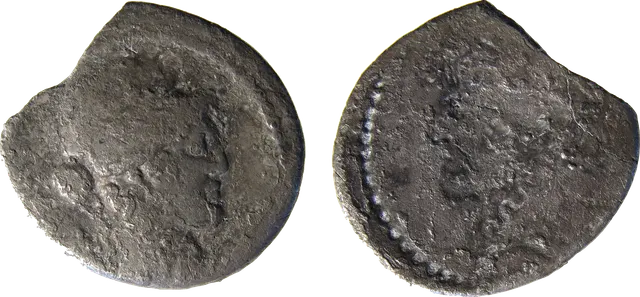
The strangest error is the brockage. Sometimes a freshly struck coin stuck to the upper die. The next blank was then stamped by that stuck coin instead of the die. The result has the same design on both sides, raised on one and sunken and mirrored on the other.
Not everyone hammered
Striking wasn't the only way to make a coin. In ancient China, coins were cast. Workers poured bronze into moulds that formed many coins at once, which is why Chinese cash coins look so different from Greek and Roman ones. See Ancient Chinese Coins: Spades, Knives and Cash.
Two thousand years of hammering
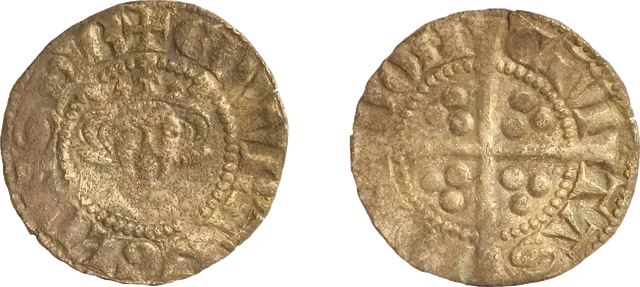
Europe kept striking coins by hand for a very long time. Medieval silver pennies were still struck between two dies with a hammer, just as Lydian electrum had been.
England only switched for good under Charles II. The Royal Mint Museum records that machine production of gold coins began in February 1662, with horse-drawn rolling mills and large screw presses. Hammering and machines ran side by side for a short time because demand was so high. The new coins also had milled edges, which made it much harder to clip silver off the rim. That story continues in From Hammer to Machine: How Minting Changed, and the clipping problem gets its own article in Coin Clipping, Debasement and Gresham's Law.
Next time you hold an old coin, look at its edge and its back. The marks of the hammer are usually still there.
Questions people ask
How were ancient coins made?
Most were struck by hand. A weighed metal blank went between two engraved dies, one fixed in an anvil and one held on top, and a worker hit the top die with a hammer. One blow printed both sides.
What is a hammered coin?
A hammered coin is one struck by hand with a hammer and dies, rather than by a machine press. In England, hammered coins were made until the early 1660s, when machine-made "milled" coins replaced them.
Why are ancient coins not perfectly round?
The blanks were cast in simple moulds and only checked for weight, not shape. The hammer blow also spread the metal unevenly, and a blank that slipped gave an off-centre strike.
What were coin dies made of?
Ancient dies were made of bronze or iron, with the design cut into the face in reverse. Very few survive, probably because mints destroyed worn dies so they couldn't be used for forgery.
How many coins could one die strike?
Estimates vary. With harder metals an anvil die might make around 10,000 coins, and with softer gold more than 30,000. The upper punch die took the hammer blow directly and wore out sooner.
Sources
- American Numismatic Association, Money Museum, "Lydia & the First Coins"
- Royal Mint Museum, "Charles II"
- Ostia Antica (ostia-antica.org), "The Maxentian Mint at Ostia: minting"
- Hallie Ford Museum of Art, Willamette University, "Coins of the Greek and Roman World: Minting Process"
- Portable Antiquities Scheme / British Museum, record 863568 (Carisius denarius, minting tools)
- Portable Antiquities Scheme / British Museum, record 448913 (brockage)
- Luke S. Roberts, UC Santa Barbara, "Manufacturing cash coins"
- Classical Numismatic Group catalogue descriptions for the Alyattes trite and Athenian tetradrachm (via the Commons file pages)