Before Coins: Barter, Cowries and Hacksilver
Part 2 of the Origins series7 min read
Did people really barter before coins? How the barter system worked, why it is partly a myth, and how weighed silver, cowrie shells and hacksilver served as money.
Long before anyone stamped a lion on a lump of electrum, people were paying for things. They paid with weighed silver, with sea shells, with chopped-up bracelets, and with promises written in clay.
The story most of us learned at school goes like this. First came the barter system, where people swapped goods directly. Barter was clumsy, so people invented money. It's a tidy story, but the evidence mostly doesn't support it.
What is the barter system?
Barter is trading goods or services directly, without money. You give me a sack of grain, I give you a pair of sandals. A "barter system" or "barter economy" is a society where that is the main way things change hands.
The classic picture comes from Adam Smith. In The Wealth of Nations (1776) he imagined a butcher, a brewer and a baker trying to trade. The butcher has more meat than he needs, but the brewer and the baker already have all the meat they want, so no trade happens.
In 1875 the economist William Stanley Jevons gave this problem a name: the "double coincidence of wants". For barter to work, each side has to want exactly what the other side has, at the same time and in the right amount. A cow is hard to split into change.
Money solves that. Everyone accepts it, so you can sell to one person and buy from another. That is why textbooks say money replaced the barter system.
The barter myth: did a barter economy ever exist?
Anthropologists went looking for Smith's barter villages and couldn't find them. In 1985 the Cambridge anthropologist Caroline Humphrey reviewed the evidence and wrote that no example of a barter economy, "pure and simple", had ever been described.
What they found instead were gifts, favours and running debts. Within a village, neighbours didn't haggle over each trade. They helped each other and kept track, loosely, of who owed whom. The anthropologist David Graeber popularised this argument in Debt: The First 5,000 Years (2011): credit came first, coins came much later, and barter mostly shows up between strangers.
Barter is real, though. It tends to appear at the edges of everyday economic life, between strangers and in emergencies.
Herodotus describes Carthaginian traders who left goods on a beach in West Africa, lit a smoke signal and waited while local people set out gold beside them. Neither side touched the other's goods until both were happy. Historians call it "silent trade".
When money breaks down, barter comes back. In a 1945 study of a Second World War prisoner-of-war camp, the economist R. A. Radford described how prisoners traded Red Cross rations and ended up using cigarettes as currency. Russia in the 1990s saw factories settle a large share of their bills in goods.
The evidence points somewhere in between. Barter happened, and some economists argue it mattered more than the anthropologists allow. But no one has found a society that ran on barter and then "invented" money to escape it. Money grew out of credit, accounting and trusted stores of value.
Silver by weight: money in Mesopotamia
The best early evidence comes from Mesopotamia, in what is now Iraq. Thousands of clay tablets record loans, wages, rents and fines. By about 2000 BC, two things worked as money there: barley, measured by volume, and silver, measured by weight.
Silver didn't need a fixed shape. It could be a ring, a coil, a bar or a scrap of jewellery. What mattered was how much it weighed.
The basic unit was the shekel, about 8.3 grams of silver. The word comes from the Akkadian verb šaqālu, "to weigh". Sixty shekels made a mina (about half a kilo), and sixty minas made a talent (about 30 kilos).
Prices and penalties were set in shekels. The Laws of Eshnunna, from around 1770 BC, list what a shekel of silver should buy: one kor of barley (a few hundred litres), or six minas of wool. The Laws of Hammurabi, a few decades later, set fines in silver. Hit a free woman so hard that she miscarried, and you paid ten shekels.
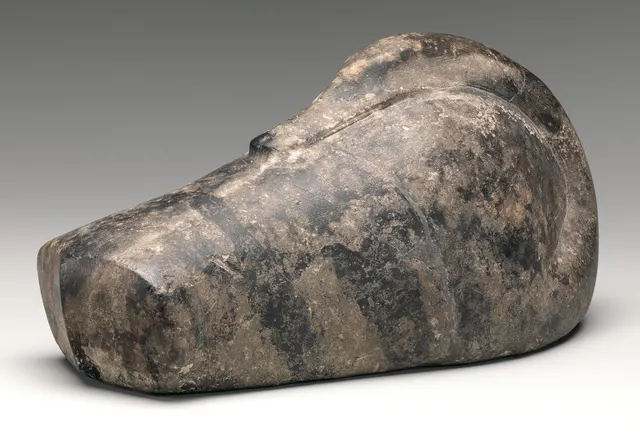
To pay, you weighed. Merchants carried balance scales and sets of stone weights, many carved in the shape of a sleeping duck.
Much of the time, the silver never moved at all. A farmer could run up a debt in silver over the year and settle it in barley at harvest. Silver was the measuring stick, the unit everyone did their sums in.
You can still hear this world in the Bible. In Genesis 23, Abraham buys a burial cave and "weighed to Ephron the silver", 400 shekels of it, "current money with the merchant". Today Israel's currency is still called the shekel.
Hacksilver: money you could cut
If silver is valued by weight, you need a way to make change. The answer was simple: cut it.
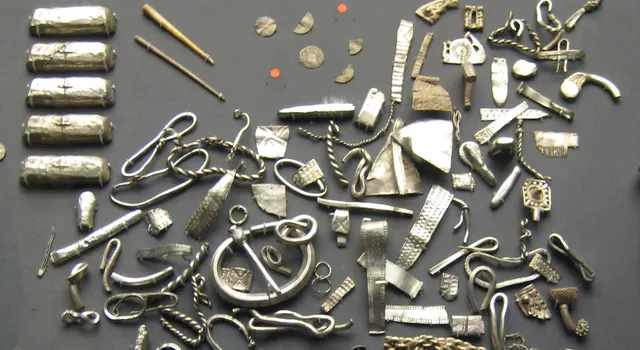
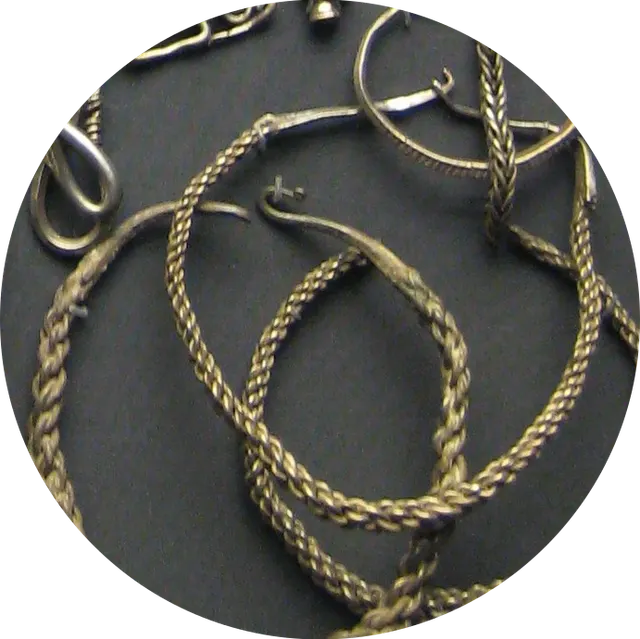
Archaeologists call these pieces hacksilver, from the German Hacksilber. A hacksilver hoard is a jumble of broken bracelets, snipped bars, coil fragments and bits of melted-down jewellery. It looks like scrap, but to its owner it was savings, ready to be weighed out.
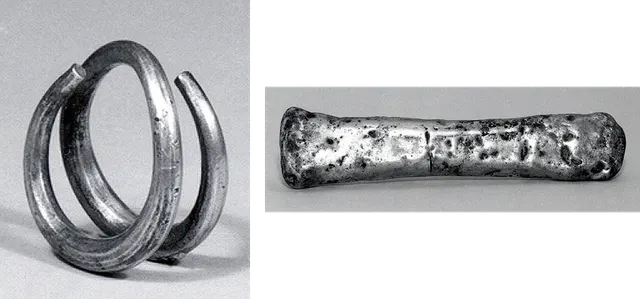
Hacksilver turns up across the ancient Near East. Hoards from Iron Age Israel and Phoenicia, buried between about 1200 and 600 BC, are full of it. A 2019 study by Tzilla Eshel and colleagues used lead isotopes to trace where that silver came from. Silver from hoards at Dor and Akko matched ores in Sardinia. Silver from Ein Hofez came largely from southern Spain. Phoenician traders were shipping silver across the whole Mediterranean centuries before the first coins.
In western Iran, a hoard from the Median site of Nush-i Jan held silver coils, bars, jewellery and scraps, all buried in the 7th or 6th century BC. Coins existed by then in Lydia, but here silver was still money by weight.
Viking hacksilver
Hacksilver had a second life almost 2,000 years later, in the Viking world. Viking traders took in silver from everywhere: Islamic dirhams from Central Asia, Anglo-Saxon pennies, Frankish jewellery, Irish arm-rings. They didn't care much whose coin it was. They cared what it weighed.
Many Viking-age traders carried folding scales and small lead weights. To check that a piece was solid silver and not plated, they cut a small nick into it. Archaeologists call these test cuts "nicking", and they show up on objects in hoard after hoard.
The biggest Viking silver hoard ever found in Britain turned up in 1840 at Cuerdale, near Preston in Lancashire. It holds more than 8,600 items, including coins, ingots, jewellery and hacksilver, and weighs somewhere between 32 and 40 kilos. Most of it is now in the British Museum.
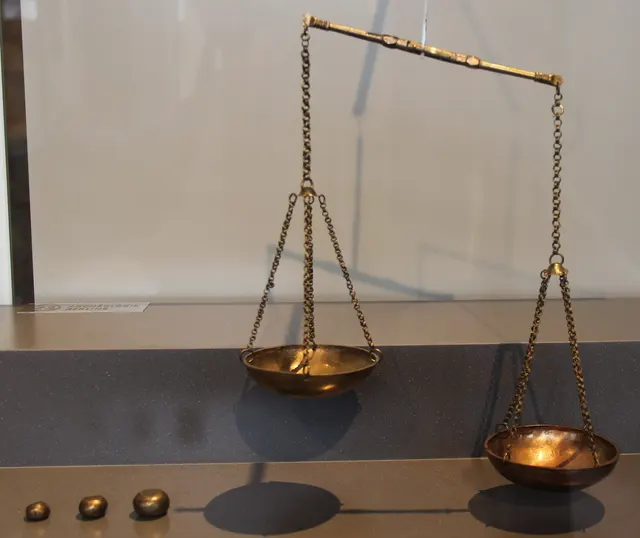
If you know the word from the God of War games, that's where it comes from. The game's currency borrows the name of real Viking-age money.
Cowrie shells: money from the sea
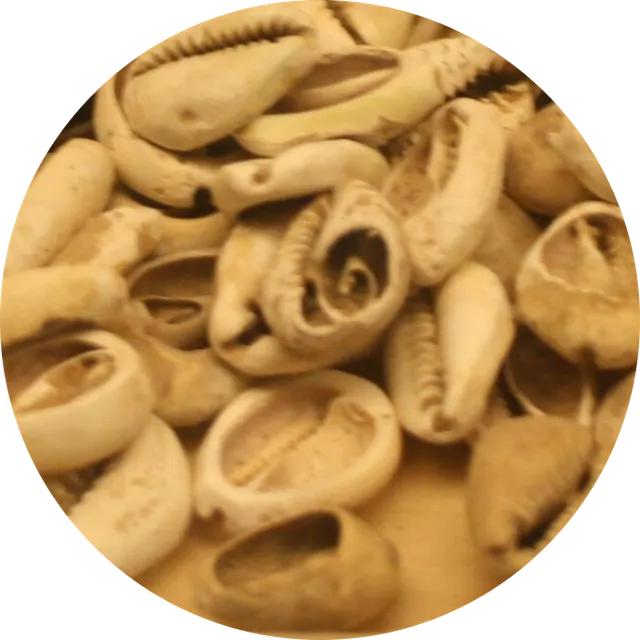
While some societies weighed metal, others counted shells. The money cowrie, Monetaria moneta, is a small, glossy sea snail shell about the size of a fingertip. It's hard to fake, easy to count and very hard to break.
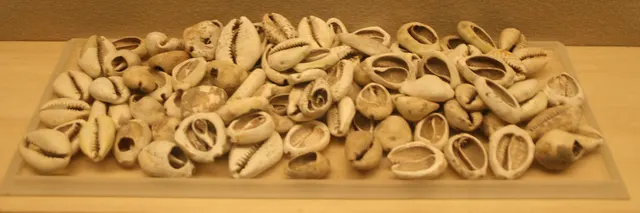
Most money cowries came from the Maldives, in the Indian Ocean. Islanders collected them in the shallow lagoons. Ships carried them as ballast to Bengal, where cowries served as small change for centuries. The traveller Ibn Battuta saw the trade on his visit to the Maldives in the 1340s.
From the 1500s, Portuguese, Dutch and British merchants shipped billions of Maldivian cowries to West Africa. There they became everyday money, and also the currency of the Atlantic slave trade. Historians Jan Hogendorn and Marion Johnson traced this grim link in detail. In the 1800s, cheaper shells from East Africa flooded in, the shells lost value, and colonial coins and notes replaced them in the early 1900s.
Shell money in ancient China
Cowries reached China too, carried overland from the Indian Ocean. In the Shang dynasty (about 1600 to 1046 BC) they were treasured. The tomb of Lady Fu Hao, a royal consort and general at Anyang, held about 6,880 of them when archaeologists opened it in 1976.
Bronze inscriptions from the Shang and Zhou record kings giving out cowries by the peng, or "string", as rewards. Scholars still argue about whether these were money in the modern sense or prestige gifts, closer to a medal than a wage.
The shell left a mark on the Chinese language. The character for cowrie, 貝 (bei), sits inside many words about value: 財 (wealth), 貨 (goods), 買 (buy) and 貴 (expensive).
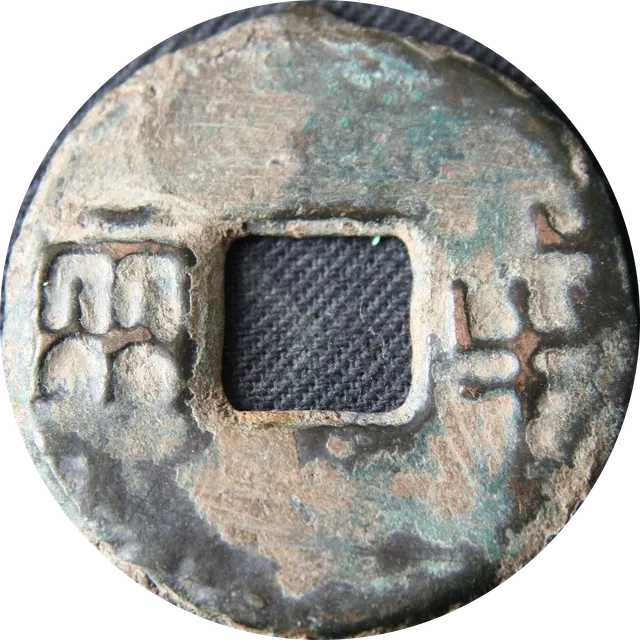
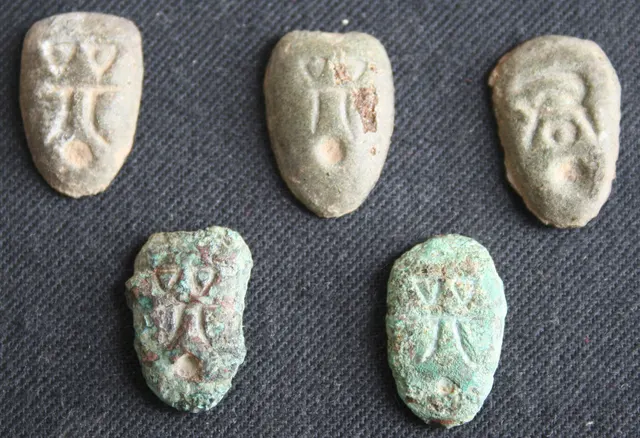
As real shells grew scarce, people made copies in bone, stone and bronze. In the southern state of Chu, bronze cowrie-shaped pieces called "ant-nose money" circulated in the Warring States period (475 to 221 BC). We cover those, along with spade and knife money, in Ancient Chinese Coins.
From weighed silver to the first coins
By the 7th century BC, people around the Mediterranean had been paying in weighed silver for well over a thousand years. Every payment meant a scale, a set of weights and some trust that the silver was good.
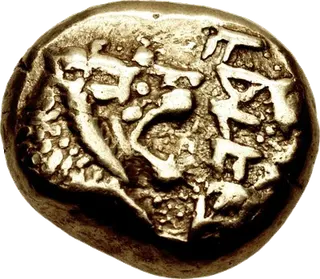
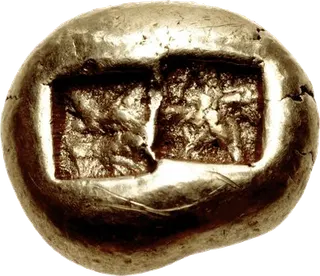
Coins fixed that. A ruler stamped a piece of metal to promise its weight and purity, so nobody had to weigh it again. The first coins, struck in Lydia from electrum, are the next chapter: The First Coins Ever Made. For how the stamp got onto the metal, read How the First Coins Were Made.
Weight never quite went away, though. As soon as coins appeared, people started clipping them, and governments started quietly shrinking them. That story is in Coin Clipping, Debasement and Gresham's Law.
A cowrie shell even makes a decent coin toss: it lands on its flat, toothed side or its domed back. If you'd rather flip a real coin, our coin flipper is ready.
Questions people ask
What is the barter system?
The barter system is trading goods or services directly, without money, such as swapping grain for sandals. It only works when each side wants what the other has, which economists call the "double coincidence of wants".
Why did money replace the barter system?
The textbook answer is that barter was too clumsy, so people invented money. Historians now think most early societies never ran on barter. They used credit and units of account like weighed silver, and coins came later as a convenient, trusted form of that silver.
Did a barter economy ever exist?
No pure barter economy has ever been documented. Barter does happen between strangers and when money collapses, as in prisoner-of-war camps or 1990s Russia, but everyday life in early societies ran on gifts, debts and accounting.
What is hacksilver?
Hacksilver is silver cut into pieces and used as money by weight. Hoards of it survive from the ancient Near East (around 1200 to 600 BC) and from the Viking Age, when traders weighed it on folding scales and nicked it to test its purity.
Were cowrie shells used as money?
Yes. Money cowries from the Maldives served as currency in Bengal, in parts of China and, for centuries, in West Africa, where they were used until colonial coins replaced them in the early 1900s.
Sources
- The Metropolitan Museum of Art, Open Access records: silver coil and silver ingot (Nush-i Jan hoard, Iran, 7th–6th c. BC); duck weights 326647 and 321516
- T. Eshel, Y. Erel, N. Yahalom-Mack, O. Tirosh and A. Gilboa, "Lead isotopes in silver reveal earliest Phoenician quest for metals in the west Mediterranean", PNAS 116 (2019)
- Laws of Eshnunna §1 (price list, c. 1770 BC) and Laws of Hammurabi §209, in M. Roth, Law Collections from Mesopotamia and Asia Minor (SBL, 1997); M. A. Powell, "Masse und Gewichte", Reallexikon der Assyriologie 7 (1987–90)
- British Museum / Ashmolean Museum, Cuerdale Hoard
- York Museums Trust, "Beyond Jorvik: The Vale of York Viking Hoard" (A. Woods)
- J. Hogendorn and M. Johnson, The Shell Money of the Slave Trade (Cambridge University Press, 1986); cross-check: MoneyMuseum (Zurich), "Cypraea moneta, a global money unit"
- Li Yung-ti, "On the Function of Cowries in Shang and Western Zhou China", Journal of East Asian Archaeology 5 (2006); chinaknowledge.de, "Currencies of the Zhou Period"; Britannica "Fuhao" and Institute of Archaeology, CASS excavation report (1980)
- C. Humphrey, "Barter and Economic Disintegration", Man 20 (1985); D. Graeber, Debt: The First 5,000 Years (2011); counterpoint: G. Selgin, "The Myth of the Myth of Barter", Cato Institute
- A. Smith, The Wealth of Nations (1776), Book I ch. 4; W. S. Jevons, Money and the Mechanism of Exchange (1875), ch. 1
- Herodotus, Histories 4.196 (silent trade); Genesis 23:16; R. A. Radford, "The Economic Organisation of a P.O.W. Camp", Economica 12 (1945)
Coins in this story
- Hacksilver
- Money cowrie
- Lydian stater
- Chinese cash coin