Tap the coin to flip it
The Maria Theresa Thaler: The 1780 Coin Still Struck Today
AustriaThalerHer thalers from 1741; the 1780-dated type from 1781 to today
- Issuer
- Habsburg Austria (Vienna and other Habsburg mints); later also Rome, Paris, London, Birmingham, Brussels, Utrecht and Bombay
- Denomination
- Conventionsthaler (1 thaler = 2 gulden)
- Years minted
- Her thalers from 1741; the 1780-dated type from 1781 to today
- Metal
- Silver, 833⅓/1000
- Weight
- 28.0668 g (23.389 g pure silver, 0.752 troy oz)
- Diameter
- About 39.5–40 mm
- Edge
- Lettered: IUSTITIA ET CLEMENTIA
- Marks
- S.F. under the bust (Günzburg mint officials Schöbl and Faby)
In the hand
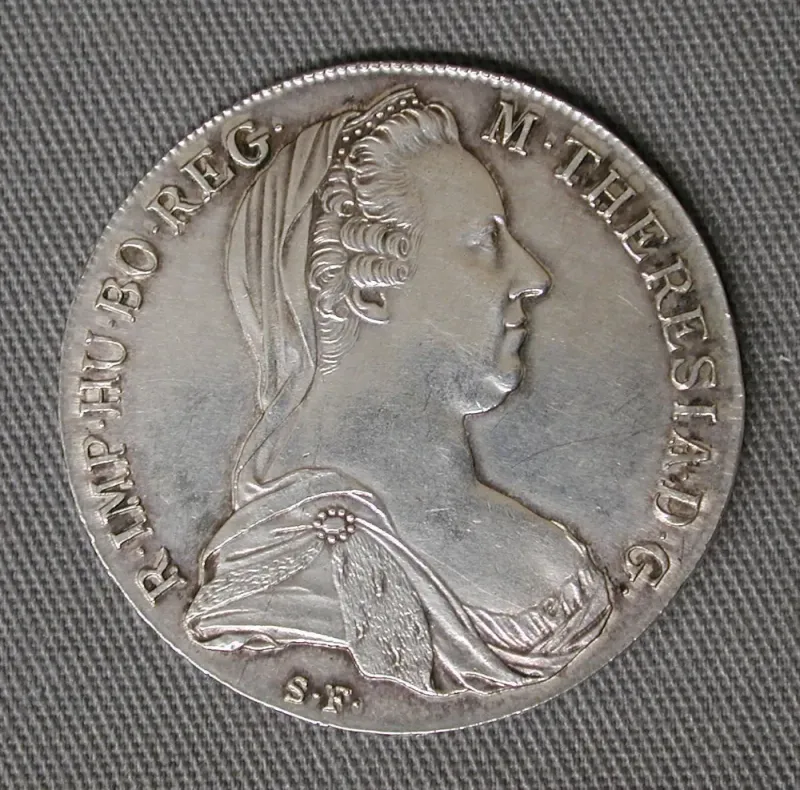
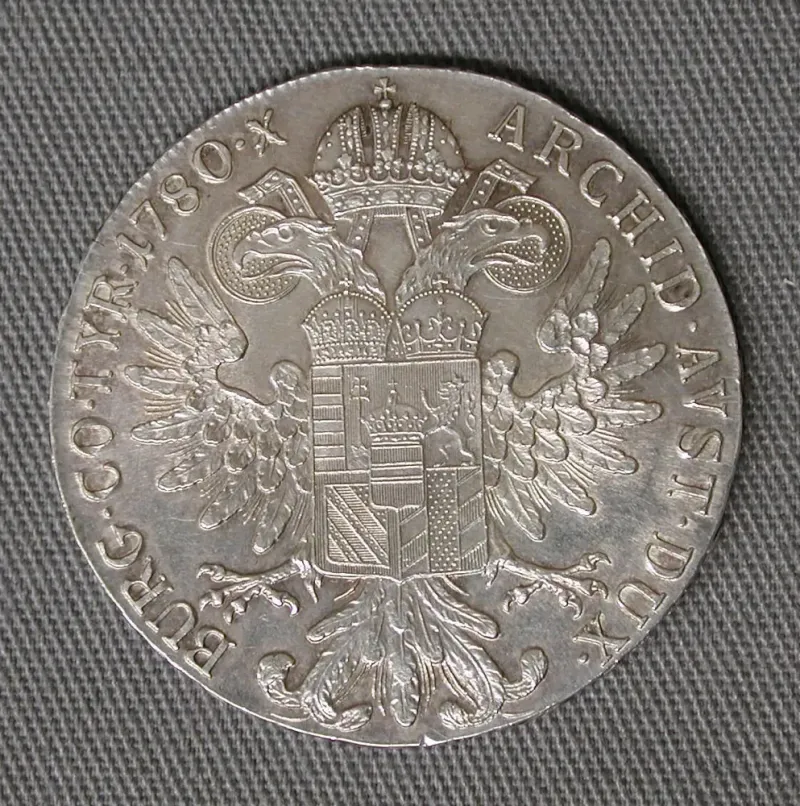
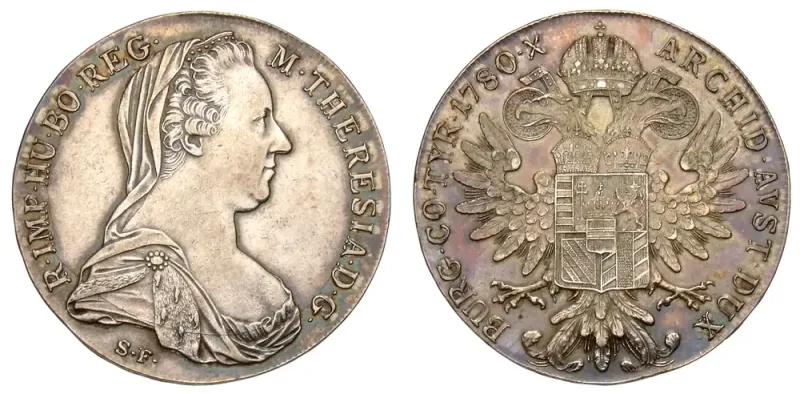
The story of the Maria Theresa thaler
The Maria Theresa thaler is a large Austrian silver coin bearing the portrait of Empress Maria Theresa, who ruled the Habsburg lands from 1740 to 1780. Nearly every one you'll see is dated 1780, the year she died, and the Austrian Mint in Vienna still strikes it.
The coin follows the Convention standard, which Austria adopted in 1750 and agreed with Bavaria in 1753. It weighs 28.0668 grams, is 833 parts per thousand silver, and holds 23.389 grams of pure silver. It's about 39.5 to 40 mm across.
On the front is the empress as a widow, wearing a veil and a brooch, with her titles in Latin. On the back is the Habsburg double-headed eagle with her coat of arms, and the date 1780. The edge carries the motto IUSTITIA ET CLEMENTIA, "justice and clemency".
The letters S.F. under her bust are the initials of two officials at the Günzburg mint, Tobias Schöbl and Joseph Faby, and they stayed on the coin long after both men were gone. The S.F. is one of the details that make the coin look "right" to people who use it.
After her death the design was frozen. Traders in the Levant, Arabia and East Africa knew the coin and trusted it, so Austria kept striking it with her face and the 1780 date. The coin was still being used as money in Ethiopia, Yemen and the Sahel well into the 20th century.
Other mints made it too. In the 20th century Rome, Paris, London, Birmingham, Brussels, Utrecht and Bombay all struck their own 1780-dated thalers, mostly to pay for trade and military campaigns in Africa and Arabia. Experts can tell some of these apart by small differences in the strike and the edge.
Austria ended its legal tender status at home on 31 October 1858, but kept making it for export. Some 389 million were struck between 1751 and 2000.
So if you have a 1780 Maria Theresa thaler, it's almost certainly a later restrike, not a coin from the empress's lifetime. That doesn't make it a fake: it's real silver, from a real mint. True 1780 originals do exist, but telling them apart takes a specialist.
The story of how a dead empress's coin became money across the Red Sea world is in the history article linked below.
Questions people ask
Why is every Maria Theresa thaler dated 1780?
Maria Theresa died in 1780. Austria froze the design and date because traders in Arabia and Africa trusted that exact coin, and it has been restruck with the same date ever since.
Is my 1780 Maria Theresa thaler real?
Almost certainly it's a genuine restrike made after 1780, often in the 20th century. It contains 23.4 g of silver. Original 1780 coins exist but need an expert to identify.
How much silver is in a Maria Theresa thaler?
23.389 g of pure silver, about 0.752 troy ounces, in a 28.07 g coin of 83.3% silver.
Is the Maria Theresa thaler still made?
Yes. The Austrian Mint in Vienna still strikes it with the 1780 date.