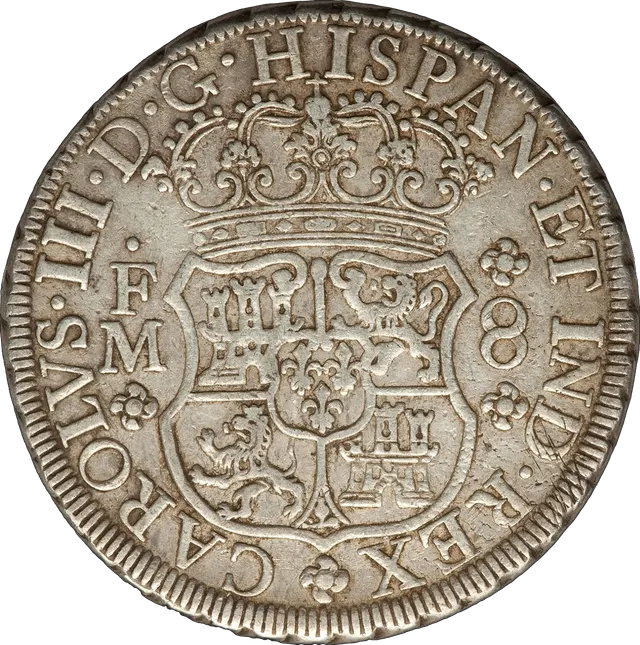
The Maria Theresa Thaler: A Dead Empress's Coin Still Struck Today
Part 25 of the Trade empires series5 min read
Why is every Maria Theresa thaler dated 1780? How a dead empress's silver coin became trusted money in Ethiopia and Arabia, and why Vienna still strikes it.
Empress Maria Theresa died in Vienna in November 1780. Her silver thaler didn't stop with her.
Mints went on striking it with the date 1780 for the next 240-odd years. They still do. Coins carrying that date were spent in Ethiopian markets in the 1930s, paid out by British and Italian armies, and melted into jewellery from Yemen to Zanzibar. A coin dated 1780 can be brand new.
Here's how one Habsburg coin outlived its empire, and why the date never changed.
A coin for an empress
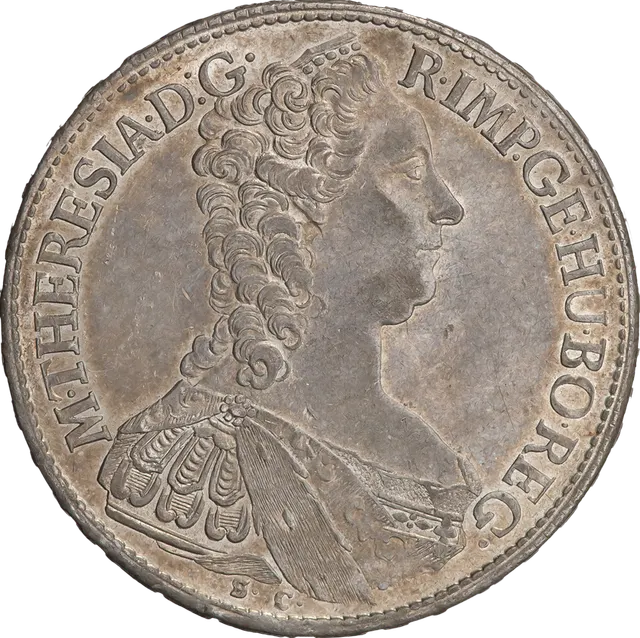
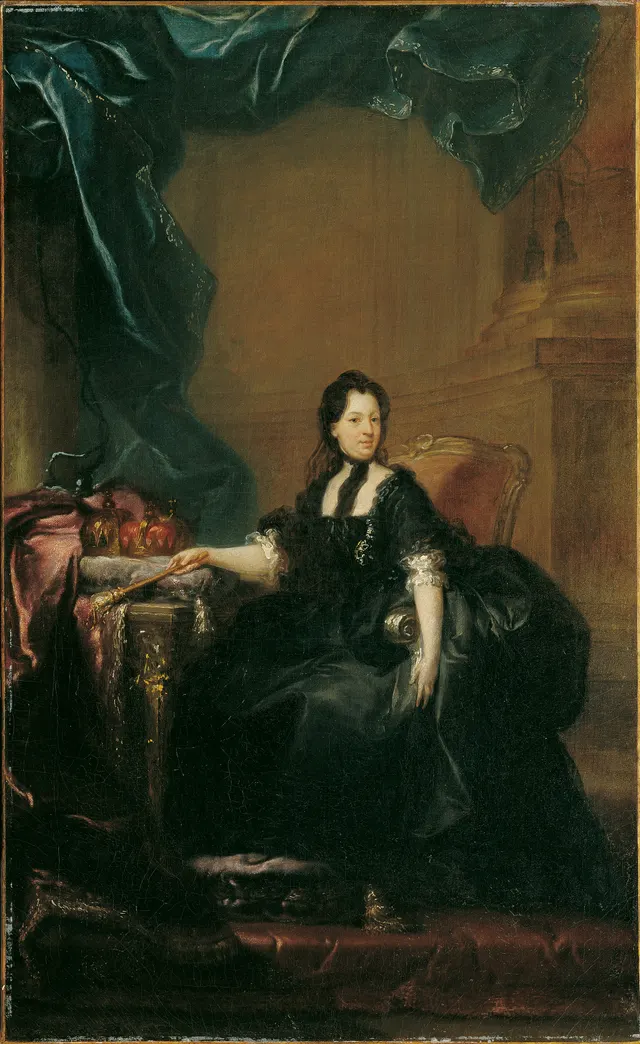
Maria Theresa came to the Habsburg throne in 1740. Her mints struck the first thalers with her portrait in 1741: big silver coins, about 41 mm across, the kind of money merchants used for serious payments. (For where the name "thaler" came from, see The Thaler: The Coin That Named the Dollar.)
In 1753 Austria and Bavaria agreed a new coin standard, the Conventionsthaler. Each thaler weighed about 28.07 grams and was 833 parts in 1,000 silver, so it held roughly 23.4 grams of pure silver. That is the same coin the Austrian Mint sells today.
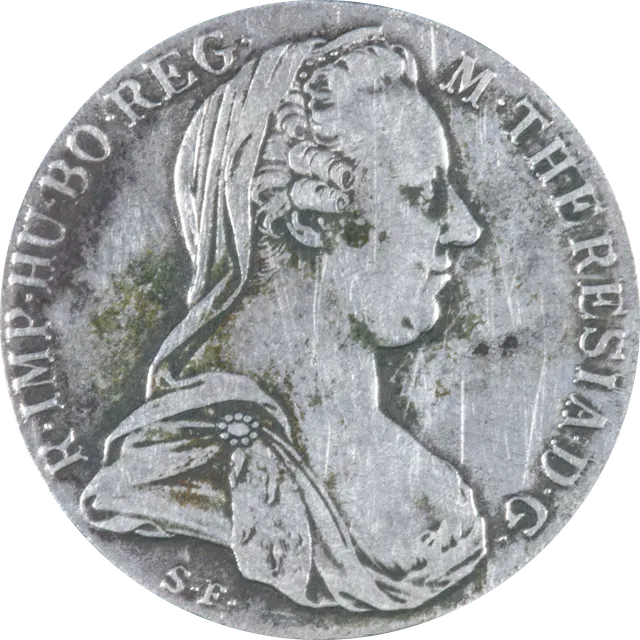
The portrait aged with her. Early thalers show a young woman with her hair up. After her husband, Emperor Francis I, died in 1765, the coins show her in a widow's veil, with a jewelled brooch on her shoulder.
The 1780 coin that never changed
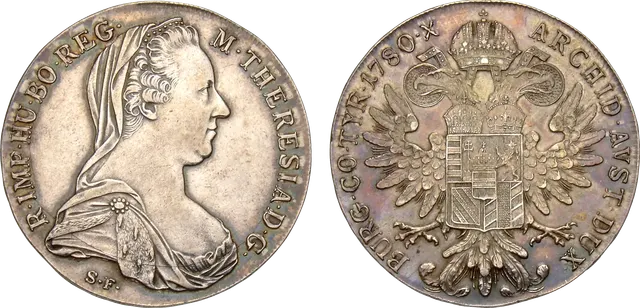
The thaler most people know is the last version: the widow's bust, dated 1780, struck at Günzburg in the Habsburg lands of Swabia. Look under the bust and you'll see the letters S.F. They stand for the two Günzburg mint officials of the time, Tobias Schöbl and Joseph Faby.
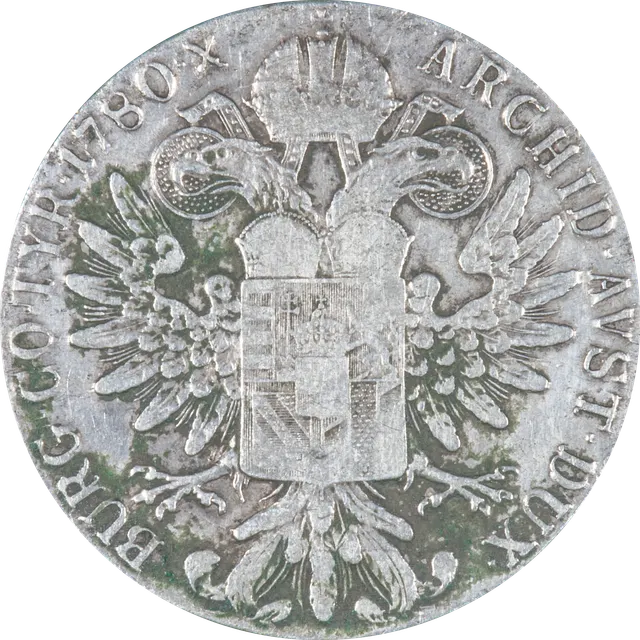
The reverse shows the Habsburg double-headed eagle under a crown, carrying a shield with the arms of Austria, Hungary, Bohemia, Burgundy and Burgau. The edge is lettered IUSTITIA ET CLEMENTIA, "justice and clemency", the empress's motto. That lettered edge mattered. Nobody could shave silver off the rim without destroying the words.
After she died, her son Joseph II let the Günzburg mint keep using the 1780 dies. The reason was trade. The coin had become popular in the Levant, the eastern Mediterranean, and traders there trusted that exact design. A new emperor's face on the coin would have been a different coin to them, and a suspicious one.
So the date stayed. In 1857 Emperor Franz Joseph made it official, declaring the 1780 thaler a trade coin. A year later, on 31 October 1858, it stopped being legal money in Austria itself. Vienna kept striking it anyway, for export.
How a Habsburg coin conquered the Red Sea
The thaler went where the trade went: east across the Mediterranean, through Egypt and down the Red Sea. By the 1800s it was the main silver coin in Ethiopia and the Horn of Africa, across Yemen and Oman, and down the East African coast to Zanzibar.
Arabic speakers had a string of names for it. It was al-riyal al-fransi, the "French riyal", or abu tayr, "the one with the bird", after the eagle. In Ethiopia it was simply the thaler, or birr, "silver".
People there were fussy about it, and traders checked a thaler before they took it. They counted the pearls on the empress's brooch and looked hard at the points of her diadem. A coin with the wrong details, a different date or a worn face could be refused or taken at a discount. Clara Semple, who wrote the standard history of the coin, describes the brooch-counting habit in Ethiopia.
Why this coin? Partly the silver: it was full weight, hard to clip, and the same every time. The historian Akinobu Kuroda adds a second reason. In a region with many kinds of money, from salt bars to Indian rupees, the thaler worked as a shared measure that let value move between markets. Everyone knew what it was.
Coins also turned into jewellery. Silversmiths across Arabia and Ethiopia melted thalers down for necklaces and bracelets, or hung whole coins on them. In Ethiopia they were cut into neck crosses.
Armies, empires and other people's mints
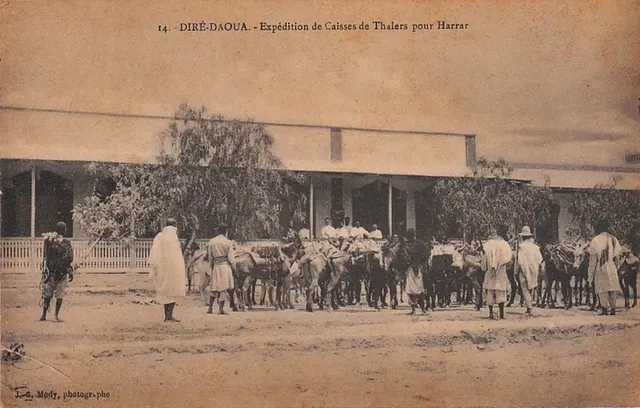
Anyone who wanted to do business in Ethiopia needed thalers, armies included.
In 1868 Britain sent an army under Sir Robert Napier into Abyssinia to free hostages held by Emperor Tewodros II. Local sellers wanted thalers for food and mules, not rupees or pounds, so the British bought millions of Maria Theresa thalers from the Vienna mint and shipped them in.
Then other countries started making the coin themselves. When Italy invaded Ethiopia in 1935, Mussolini's government got the right to strike the thaler and produced it at the Rome mint. Britain answered with its own thalers from the Royal Mint in London from 1936, and during the Second World War the London dies went to Bombay, which struck about 18 million for the East African campaign. Paris, Brussels, Utrecht and Birmingham all struck it at different times too.
These foreign thalers still say 1780. Collectors tell them apart by tiny die details. The London dies, for example, are said to leave out a central feather on the eagle, and the Bombay and Birmingham coins struck from them share the slip.
Once the Italian concession ran out, Austria asked the other governments to give the coin back. Britain was the last to agree, in February 1962.
The slow goodbye
The thaler faded as new national currencies arrived. Ethiopia replaced it in 1945 with a new Ethiopian dollar, and kept the old Ethiopian word for silver, birr, as its name. Yemen launched its own rial in 1964 and pegged it to roughly a thaler's worth of value before buying the old coins back. When Oman issued the rial Saidi in 1970, the thaler stopped being legal money anywhere in the Arabian Peninsula.
Counting how many were made is hard. A common estimate is about 389 million between 1751 and 2000, and some writers put it far higher. Either way, it's one of the most-struck silver coins ever.
A 1780 coin you can buy new
The Austrian Mint in Vienna still strikes the Maria Theresa thaler, at the 1753 standard, with the 1780 date and the S.F. initials. You can buy one uncirculated today.
That's why so many people find a "1780" thaler in a drawer and think they've found something rare. Almost always, it's a restrike, and its value sits close to its silver content of about three-quarters of an ounce. A genuine coin struck before Maria Theresa's death in 1780, or a scarce mint variety, is worth more, but telling those apart takes a specialist catalogue or a coin dealer.
Flip the coin you just read about
Our Maria Theresa thaler coin page has the specs and photos, and you can flip one in our coin flipper. Before this: The Doubloon: Spanish Gold and Pirate Legend. Next in the series: Ottoman and Mughal Coins. The silver dollar the thaler competed with in Asia is in Pieces of Eight.
Questions people ask
Why is the Maria Theresa thaler always dated 1780?
Maria Theresa died in 1780, and her son Joseph II let the mint keep using the last dies so the coin would look exactly the same to traders in the Levant and the Red Sea, who trusted that design. In 1857 Austria made the 1780 coin an official trade coin, and every thaler since has carried that date.
Is my 1780 Maria Theresa thaler real?
It's very likely a real silver coin, but probably not one from 1780. Austria and several other mints have restruck it with the 1780 date ever since, and the Austrian Mint still makes it. Most "1780" thalers are restrikes from the last two centuries.
How much is a Maria Theresa thaler worth?
A restrike is worth roughly its silver value plus a small premium. It holds about 23.4 grams, or three-quarters of a troy ounce, of pure silver. Coins actually struck during Maria Theresa's lifetime, and rare mint varieties, sell for more.
Where was the Maria Theresa thaler used as money?
Across the Red Sea world and beyond: Ethiopia, Eritrea, Somalia, Sudan, Yemen, Oman, the Arabian coast and East Africa down to Zanzibar. Ethiopia replaced it in 1945, Yemen in 1964 and Oman in 1970.
Is the Maria Theresa thaler still made today?
Yes. The Austrian Mint in Vienna still strikes it in 833 silver with the 1780 date, as a bullion and collector coin.
Sources
- Münze Österreich (Austrian Mint), "Maria Theresa Taler Silver Uncirculated."
- Clara Semple, A Silver Legend: The Story of the Maria Theresa Thaler (Barzan Publishing, 2005); and her lecture "The Maria Theresa Thaler in Ethiopia and Beyond," Anglo-Ethiopian Society, 2005.
- Saudi Aramco World, "Tales of a Thaler" (January/February 2003).
- Akinobu Kuroda, "The Maria Theresa Dollar in the Early Twentieth-Century Red Sea Region: A Complementary Interface Between Multiple Markets," Financial History Review 14:1 (2007), 89–110.
- Habsburger.net, "The 'fat lady' in Ethiopia: Maria Theresa's likeness on its travels."
- Münzkabinett der Staatlichen Museen zu Berlin, object 18205153 (Maria Theresa thaler, 1780, Günzburg).
- IMF Staff Papers, "Currency Arrangements and Banking Legislation in the Arabian Peninsula" (1975).