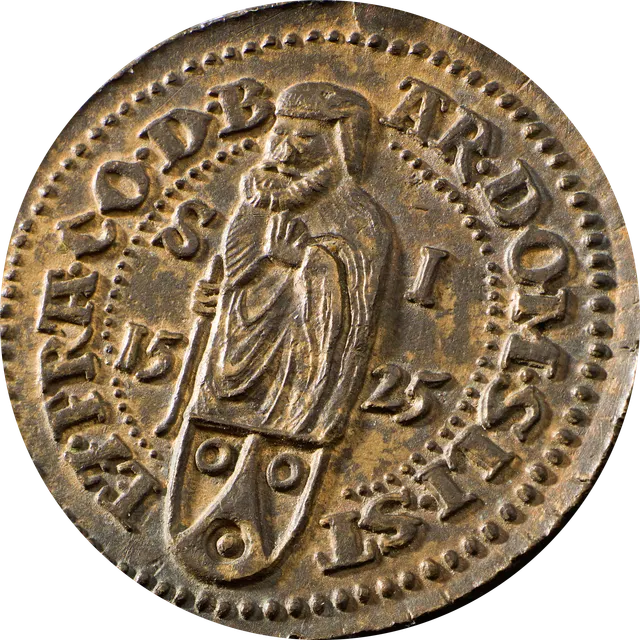
The Florin and the Ducat: Gold of Renaissance Italy
Part 19 of the Medieval money series6 min read
Florence struck the gold florin in 1252 and Venice the ducat in 1284. How two 3.5-gram coins became the trusted gold of medieval Europe, and where their names live on.
For about 500 years, Western Europe ran on silver. Kings and bishops struck pennies, merchants counted them by the pound, and gold coins were things you saw from Byzantium or the Islamic world, not from home.
Then, in the middle of the 1200s, two Italian republics started striking gold of their own. Florence's florin and Venice's ducat were almost the same size and weight. Both stayed nearly unchanged for centuries, and between them they set the standard for gold money across Europe and the Mediterranean.
Florence strikes a golden lily
In 1252, Florence began minting the fiorino d'oro, the gold florin. Genoa launched its own gold coin the same year. The florin is the one that took over Europe.
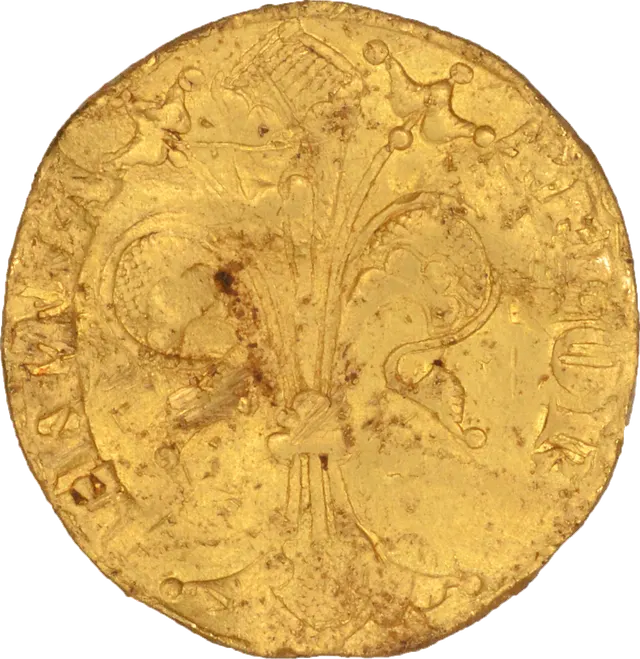
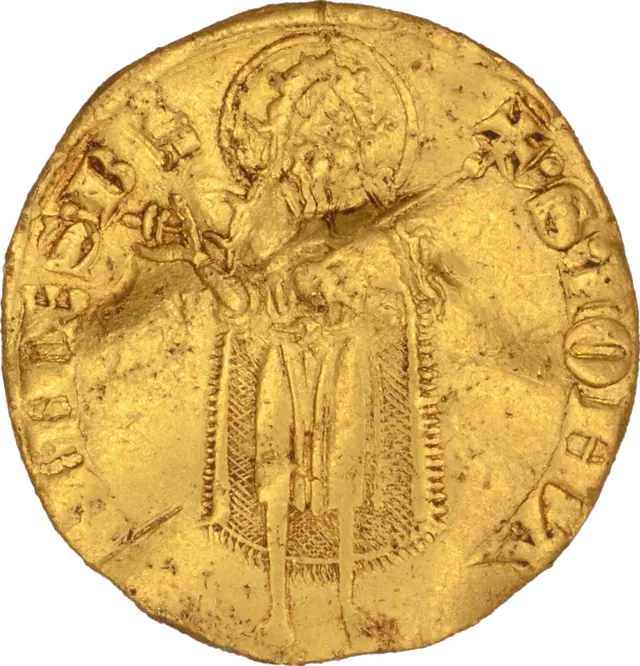
The design was simple. One side shows a lily, the flower of Florence, with the word FLORENTIA around it. The other side shows St. John the Baptist, the city's patron saint, raising his hand in blessing. The coin's name comes from that flower: fiore in Italian, flos in Latin.
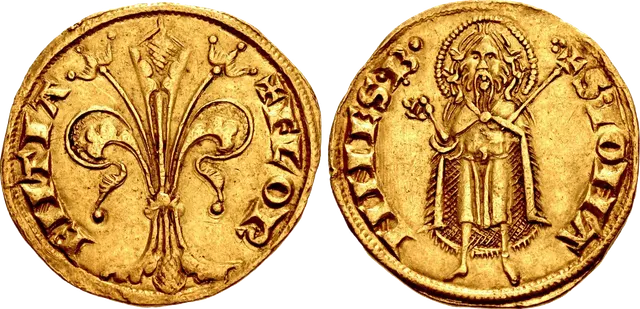
A florin weighed about 3.5 grams and measured about 20 mm across, between a US dime and a nickel in size. It was struck from gold as pure as medieval refiners could make it, and Florence kept that weight and purity steady from 1252 until 1533.
What a florin could buy
When it was new, one florin was worth one lira, the money of account that every Florentine used for bookkeeping: 20 soldi, or 240 small silver pennies.
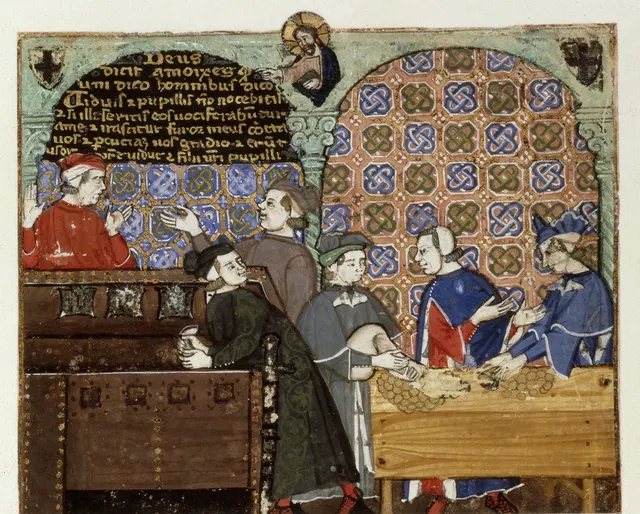
That didn't last. Florence's everyday silver coins kept losing value while the florin held firm, so the florin's price in silver kept climbing. By the early 1330s it was worth about 60 soldi, three times its starting value.
At that price, according to the American Numismatic Society, an unskilled laborer in Florence earned about 4.5 soldi a day. One gold florin was roughly 13 days of his work.
The mint kept up with demand. In the 1300s it reportedly struck 350,000 to 400,000 florins a year. Each mintmaster served a short term and put a small personal mark on the coins, which is why collectors can often date a florin to within six months.
Everyone copied the florin
Merchants trusted the florin, and rulers noticed. Over a hundred rulers, states and cities in Germany, the Low Countries, France and Aragon struck their own copies. They kept the lily and St. John but swapped FLORENTIA for their own names.
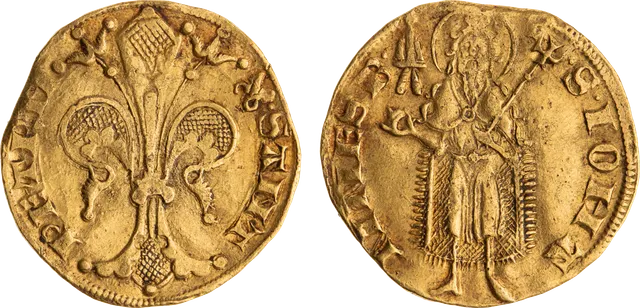
A hoard buried near Bretzenheim, in the Rhineland, around 1390 shows how far the coin had spread. Of its 1,005 gold coins, 451 were real Florentine florins and 549 were copies or local coins on the florin pattern. Only five were Venetian ducats.
Some copies had a long afterlife. In 1325, King Charles Robert of Hungary began minting gold florins of his own. Hungary's currency is still called the forint. In Germany, florin-style coins turned into the Goldgulden, the "golden gulden."
England tried too. In 1344 Edward III issued a gold "florin," now nicknamed the double leopard, but he priced it badly and merchants refused it. It was withdrawn within months. Two of the three known survivors were found by children in the River Tyne in 1857.
Britain brought the name back in 1849 for a silver two-shilling piece, a tenth of a pound, as an early experiment in decimal money.
Venice answers with the ducat
Venice was slower. Its silver grosso, struck since 1202, was already a trusted trade coin. In 1284, under Doge Giovanni Dandolo, it finally struck a gold coin of its own.
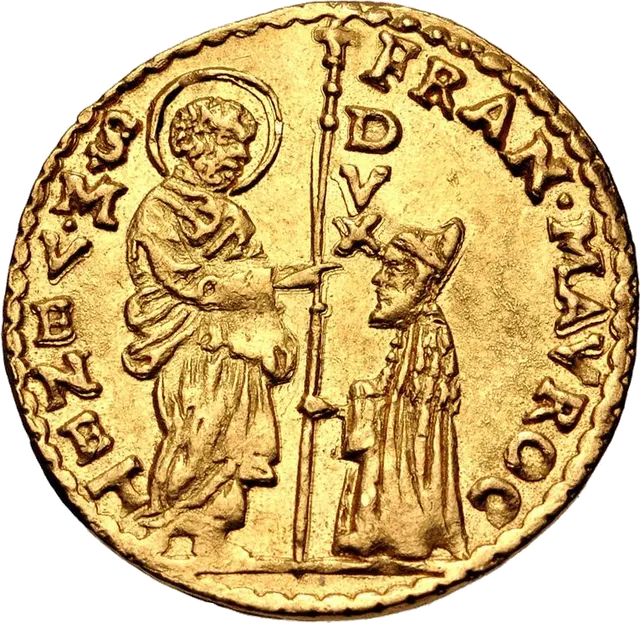
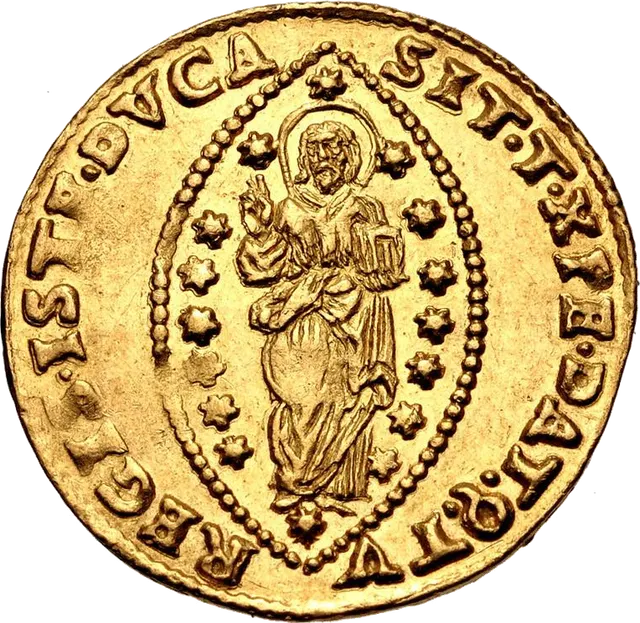
The ducat matched the florin almost exactly: about 3.5 grams of nearly pure gold, about 20 mm across. The design was busier. On one side St. Mark, the city's patron saint, hands a banner to the doge, who kneels beside him. On the other, Christ stands inside an oval of stars.
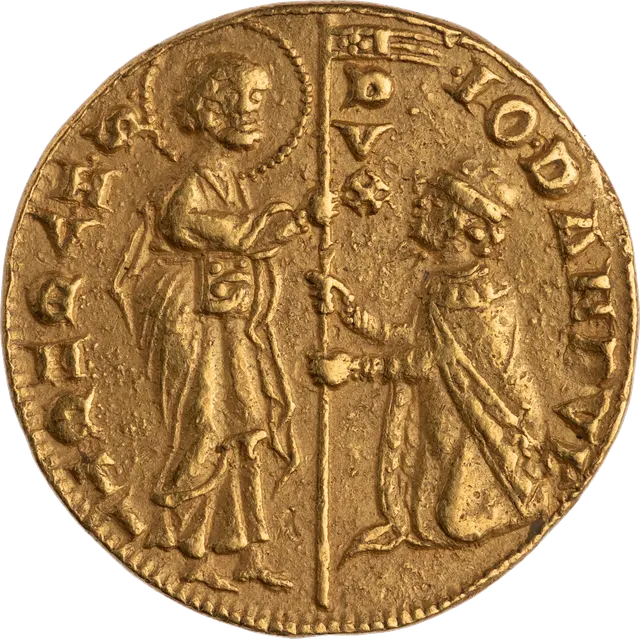
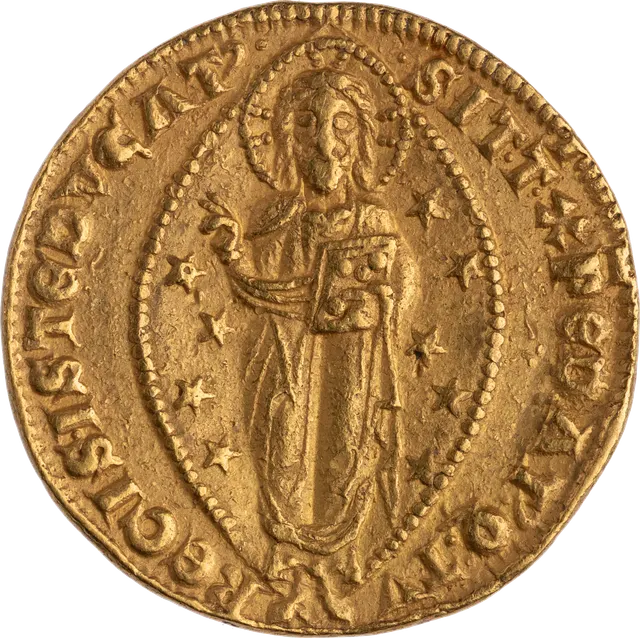
Around Christ runs a Latin line: Sit tibi, Christe, datus, quem tu regis, iste ducatus. "Let this duchy, which you rule, be given to you, O Christ."
Where the word "ducat" really comes from
Most books will tell you the coin took its name from ducatus, the last word of that legend. It's a neat story, and the American Numismatic Society's study of the ducat calls it wrong.
The name is older than the gold coin. Around 1140, Roger II of Sicily struck silver coins for his duchy of Apulia, and people called them ducales or ducati. Venice's silver grosso, from 1202, picked up the same nickname. When the gold coin arrived 80 years later, Venetians called it the ducato d'oro, the gold ducat, to tell it apart from the silver one. Eventually the gold coin kept the name for itself.
The florin's name worked the same way. Florence had silver fiorini before it had gold ones.
The coin of the eastern Mediterranean
The florin ruled northern Europe. The ducat went the other way: south and east, along Venice's trade routes.
Venetian merchants paid for spices, silk and cotton in the Levant with ducats, and the coins piled up there. A Florentine traveller found them in common use in Cairo in 1384. In Egypt they were called ifranti, "Frankish" coins. Copies were struck by the Knights of St. John on Rhodes, by rulers around the eastern Mediterranean, and as far away as India.
The ducat also became the model for new gold coins. Portugal's cruzado of 1457, Spain's coinage reform of 1497 and the first Ottoman gold coin, the altun (recorded from 1478), all took the ducat as their standard.
By the 1400s, "ducat" had replaced "florin" as the everyday word for a good gold coin. Even in Florence, people sometimes called their own florin the "ducat of Florence." Part of the reason was trust. The florin had been copied so often, and some copies were so debased, that the name had lost some of its shine. The ducat had hardly been copied in the West.
Zecchino, sequin and Shylock's ducats
Venice's mint was called the zecca, a word that goes back to the Arabic sikka, a coin die. The gold coin came to be called the ducato di zecca, "ducat of the mint," to tell it apart from silver ducats, and that was shortened to zecchino. In French and English, zecchino became "sequin." The word later passed to the small shiny discs sewn on clothes, because women in the eastern Mediterranean wore pierced Venetian gold coins as jewelry.
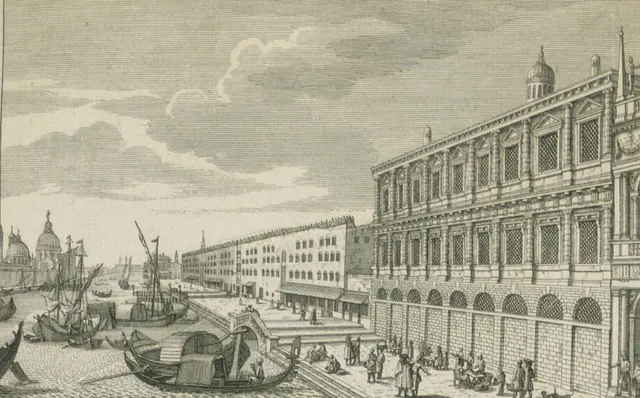
The mint building itself still stands on the waterfront by St. Mark's Square. Jacopo Sansovino designed it, and it was built between 1536 and 1548 out of heavy rusticated stone, to keep out fire and thieves. It struck coins until 1870 and now holds reading rooms of the Biblioteca Nazionale Marciana.
English audiences knew the ducat as Venice's money. In The Merchant of Venice, written in the 1590s, Antonio borrows 3,000 ducats from Shylock for his friend Bassanio, and Shylock's cry after his daughter runs off is reported as "My daughter! O my ducats! O my daughter!"
The long goodbye
The florin went first. Florence struck it until 1533, when Alessandro de' Medici had become the city's first duke and the old republic was gone. It had lasted 281 years.
The ducat lasted far longer. Venice struck it for every doge for more than five centuries, with only small changes to details like the doge's cap and the number of stars. When Napoleon ended the Venetian Republic in 1797, the ducat survived its own government: the Austrians, who took over Venice, kept striking it, and ducats in the name of the last doge, Lodovico Manin, are thought to have been made until about 1823 because traders in the Levant still wanted them.
Gold ducats never fully disappeared. Austria still strikes a ducat dated 1915 as a bullion coin, and the Royal Dutch Mint still issues a gold ducat with a knight on it, a design first used in 1586.
Flip the coins in this story
You can flip a florin and a ducat on their coin pages, then compare them with the silver thaler, which began as a silver match for a gold gulden, the florin's German descendant. Or head back to the coin flipper and toss a modern coin.
Keep reading in the Medieval series: Medieval Coins of Europe: Pennies, Groats and Bracteates · Byzantine Coins: The Solidus That Lasted 700 Years · The Thaler: The Coin That Named the Dollar · All Medieval articles
Questions people ask
What is a florin coin?
The florin (fiorino d'oro) was a gold coin first struck in Florence in 1252. It weighed about 3.5 grams, showed a lily on one side and St. John the Baptist on the other, and was copied across medieval Europe. Later coins borrowed the name, including Hungary's forint and Britain's two-shilling florin of 1849.
How much gold is in a florin or a ducat?
Each held about 3.5 grams of nearly pure gold, roughly an eighth of a troy ounce. The two coins were designed to be almost interchangeable.
Why is it called a ducat?
Not from the word ducatus in its Latin legend, despite the popular story. "Ducat" was first a nickname for silver coins struck around 1140 for the duchy of Apulia in southern Italy, and then for Venice's silver grosso. Venice's gold coin of 1284 was the "gold ducat," and over time it took the name for itself.
What is the difference between a florin and a ducat?
The florin came from Florence (1252) and shows a lily and St. John the Baptist. The ducat came from Venice (1284) and shows St. Mark with the doge and Christ in an oval of stars. Their weight and gold content were nearly identical. Florin copies spread through northern and western Europe, while ducat copies spread around the eastern Mediterranean and as far as India.
Are ducats still made today?
Yes, as bullion and collector coins. The Austrian Mint strikes a gold ducat with the frozen date 1915, and the Royal Dutch Mint issues a gold ducat with a knight design first used in 1586.
Sources
- Herbert E. Ives, The Venetian Gold Ducat and Its Imitations, ed. Philip Grierson. Numismatic Notes and Monographs 128 (American Numismatic Society, 1954)
- Deutsche Bundesbank, "Sign of the lily: Gold florin of Florence" (Money Museum, selected objects)
- David Yoon, "How Much Is That in Dollars? The florin," Pocket Change, American Numismatic Society, 25 October 2022
- National Bank of Slovakia, "700th anniversary of the introduction of gold coinage: the florin in the Kingdom of Hungary."
- Royal Mint Museum, "Demise of the Florin."
- Peter Spufford, Money and Its Use in Medieval Europe (Cambridge University Press, 1988)
- William Shakespeare, The Merchant of Venice, Act 2, Scene 8 (Folger Shakespeare Library edition)