Medieval Coins of Europe: Pennies, Groats and Bracteates
Part 18 of the Medieval money series5 min read
For 500 years Europe ran on a thin silver penny. Here's how Charlemagne's denier, the English penny, the groat and paper-thin bracteates worked, and why.
For about 500 years, most of Europe ran on one coin: a small, thin silver penny. Gold had largely disappeared from western mints after Rome fell. Silver was what Europe could dig out of its own hills, so kings, bishops and abbots struck pennies by the million.
Here's how that penny came about, why it was cut into halves and quarters, and how it eventually made room for the bigger groat and the paper-thin bracteate.
Charlemagne's denier sets the pattern
The story starts with the Franks. In about 755, King Pepin the Short reorganised his coinage around a good-quality silver penny, the denier. The name comes straight from the Roman denarius.
His son Charlemagne made it heavier and more uniform. Around 793–794 he brought in a new, broader denier, and the Synod of Frankfurt in 794 ordered people to accept these "new deniers" everywhere in the kingdom. Most carry his name and a monogram of KAROLVS, the same monogram he used to sign official documents.
Charlemagne also fixed the accounting system. A pound of silver made 240 deniers. Twelve deniers made a solidus (shilling), and twenty solidi made a pound.
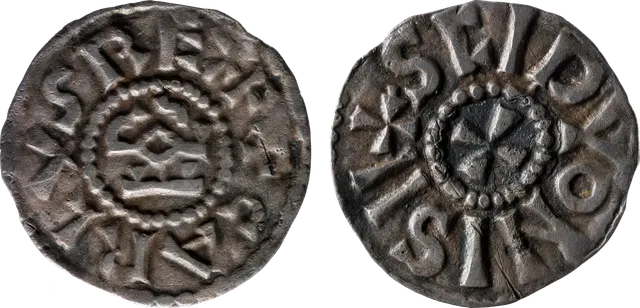
Only the penny existed as a real coin. The shilling and the pound were units for counting. Britain kept the same 240-pence pound, written £sd from the Latin librae, solidi, denarii, until decimal day in 1971.
England's silver penny
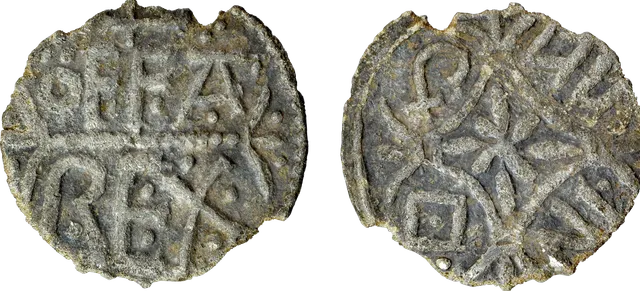
Anglo-Saxon England already had small silver coins, which collectors now call sceattas. The penny as we know it arrived soon after Pepin's reform. King Offa of Mercia (757–796) struck broad, thin pennies, and his portrait pennies from about the 780s are some of the finest coin portraits made anywhere in Europe in those centuries.
The bigger change came in 973. King Edgar reorganised the whole English coinage into one national design: the king's bust on one side and a small cross on the other, ringed by the name of the moneyer and the town where the coin was struck. About 70 places are known to have minted coins under this system.
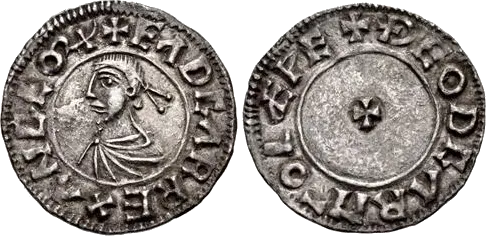
From then on the design was changed every few years, at times about every six. Old pennies had to be traded in for the new type, and the crown took a cut each time.
Cutting a penny into change
A penny was a fair amount of money, so how did you buy something cheaper? You took out a knife.
For centuries the English didn't strike halfpennies or farthings in any number. People cut pennies in half along the arms of the cross on the reverse, or into quarters. The farthing takes its name from that practice: it was the "fourth-thing" of a penny. Cut halves and quarters turn up all the time when metal detectorists find medieval coins in English fields.
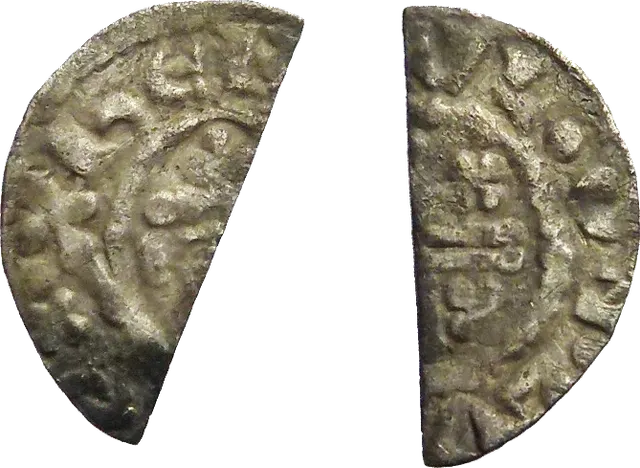
Edward I's recoinage of 1279 finally made round halfpennies and farthings in quantity, and cut coins faded out.
Short Cross, Long Cross and the clippers
English pennies were made of sterling silver, which is 92.5 percent pure. The standard was set in a "pennyweight" of 22½ grains, about 1.46 grams. Henry II's Short Cross penny of 1180 held to it, and the same design ran almost unchanged for 67 years, through Richard I and John and into Henry III's reign.
The short cross on the reverse had a weakness. It sat well inside the edge of the coin, so a dishonest person could shave silver from the rim without anyone noticing at first. Coin clipping was a constant problem.
In 1247 Henry III's moneyers answered with the Long Cross penny. Its cross reached all the way to the edge. If the ends of the cross were missing, the coin had been clipped.
The groat: a bigger coin for bigger deals
As trade grew in the 1200s, a coin worth one penny was too small for many deals. Paying for a horse or a bale of wool meant counting out hundreds of tiny coins.
Italy found the answer first. Around 1193–1194, under Doge Enrico Dandolo, Venice began striking a heavier silver coin worth several pennies, the grosso, or "big one." France followed in 1266 with Louis IX's gros tournois. It weighed a little over 4 grams, was worth 12 deniers, and was the first heavy silver coin struck north of the Alps.
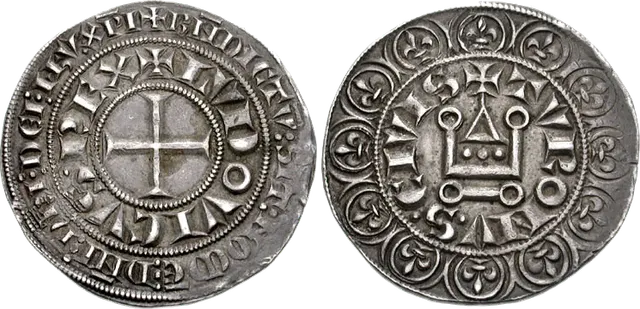
The name spread with the coin: gros in France, groschen in the German lands, groat in English. In 1300 King Wenceslas II of Bohemia began striking the Prague groschen from the silver of Kutná Hora, and it became one of the most widely used coins in central Europe.
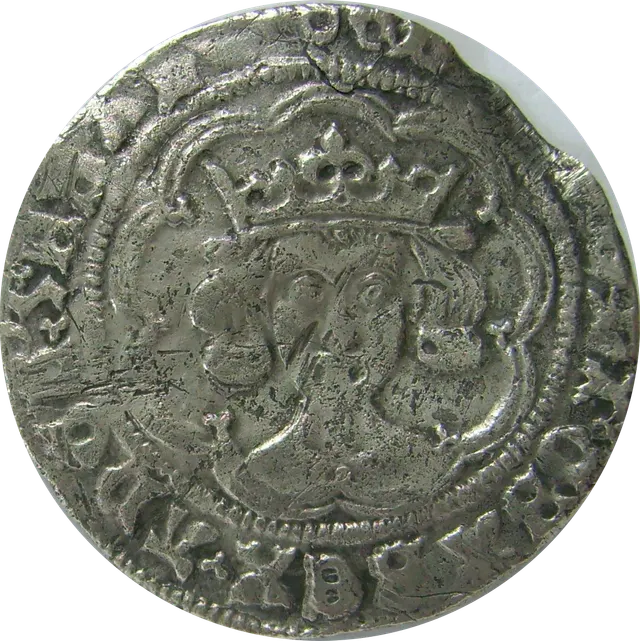
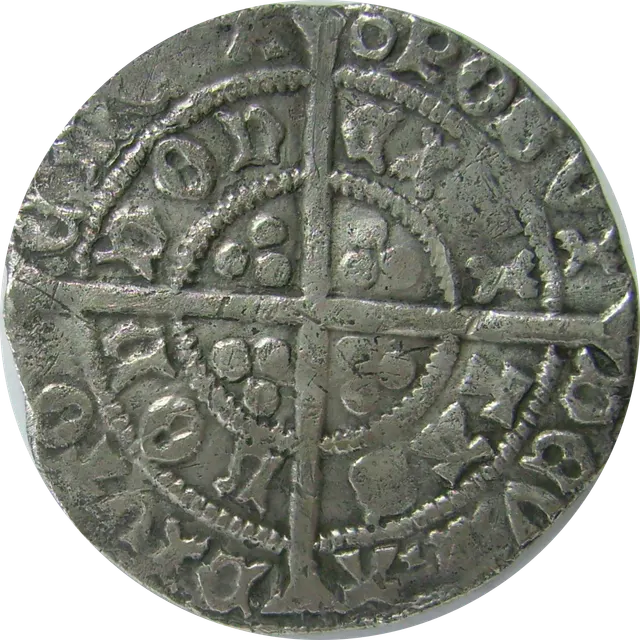
England tried a groat worth four pence in Edward I's 1279 recoinage, but it didn't catch on. Edward III brought it back in 1351, along with a half-groat, and this time it stuck. Groats were made in England for centuries afterwards.
Bracteates: pennies as thin as foil
While England and France made sturdy pennies, much of Germany and central Europe went the other way. From the early 1100s, mints in Thuringia and Saxony began striking bracteates (from the Latin bractea, a thin sheet of metal).
A bracteate is a silver penny hammered so thin, often 0.05 to 0.2 mm, that it could only take a design on one side. The die pressed the image into the foil from the front, and the back shows the same picture in reverse. Some early ones were as wide as 50 mm.
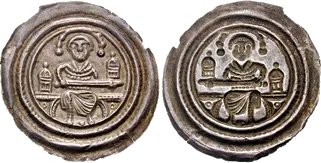
Bracteates were fragile, and that suited the people who issued them. Many lords recalled their coins once or twice a year in a practice called renovatio monetae. Holders had to swap old pennies for new ones, often getting three new coins for every four old. Coins that wore out fast and lost value at every recall were spent quickly, not saved.
Collectors know of more than 10,000 different bracteate types from hundreds of issuers, and some places kept striking them into the 1600s.
What came after the penny
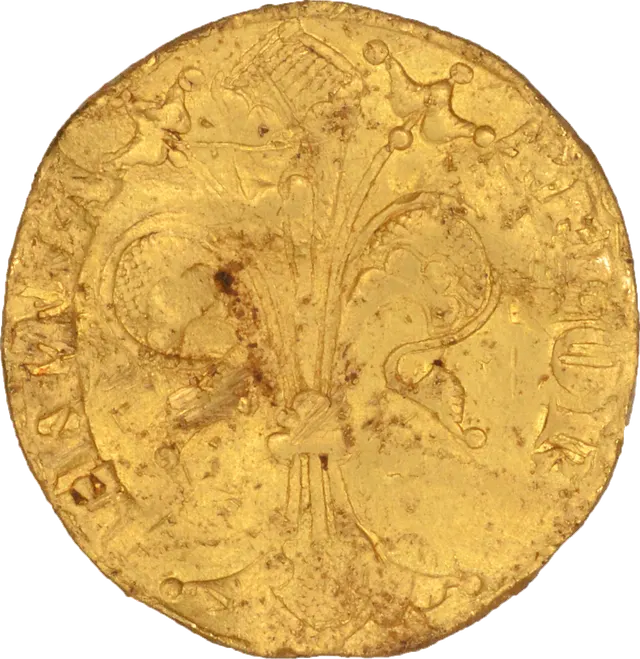
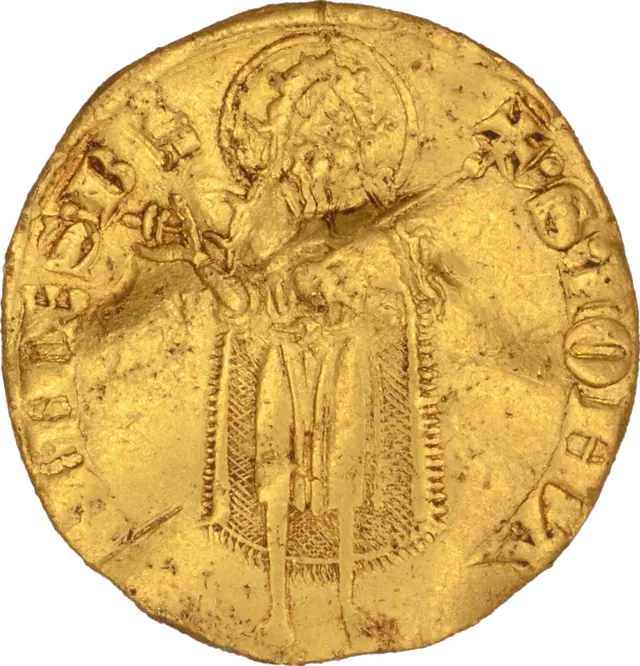
By the late Middle Ages the single-penny system was breaking up. Italian cities went back to gold with the florin and the ducat in the 1250s and 1280s. From 1486, the large silver guldengroschen led to the thaler, the coin that gave the dollar its name.
The penny itself never went away. It survived the move to machine-struck coins, crossed the Atlantic, and is still in pockets today. Read The History of the Penny for its story in America.
Flip the coins in this story
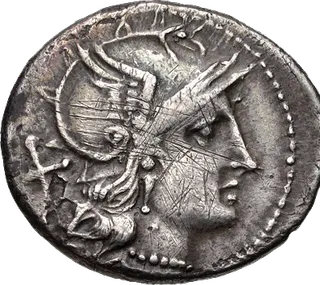
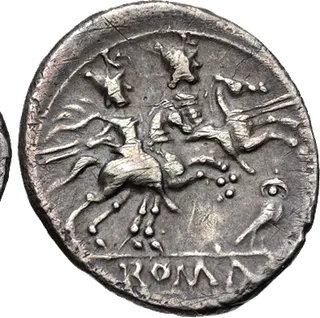
Flip an English silver penny, compare it with its Roman ancestor the denarius, or look at the gold florin that came after it. Or head back to the coin flipper and toss a modern cent.
Keep reading in the Medieval series: Byzantine Coins: The Solidus That Lasted 700 Years · The Florin and the Ducat · All Medieval articles
Questions people ask
What coins were used in medieval Europe?
For most of the Middle Ages, the silver penny (denier, denaro, pfennig) was the main coin from England to Italy. From the 1200s, bigger silver coins such as the Venetian grosso, the French gros tournois and the English groat joined it, and Italian gold florins and ducats were used for large payments.
How much was a medieval penny worth?
It varied by time and place, but a penny was real money: around 1300 an English laborer might earn a penny or two a day. That is why pennies were often cut into halves and quarters for small purchases.
What is a groat?
A groat is a silver coin worth four pence. Edward I tried one in 1279; Edward III reintroduced it in 1351, and it lasted. The name comes from the Latin grossus, "thick," the same root as the Venetian grosso and the French gros.
What is a bracteate coin?
A bracteate is a silver penny struck so thin that the design shows on one side and appears in reverse on the other. They were made mainly in Germany and central Europe from the early 1100s, and many were recalled and reissued once or twice a year.
Why did the Long Cross penny have a long cross?
To stop clipping. On Henry III's Long Cross penny of 1247 the cross runs to the edge of the coin, so anyone could see if silver had been shaved off the rim.
Sources
- American Numismatic Society, Silver denier of Charlemagne, Arles, 793–812, object 1961.100.1
- Fitzwilliam Museum, Denier of Charlemagne, Pavia, 793–812, CM.PG.1591-2006
- Royal Mint Museum, "Penny" (Curator's Corner)
- CoinWeek, "What Is a Bracteate? A Brief Explanation"
- CoinWeek, "'Gross' Medieval European Coins"
- Roger Svensson, Renovatio Monetae: Bracteates and Coinage Policies in Medieval Europe (Spink, 2013)
- Peter Spufford, Money and Its Use in Medieval Europe (Cambridge University Press, 1988)