Byzantine Coins: The Solidus That Lasted 700 Years
Part 16 of the Medieval money series7 min read
For 700 years the Byzantine gold solidus barely changed. How it became the dollar of the Middle Ages, what the M on a follis means, and how the gold ran out.
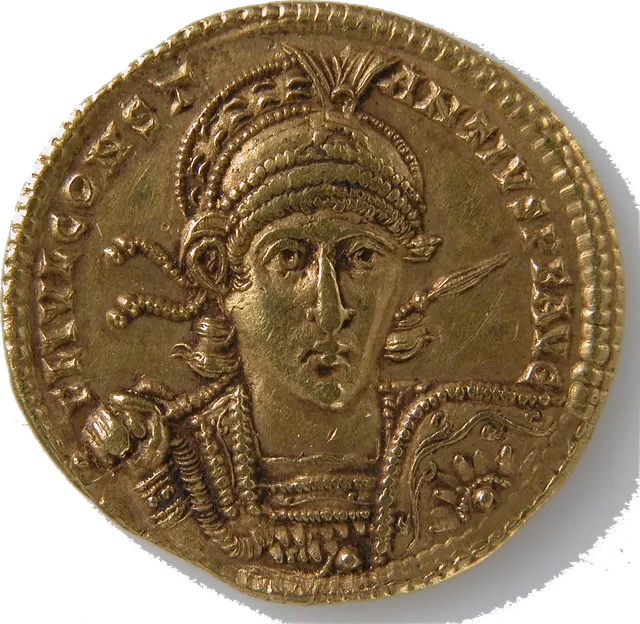
In the year 1000, a merchant in London, a banker in Cairo and a trader in a Sri Lankan port could all have recognised the same gold coin. It was small, a little smaller than a US nickel, and it weighed about 4.5 grams. On one side was a Roman emperor. Westerners called it a bezant. The Greeks who struck it called it a nomisma, and its Latin name was the solidus.
The solidus was first struck under Constantine the Great around 309, and for roughly 700 years after that its weight and its gold barely moved. The historian Robert Lopez called it "the dollar of the Middle Ages". This is the story of that coin, of the copper change that went with it, and of how it finally came apart.
Where the solidus came from
The Roman Empire of the third century had wrecked its own money. Silver coins had shrunk to bronze with a silver wash, and the gold aureus had lost weight again and again. Constantine fixed the gold first. From about 309 to 310 his mints struck the solidus at 72 to the Roman pound, about 4.5 grams of nearly pure gold.
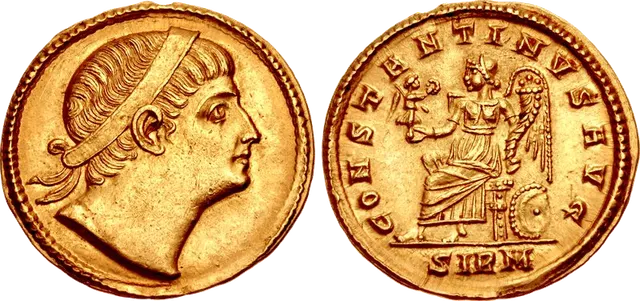
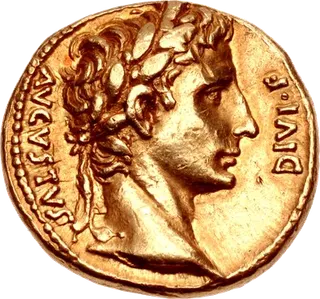
We tell the full story of how Rome got there in Roman gold: the aureus and the solidus. For this story, the important part is that Constantine's successors in the East, ruling from his new city of Constantinople, kept that standard of 72 to the pound.
When "Roman" coins became "Byzantine"
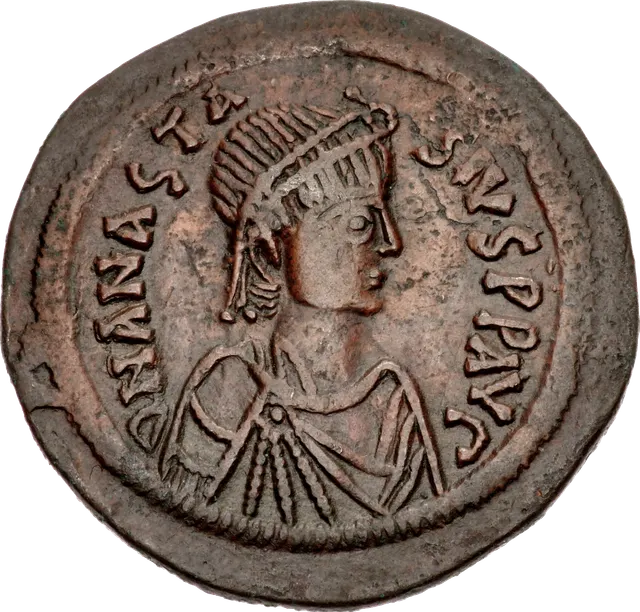
The people we call Byzantines called themselves Romans, and their coins never said otherwise. So where do Byzantine coins start? Most numismatists draw the line at 498, with a reform by the emperor Anastasius I. It didn't touch the gold. It fixed the small change.
Anastasius and the big M
By the late fifth century, everyday money in the Eastern Empire had shrunk to the nummus, a tiny bronze coin often less than a centimetre across. Prices were counted in thousands of them, and paying for anything meant counting out handfuls.
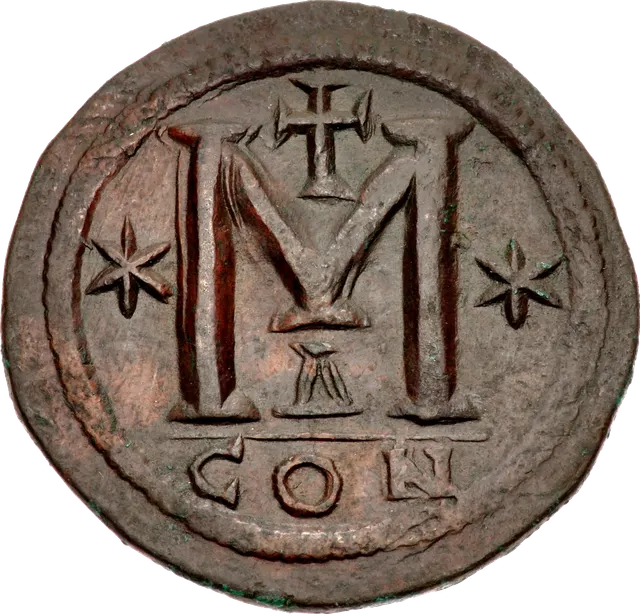
In 498 Anastasius introduced large copper coins with their value written on the back as a Greek numeral. The biggest was the follis, worth 40 nummi and marked with a large M (the Greek numeral for 40). Smaller coins followed the same system:
| Mark | Greek numeral | Value |
|---|---|---|
| M | 40 | Follis (40 nummi) |
| K | 20 | Half follis |
| I | 10 | Decanummium |
| E | 5 | Pentanummium |
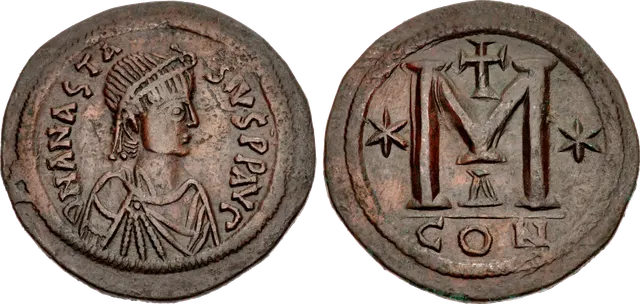
That big M is the easiest way to recognise a Byzantine coin today. Under it you'll often find a mint name, like CON for Constantinople, NIKO for Nicomedia or ANTX for Antioch. Next to it is a letter (A, B, Γ, Δ, E) for the workshop, or officina, inside the mint.
Justinian's giant coins and dated money
Justinian I, who reigned from 527 to 565, is remembered for the Hagia Sophia and his law code. He also changed the follis. In his twelfth year, 538 to 539, the follis grew to about 40 mm across, roughly the size of a modern silver dollar. The emperor's portrait turned to face the viewer, holding a globe topped by a cross.
Justinian also put dates on his coins. The reverse of the new follis carries the word ANNO and his regnal year in Roman numerals: XII, XIII and so on. This followed his decree of the same year that official documents should be dated by the emperor's regnal year. Because of it, many Byzantine bronzes can be dated to a single year, which is rare for coins this old.
The giant follis didn't last. Within a few years it began to shrink again, and later emperors let it drift steadily smaller.
The gold that everyone wanted
While the copper changed with every reign, the gold stayed the same. A solidus struck under Justinian in the 550s weighed what Constantine's had, and so did one struck under Basil II around 1000.
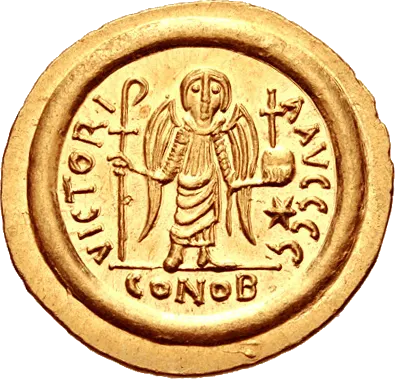
That stability made it the coin that strangers trusted. Around 550, a merchant from Alexandria named Cosmas, nicknamed Indicopleustes ("the Indian sailor"), wrote that all nations carried on their trade in Roman money, "from one extremity of the earth to the other". He also told a story about the king of Taprobane, the old name for Sri Lanka. A Roman merchant and a Persian envoy argued at the king's court about whose emperor was greater. The Roman suggested the king compare their coins. The king looked at the Persian silver drachm and at the Roman gold nomisma, turned them over, and decided in favour of the Romans.
Solidi turn up far from Constantinople. They have been found in Scandinavian hoards and in England, where one, pierced so it could be worn, turned up near Bedale in North Yorkshire. In China, archaeologists have found them in tombs along the Silk Road, along with local copies. In southern India and Sri Lanka, local rulers struck imitations.
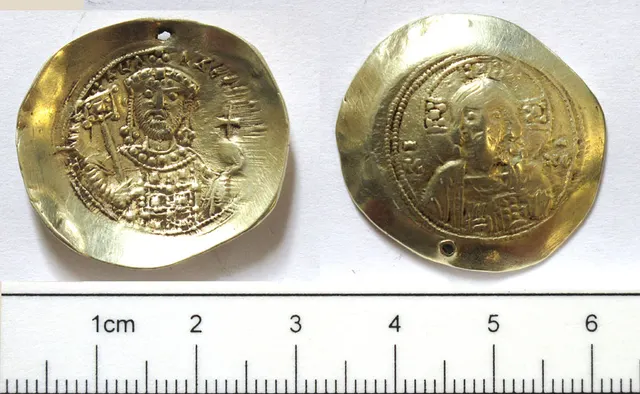
In Western Europe, where kingdoms had mostly given up striking gold, the Byzantine coin was simply the bezant, from Byzantium. Medieval accounts sometimes counted payments in bezants, even in places that had never seen one.
Christ on a coin, and an answer from Damascus
Around 692, Justinian II did something new. He put a bust of Christ on the front of his gold coins and moved his own portrait to the back. The legend calls Christ Rex Regnantium, "King of those who rule". The emperor is described as servus Christi, "servant of Christ". It is the first time Jesus appears as the main image on a coin.
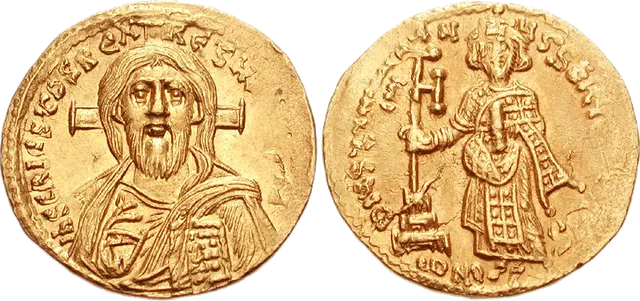
The design landed in the middle of a quarrel with the Umayyad caliph Abd al-Malik, whose lands had until then used Byzantine-style gold. Within a few years the caliphate began striking its own gold dinars. The first showed a standing caliph, and from 696 to 697 they carried only Arabic inscriptions. We follow that story in the Islamic dinar and dirham.
Christ's image vanished from the coins during Iconoclasm, the eighth- and ninth-century campaign against religious images. It came back after 843 and stayed on Byzantine gold to the end.
The slow slide
For about seven centuries, from Constantine to the 1030s, the solidus kept its weight and its fineness. Then, under Michael IV (1034 to 1041), the mint started adding silver.
At first the change was small. Under Constantine IX, in the 1040s and 1050s, the coins were still about 21 carats. Then wars on two fronts, the loss of most of Anatolia after the Battle of Manzikert in 1071, and a run of civil wars drained the treasury. Fineness fell to about 14 carats under Michael VII (1071 to 1078) and 8 carats under Nikephoros III. In the early years of Alexios I Komnenos, some "gold" coins had almost no gold left in them.
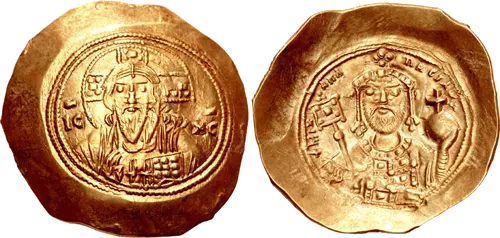
By then the coins looked different too. From the eleventh century many were struck on wide, thin blanks bent into a shallow cup. Collectors call these scyphate coins, from the Greek skyphos, a drinking cup. Nobody is sure why they were made that way. One popular theory is that cups were easier to stack and harder to bend.
(For more on what happens when a state cheapens its money, see coin clipping, debasement and Gresham's law.)
The hyperpyron: a new gold coin
In 1092 Alexios I gave up on repairing the old coin and replaced the whole system. Its new gold coin was the hyperpyron, meaning "highly refined", struck at about 20.5 carats, roughly 85% gold. It was not as pure as the old solidus, but it was honest about what it was, and it held its standard for over a century.
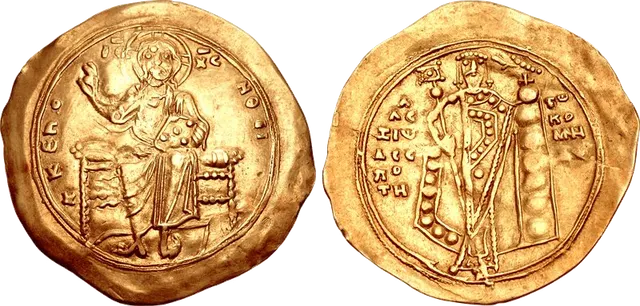
The hyperpyron kept the cup shape and the same weight of about 4.45 grams. Western merchants, especially the Venetians who now ran much of Byzantine trade, still called it a bezant.
After the Fourth Crusade sacked Constantinople in 1204, the hyperpyron slowly lost its gold. By the 1350s the empire stopped striking gold altogether. The hyperpyron lived on only as a unit of account.
The last coins of Byzantium
In its final century, the empire paid its way in a heavy silver coin called the stavraton, first struck around 1367, plus a few small coppers. When Constantinople fell to the Ottomans in 1453, the last emperor, Constantine XI, was striking silver, not gold.
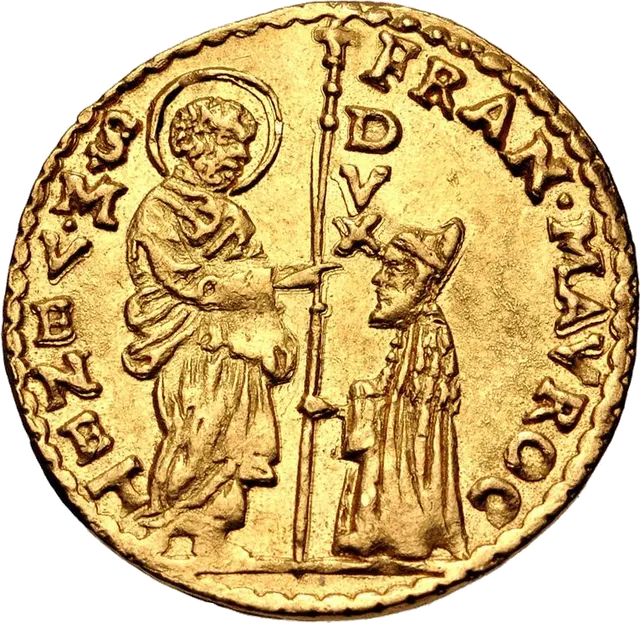
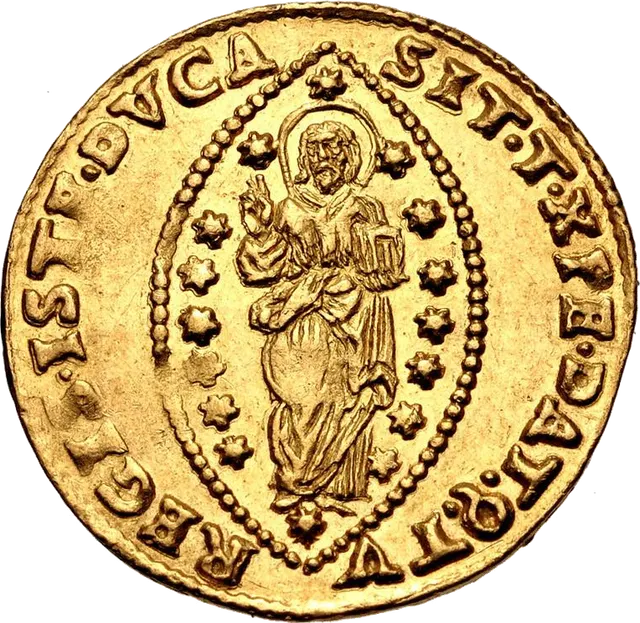
By then the gold role had passed to the Italians. Florence's florin (1252) and Venice's ducat (1284) were the coins that merchants now trusted. The ducat even borrowed the Byzantine habit of putting Christ on the coin. That story is in the florin and the ducat.
How to tell a Byzantine coin
If you have a coin and think it might be Byzantine, check these first:
- A big M, K, I or E on the back. That's a copper denomination from Anastasius onward.
- A facing bust. From Justinian onward, most emperors face you rather than appear in profile.
- Crosses everywhere: on globes, crowns and the reverse.
- Mixed Latin and Greek letters. Early coins use Latin legends, and Greek letters creep in from the seventh century on.
- A cup shape. Concave coins are usually from the eleventh century or later.
Byzantine bronze is among the cheaper ancient and medieval coinage to collect, and you can still buy worn folles of Justinian for the price of a meal. Gold is another matter, and fakes are common. If you are spending real money, buy from a dealer who guarantees authenticity.
Flip a piece of Byzantium
The solidus has its own page in our coin gallery, where you can read its specs and flip it. Or flip a coin of your own on the coin flipper.
Questions people ask
What is a Byzantine gold coin called?
The main Byzantine gold coin was the solidus, which the Greek-speaking Byzantines called the nomisma. Western Europeans called it the bezant. After a reform in 1092 it was replaced by the hyperpyron.
What does the M on a Byzantine coin mean?
The large M is the Greek numeral for 40. It marks a follis, a copper coin worth 40 nummi, introduced by Anastasius I in 498. Smaller coins carry a K (20), I (10) or E (5).
Why was the solidus called the dollar of the Middle Ages?
For about 700 years its weight (72 to the Roman pound, about 4.5 grams) and its gold content barely changed. Traders from England to India accepted it, so it served as an international currency, much as the US dollar does today. The phrase comes from the historian Robert Lopez, writing in 1951.
How do you date a Byzantine coin?
Start with the emperor's name and portrait in the legend. From 538/9 onward, copper folles also carry the word ANNO and the emperor's regnal year in Roman numerals, so many can be dated to a single year. The mint and workshop letters narrow it further.
Are Byzantine coins valuable?
Worn copper folles are common and inexpensive. Gold solidi are much scarcer and sell for far more, and their value depends on the emperor, mint, condition and rarity. Fakes are common, so buy from a dealer who guarantees authenticity.
Sources
- Philip Grierson, Byzantine Coinage (Dumbarton Oaks, 2nd ed. 1999), and Bellinger, Grierson and Hendy, Catalogue of the Byzantine Coins in the Dumbarton Oaks Collection (DOC), vols 1–5. (Anastasius reform, Justinian's dated folles, Christ type, debasement, hyperpyron, stavraton)
- Dumbarton Oaks, "Byzantine Emperors on Coins" online exhibit, solidus of Justinian II, BZC.1948.17.2348 (DOC 2, no. 8a).
- Robert S. Lopez, "The Dollar of the Middle Ages", Journal of Economic History 11.3 (1951), 209–234.
- Cosmas Indicopleustes, Christian Topography, Book 2 (Roman money used in trade everywhere) and Book 11 (Sopatros at the court of Taprobane), trans. J. W. McCrindle (1897).
- NGC Ancients, "A Guide to Denominated Byzantine Bronzes". (M/K/I/E values, 498 reform)
- CoinWeek, "Coins of Justinian the Great". (year-12 reform, ANNO dating, 40 mm follis)
- Lin Ying, "Western Turks and Byzantine gold coins found in China", Transoxiana 6 (2003). (solidi and imitations in Chinese tombs)
- David R. Sear, Byzantine Coins and Their Values (2nd ed., 1987). (Mint and officina marks, types)
- Saint Louis Art Museum, solidus of Justinian II with the bust of Christ, object 55533.
- Portable Antiquities Scheme, find record 388886 (Byzantine histamenon of Michael VII, Bedale, North Yorkshire).