Ancient Chinese Coins: Spades, Knives and Cash
Part 14 of the ancient world series7 min read
Spade money, knife money, then the round coin with a square hole that China cast for 2,000 years. How ancient Chinese coins worked, with photos and a timeline.
Around the time Lydia was stamping its first electrum lumps, China was making money in a completely different way. It didn't strike coins with a hammer. It poured bronze into moulds, and the first shapes it chose were tools: spades and knives.
Over a few centuries those tool shapes shrank and simplified. In 221 BC the first emperor of a unified China swept them all away and made one coin the law of the land: a bronze disc with a square hole in the middle. That basic design stayed in use for more than 2,000 years. You've probably seen one. They still turn up in feng shui shops and old family keepsakes all over the world.
This is the story of how China got from spades to cash.
Before metal: shells
China's earliest money wasn't metal at all. Like many early societies, it used cowrie shells. The shells were small, hard to fake and easy to count, which made them useful for paying and trading. Later, when bronze money appeared, some of it copied the cowrie's shape (more on that below).
Spade money: coins shaped like farm tools
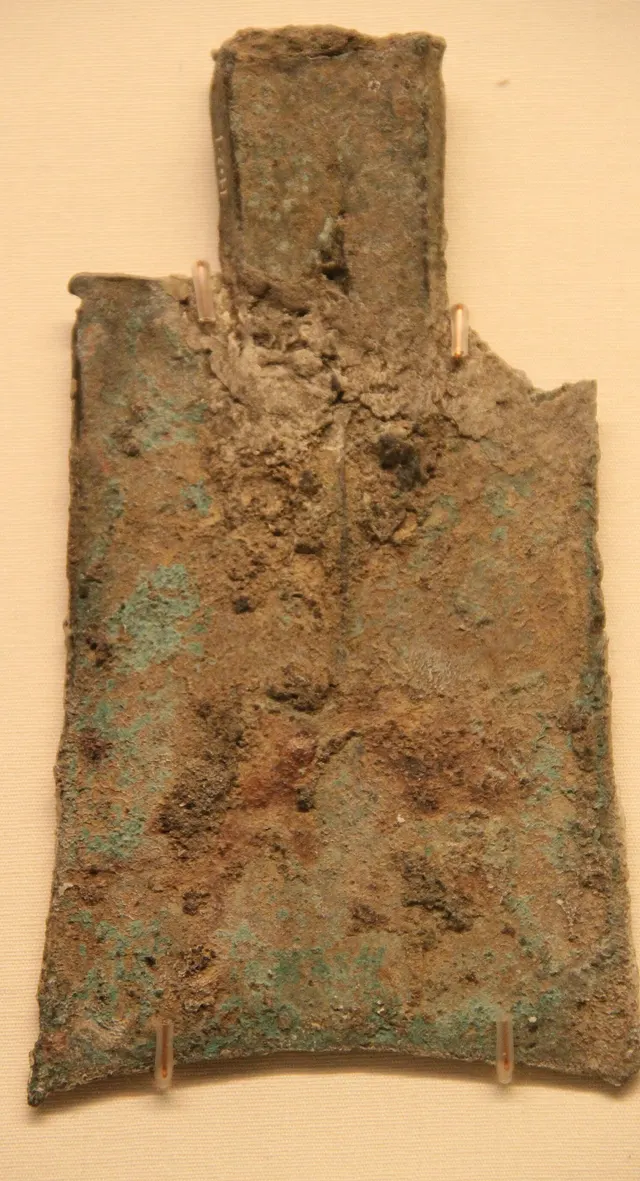
The first Chinese metal coins looked like the spades farmers used in the fields. They're called bu (布) in Chinese, and collectors call them spade money.
The oldest type is the hollow-handled spade. It even kept the hollow socket where a real spade's wooden handle would have slotted in. These were cast in the royal Zhou domain and neighbouring states during the Spring and Autumn period (770 to 476 BC). Archaeological finds suggest they were in use from about the 7th or 6th century BC. That makes them roughly as old as the first coins of Lydia and Greece, though the two traditions grew up independently.
These coins kept the outline of a working tool, but they weren't for digging. They were money.
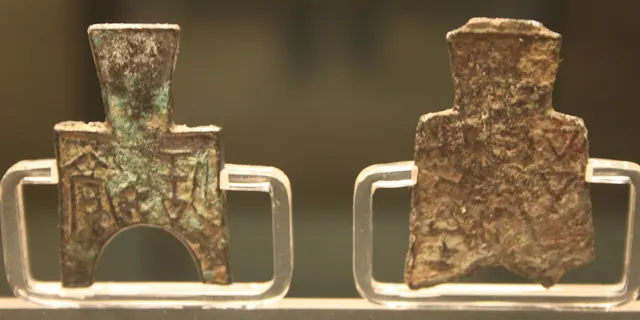
During the Warring States period (475 to 221 BC), spade money got smaller and flatter. The hollow socket disappeared. Different states cast their own styles, and collectors name them by the shape of the "feet" at the bottom: pointed-foot, square-foot and arched-foot spades. Many carry a short inscription with the name of the town that cast them, or a weight. The state of Wei, for example, cast spades marked as half a jin.
Knife money: the coins of the north and east
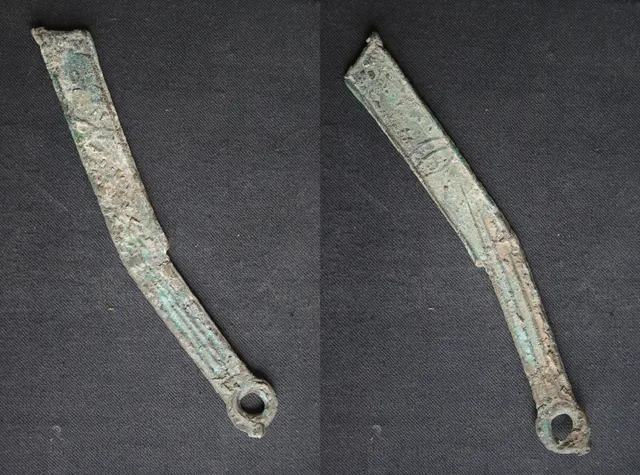
In the northern and eastern states, people used a different tool as their model: the small bronze knife. Knife money, called dao (刀), kept a real knife's features. There's a curved blade, raised ridges along the handle, and a ring at the end.
Three states are most closely linked with knife money:
- Qi, on the east coast (modern Shandong), cast large, heavy knives with inscriptions.
- Yan, in the far north-east (around modern Beijing), cast huge numbers of slimmer knives marked with a character usually read as ming (明). Collectors call them "ming knives", and they're the knife money you're most likely to see for sale today.
- Zhao used knives alongside its own spade money.
The ring at the end of the handle was practical. Knives could be threaded together on a cord, just as round coins later were.
Ant-nose money: bronze shells from the south
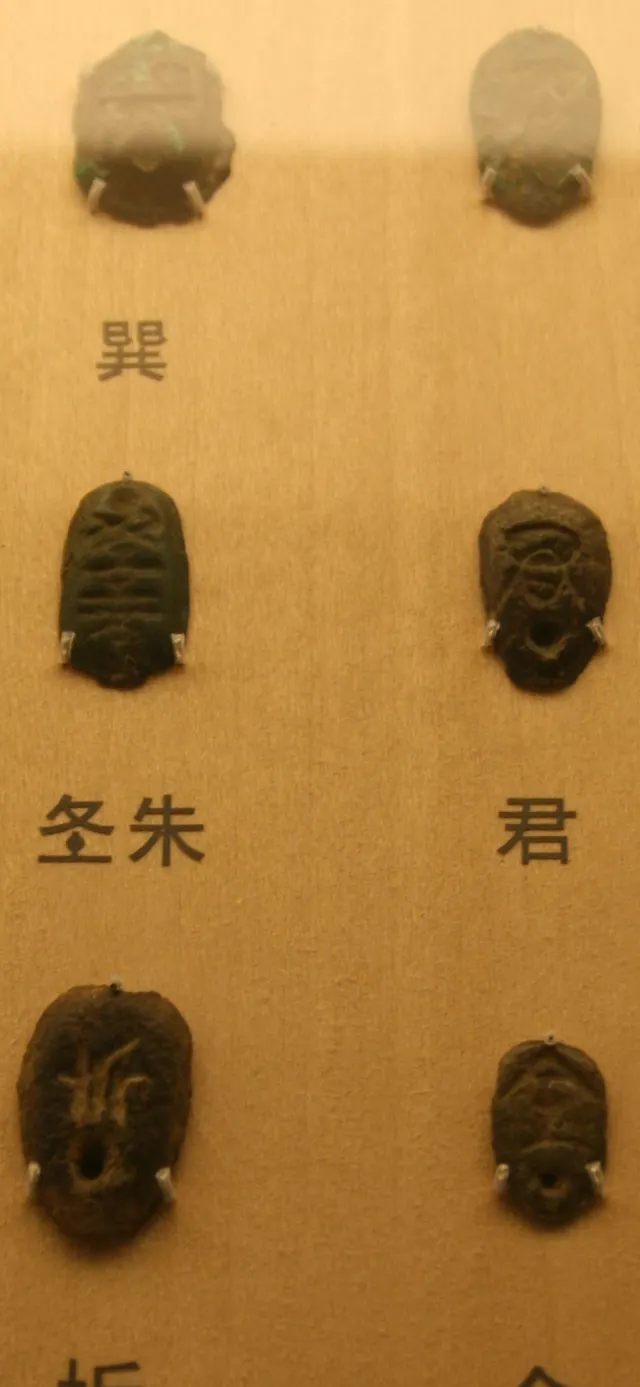
The southern state of Chu went its own way. Instead of spades or knives, it cast small bronze pieces shaped like cowrie shells. Their raised inscriptions can look like a little face, which led to the nicknames "ant-nose money" and "ghost-face money" (yibi qian in Chinese). It's a neat link back to China's shell money.
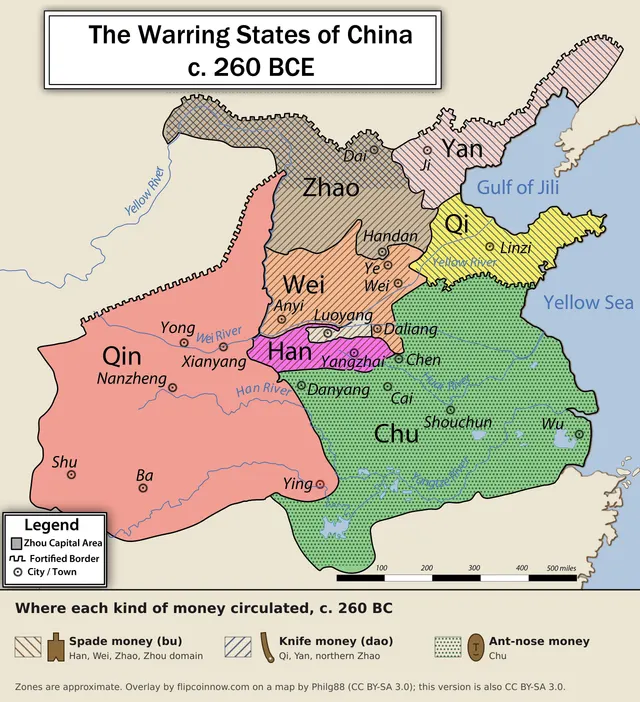
So by the 3rd century BC, China had several currency zones. Spades circulated mainly in the central plains, knives in the north and east, and ant-nose money in the south. Some states had also started casting round coins with a round hole in the middle. A merchant crossing the region dealt with a patchwork of shapes, weights and inscriptions.
Cast, not struck
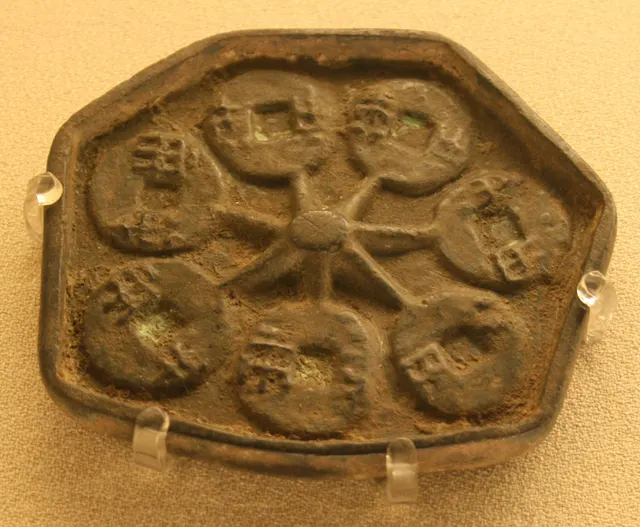
This is the biggest technical difference between Chinese coins and those of the Mediterranean. Greek and Roman coins were struck: a blank of metal was placed between two engraved dies and hit with a hammer (we explain how in How the First Coins Were Made).
Chinese coins were cast. Workers carved a pattern into a mould of stone, clay or bronze, poured in molten bronze, and broke the coins off once the metal had cooled. One mould could produce many coins at once, which made it practical to turn out coins in huge numbers. China cast its everyday coins this way for more than 2,000 years.
The first emperor's coin: the Qin ban liang
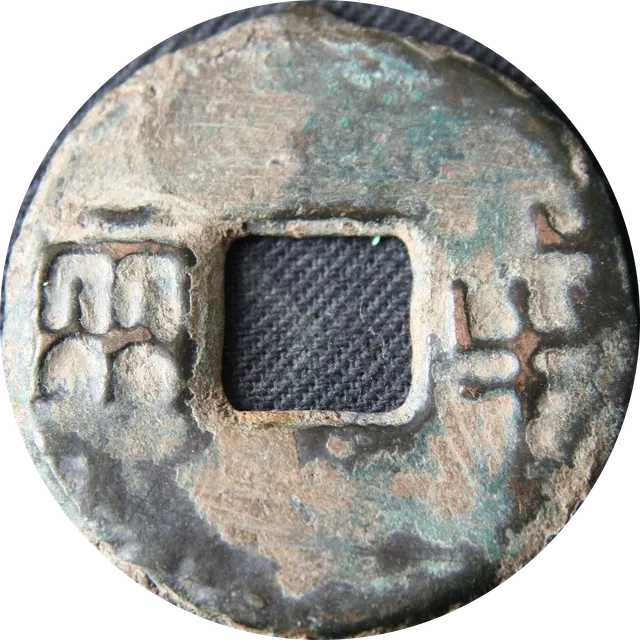
The state of Qin, in the west, had been casting its own round coins with a square hole for decades before it conquered its rivals. The Records of the Grand Historian suggests Qin first cast coins in 336 BC. Historians can't confirm that exact year, but Qin coinage was certainly in use by 306 BC.
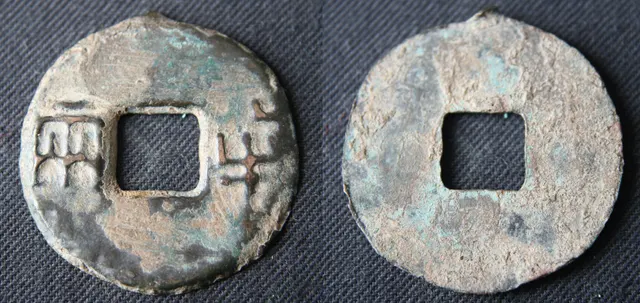
The coin was called the ban liang (半兩), meaning "half a liang". The liang was a unit of weight, so the name told you how much bronze the coin was supposed to contain: 12 zhu, about 8 grams.
In 221 BC Qin finished conquering the other Warring States, and its king became Qin Shi Huang, the first emperor of China. He standardised writing, weights and measures. He also abolished the spades, knives and ant-nose money of the defeated states. The ban liang became the single legal coin of the empire.
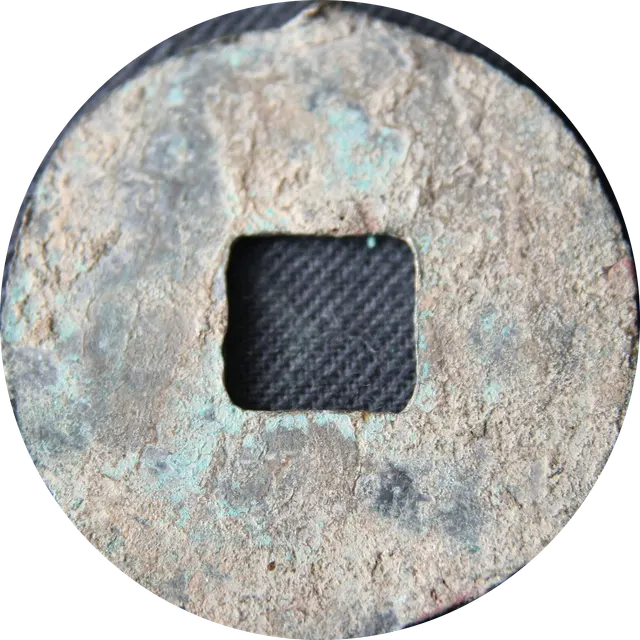
In practice, ban liang coins varied a lot in size and weight. Our hero coin is about 30 mm across. Plenty of others are noticeably smaller and lighter. But the shape was now fixed. Round coin, square hole, inscription on one side, plain on the other: that template stayed in use until the 20th century.
Why the square hole?
There are two answers, a practical one and a symbolic one.
The practical one is that the hole let people string coins on a cord. In an age before pockets, that was the easiest way to store them, count them and carry them.
The symbolic one comes from Chinese tradition. The round coin stands for heaven, and the square hole for earth. Whether the first casters meant it that way or not, the idea stuck, and you'll still hear it wherever cash coins are sold as charms.
The wu zhu: seven centuries of one coin
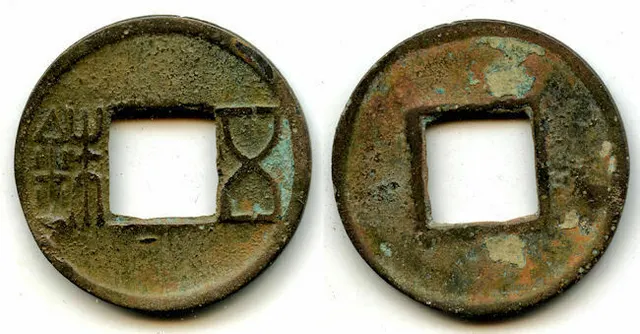
The Han dynasty, which followed the Qin, kept the ban liang for a while. But its weight kept drifting. In 118 BC Emperor Wu of Han replaced it with a new coin: the wu zhu (五銖), or "five zhu", again named for its weight.
The wu zhu was one of the most successful coins ever made. It outlived the Han dynasty, and the wu zhu inscription stayed in use for more than 700 years, until AD 621.
There was one strange interruption. Wang Mang, who seized the throne in AD 9, launched a series of currency reforms that brought back knife and spade shapes alongside new round coins. The system was confusing and unpopular, and it collapsed when he fell in AD 23. The restored Han dynasty went back to the wu zhu.
The Kaiyuan Tongbao: a new model for East Asia
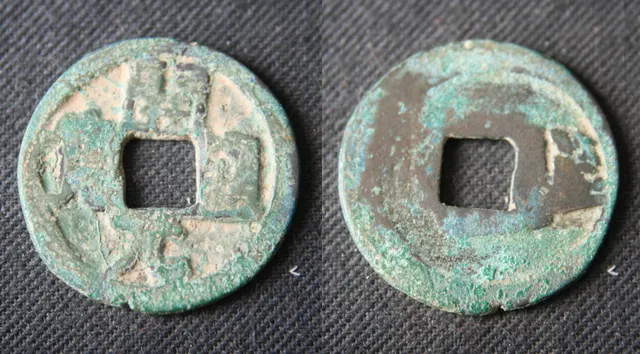
In 621 the Tang dynasty's founder, Emperor Gaozu, retired the wu zhu and cast a new coin, the Kaiyuan Tongbao (開元通寶). Its inscription doesn't describe a weight. Kaiyuan means roughly "inaugurating a new beginning", and tongbao means "circulating treasure".
The new coin had a strict standard: 10 coins had to weigh exactly one liang. The coin was so widely used that its weight became a unit in its own right, the qian (錢), or one tenth of a liang.
The Kaiyuan Tongbao set the pattern for almost every Chinese coin that followed. Most later coins carried four characters around the hole, and most used tongbao or a similar phrase. Over time the inscription usually named the emperor's reign period, which is how collectors date cash coins today.
Billions of coins: the Song dynasty
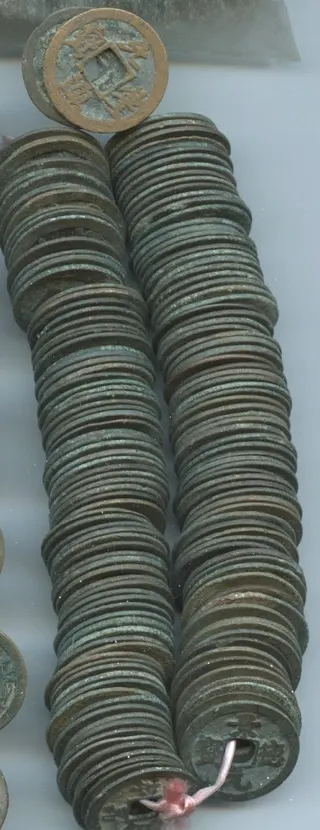
Cash coin production peaked under the Song dynasty. By 1085 the state was casting more than 6 billion coins a year, about ten times the Tang output.
Large payments were counted in strings of coins. A full string nominally held 1,000 cash, which made it heavy and awkward to carry any distance. That weight problem is one reason why, in the 1020s, the Song government started issuing the world's first state paper money.
How cash coins spread across East Asia
The round coin with a square hole didn't stay in China. Japan, Korea, Vietnam and the Ryukyu Kingdom all cast their own versions, often copying Chinese inscriptions and standards. Chinese coins themselves travelled along trade routes and turned up in hoards far from home. We follow the Japanese side of the story in Coins of Medieval Japan.
Why we call them "cash"
When Portuguese traders reached Asia, they used the word caixa for small local coins. It came from the Tamil kāsu, a South Indian coin, which in turn came from the Sanskrit karsha, a weight unit. English traders turned caixa into "cash", and the name stuck to the Chinese coins.
It's a coincidence that it sounds like the ordinary English word "cash", meaning money in hand. That word came from the French caisse, a money box.
The end of the cash coin
China cast its last cash coins in 1912, the first year of the Republic, at Dongchuan in Yunnan. By then machine-struck coins without holes were taking over. Vietnam kept going a little longer. The Bảo Đại Thông Bảo, cast under Vietnam's last emperor, is usually counted as the last cash coin made anywhere, with production ending in 1945.
That's more than 2,000 years from the Qin ban liang. If you'd like to feel the shape for yourself, flip a Chinese cash coin on our coin page, or try the coin flipper.
Keep reading
- Part of the Ancient world series. Previous: Celtic Coins: Horses, Faces and Abstract Art. Next: Punch-Marked Coins of Ancient India.
- The First Coins Ever Made: Lydia's Electrum Lion, the Western tradition that started at about the same time
- Ancient Greek Coins: Owls, Turtles and Tetradrachms
- Sycee and Chinese Silver, what China used for big payments when strings of cash got too heavy
- The Most Circulated Coins in Every Era of History
Questions people ask
What is the oldest Chinese coin?
The oldest Chinese metal coins are hollow-handled spade coins, cast in the shape of a farmer's spade during the Spring and Autumn period (770 to 476 BC). They date from around the 7th or 6th century BC, about the same time as the first coins of Lydia. Before metal coins, China used cowrie shells as money.
Why do Chinese coins have a square hole?
The hole let people string coins on a cord, which was the easiest way to carry, store and count them. Chinese tradition also gives it a symbolic meaning: the round coin stands for heaven and the square hole for earth.
What is a cash coin?
"Cash" is the English name for the round, cast bronze coins with a square hole that China used from the Qin ban liang (made the single legal coin in 221 BC) until 1912. Japan, Korea and Vietnam cast their own versions. The word comes from the Portuguese caixa, borrowed from the Tamil kāsu.
What were spade money and knife money?
They were early Chinese bronze coins cast in the shape of tools. Spade money (bu) copied farming spades and circulated mainly in the central plains. Knife money (dao) copied small knives and was used in the northern and eastern states of Qi, Yan and Zhao. The Qin abolished both in 221 BC.
How long were Chinese cash coins used?
For more than 2,000 years. The design was fixed by the Qin dynasty in 221 BC, China cast its last cash coins in 1912, and Vietnam cast its last in 1945.
Sources
- American Numismatic Society, "Cash and Carry" (Pocket Change)
- American Numismatic Society, "Ancient and Medieval East and South Asia" exhibit
- Asia for Educators, Columbia University, "Song Dynasty: Money"
- Gary Ashkenazy, "Chinese Coins", Primaltrek
- MoneyMuseum (Zurich), "The History of Coins in China"
- David Hartill, Cast Chinese Coins, 2nd edition (New Generation Publishing, 2017)
- Wikipedia: "Spade money", "Banliang", "Wu Zhu", "Kaiyuan Tongbao", "Cash (Chinese coin)", "Vietnamese cash" (used to cross-check dates, not as the only source for any claim)