Tap the coin to flip it
The Daric: Gold Coin of the Persian Empire
Achaemenid Persian EmpireDaricc. 500 BC to c. 330 BC
- Issuer
- Achaemenid Persian Empire (the Great King)
- Denomination
- Daric; 1 daric = 20 sigloi
- Years minted
- c. 500 BC to c. 330 BC
- Metal
- Gold, about 95–98% pure
- Weight
- About 8.35–8.4 g
- Diameter
- About 14–17 mm (thick, dumpy flan)
- Front
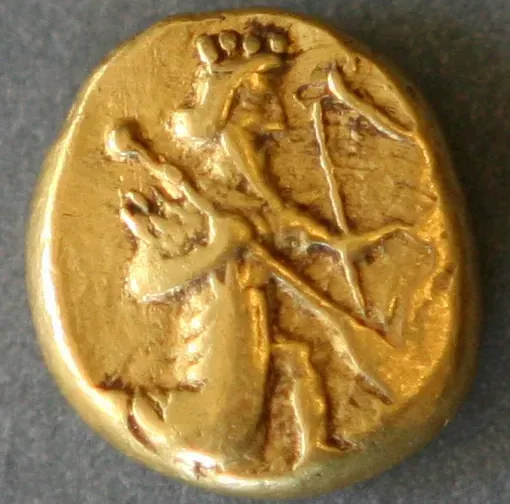
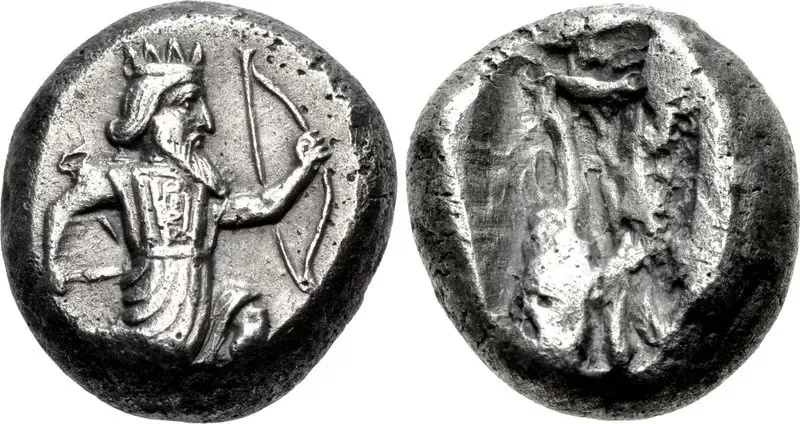
- Crowned king or royal hero with a bow, half-length (Type II) or running/kneeling (Types III–IV)
- Back
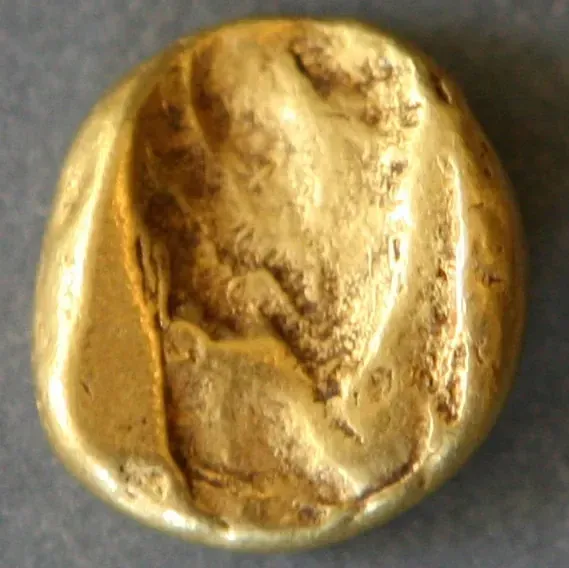
- Oblong incuse punch, no design
- Main mint
- Sardis
In the hand
The story of the Daric
The daric was the gold coin of the Achaemenid Persian Empire, the empire of Darius, Xerxes and their successors. It was struck from around 500 BC until Alexander the Great brought the empire down in the 330s BC. For most of those two centuries it was the best-known gold coin in the eastern Mediterranean.
It's a small, chunky coin. A daric weighs about 8.4 grams of almost pure gold and is roughly 14 to 17 mm across. On the front a crowned figure, the Great King or a royal hero, runs or kneels with a bow. The back has no picture at all, only a rough oblong dent left by the punch. There's no inscription, no date and no ruler's name.
Persia didn't invent coinage. It inherited it. When Cyrus the Great took Sardis from King Croesus of Lydia, around 547 BC, the Persians kept the Lydian mint running and went on striking Croesus' lion-and-bull coins for a while. Later, probably under Darius I, the royal archer took the lion's place.
Numismatists sort the archer coins into four types. Type I shows the king from the waist up holding a bow, and was struck only in silver. Type II shows him drawing the bow, and this is where the gold daric begins. Types III and IV show him running or kneeling, with a spear or a dagger as well as the bow. A seal impression on a Persepolis tablet dated 500/499 BC copies a Type II coin, which helps date the start.
Sardis, in western Anatolia, was the main mint. Coins mostly circulated in the western provinces and among the Greeks. In the Persian heartland, people still paid each other in weighed silver for a long time.
The Greeks called the coin dareikos and linked the name to Darius. Some scholars think it comes from an Old Persian word for gold instead. Its silver partner was the siglos, of about 5.4 grams, and twenty sigloi made one daric.
Darics paid soldiers and bought friends. Xenophon says Cyrus the Younger promised his Greek mercenaries a daric a month, and raised it to a daric and a half when they grumbled. Persian gold also flowed to Greek cities whenever the king wanted Greeks fighting each other. Plutarch says the Spartan king Agesilaus complained he'd been driven out of Asia by "ten thousand archers". He meant ten thousand darics, sent to stir up war against Sparta at home.
After Alexander captured the Persian treasuries, his own gold staters took over, and most darics went back into the melting pot. The story of Persian money, from Croesus to Alexander, is in the history article linked below.
Questions people ask
What is a daric?
The daric was the gold coin of the Persian Empire, struck from about 500 BC to 330 BC. It weighs about 8.4 g and shows the Persian king as an archer.
How much was a daric worth?
Twenty silver sigloi. Xenophon says it was a month's pay for a Greek mercenary in 401 BC.
Who is shown on a daric?
A crowned figure with a bow, usually read as the Persian Great King or an idealised royal hero rather than a portrait of one particular king.
Why is the back of a daric blank?
Early coins were struck with a punch on top of the blank, which left an oblong dent rather than a design. Persia kept that style for its whole coinage.