Sycee and Chinese Silver
Part 21 of the Medieval money series6 min read
For 800 years China paid its big bills in silver ingots weighed in taels. What a sycee is, how it was cast and tested, and how Spanish dollars changed it.
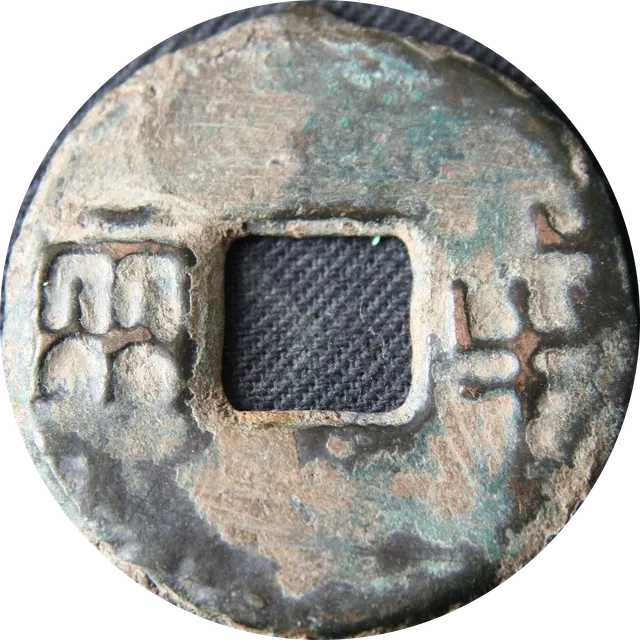
For most of its history, China's everyday money was the bronze cash coin, round with a square hole. But you couldn't buy a house or pay a province's taxes with strings of bronze. For big sums, China used silver, and for more than 800 years that silver didn't come as coins at all. It came as lumps of metal, mostly cast by private silversmiths, stamped with their names and weighed out on a scale.
Western merchants called these ingots sycee. Their weight was counted in taels, and the system only ended in 1933.
Why China weighed its silver
Chinese coins were almost always cast bronze. Silver had been used in payments since the Han dynasty, but it only became common after about 1100, under the Song. From then on, the rule was simple: silver was worth what it weighed, adjusted for how pure it was.
The unit of weight was the liang, which foreign traders called the tael. A tael was roughly 37 grams, a little over an ounce, though the exact figure changed from city to city. It divided into 10 qian (mace) and 100 fen (candareens).
So a sycee wasn't a coin with a face value. It was a known lump of silver. When it changed hands, someone weighed it and checked its quality, and the deal was priced from there.
Song silversmiths and their stamps
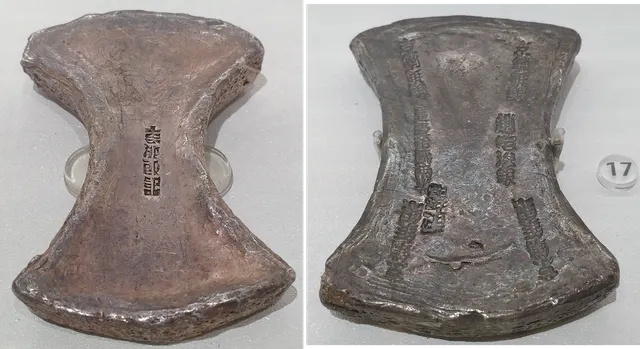
The earliest ingots that survive in numbers come from the Song dynasty (960 to 1279). Most are flat slabs with a narrow waist and flared ends, a shape a little like a bow tie.
They carry stamped or engraved marks. A 5-tael Southern Song ingot now in the National Museum of History in Taipei has just one stamp in the centre: the name of the shop that made it, "Li Na Lang Ji." A larger 12½-tael ingot in the same museum has six inscriptions. They say it was refined in the capital, Lin'an (today's Hangzhou), give its weight, and name the exchange shop that vouched for its purity.
That mix of maker, place, weight and grade stayed on Chinese silver ingots for the rest of their history.
The Mongols and the 50-tael yuanbao
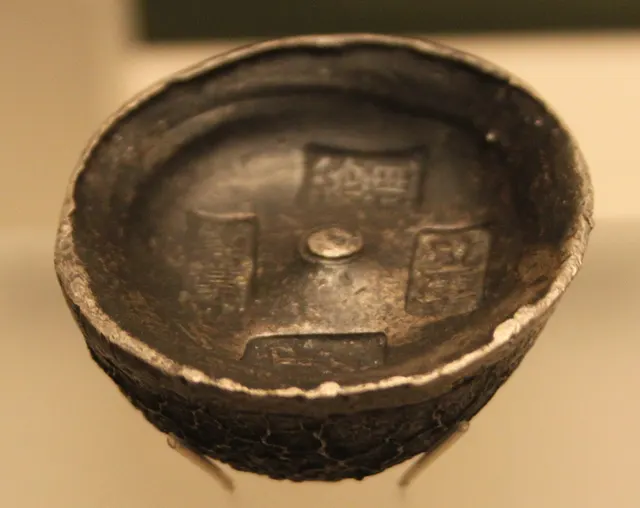
Under the Mongol Yuan dynasty (1279 to 1368), silver became even more important than copper cash. The state cast silver into heavy ingots of 50 taels, close to 2 kilograms each.
One of them, now in the Shanghai Museum, was cast at Yangzhou in 1277. Its inscription lists the officials in charge: the man who melted the silver, the man who weighed and checked it, the treasury officer and the caster. These big ingots were called yuanbao. The name is often read as "Yuan treasure," though the word itself may go back to inscriptions on Tang-dynasty coins. Either way, "yuanbao" became the everyday word for a large boat-shaped ingot, and it still is.
The Ming switch to silver
The first Ming emperor tried to replace silver with paper money in 1375. The notes lost value fast, and by the early 1400s the government had given up on them and silver had taken their place.
By the late 1500s silver was everywhere. One estimate has more than 90 percent of market transactions in 1570 settled in silver. In 1581 the grand secretary Zhang Juzheng pushed the "Single Whip" reform across the empire. It rolled many land taxes and labour duties into one payment, made in silver.
That created a problem. China's own mines couldn't supply that much silver, so the country began pulling it in from abroad.
Where China's silver came from
Some came from Japan, whose mines were booming in the 1500s. Much more came from the Americas.
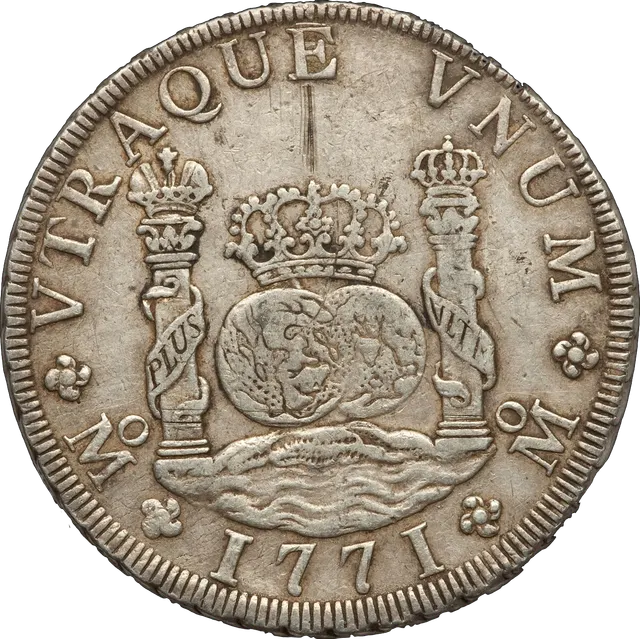
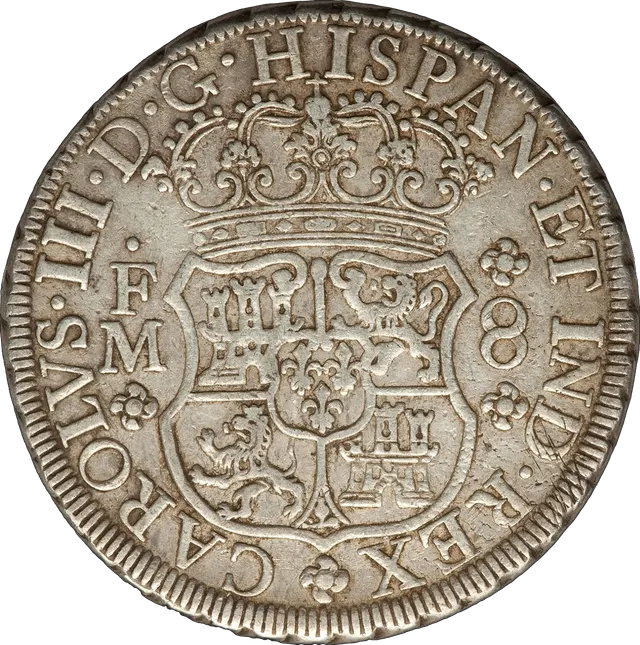
Spain founded Manila in 1571, and its galleons began carrying silver from Acapulco across the Pacific. The silver was mined in Potosí and Mexico and minted into 8-real coins, the pieces of eight. Chinese merchants in Manila traded silk and porcelain for them.
The deal made sense because silver was worth roughly twice as much in China as it was in Europe. Historians argue over the numbers, but a common estimate is that a third or more of all the silver mined in the Americas ended up in China.
Testing and stamping the silver
With so much silver changing hands, the people who tested it mattered. Under the Ming and Qing, most ingots were cast by private silversmiths or banks rather than by an imperial mint, and every region had its own taels and its own standard of purity.
Ingots carried the maker's name, the place, the weight and at least one assayer's stamp. In many towns a public assayer checked the silver and stamped it as tested. A Qing ingot from Yunnan in the China Numismatic Museum carries two such stamps, each with the assayer's surname and the words "inspected and passed."
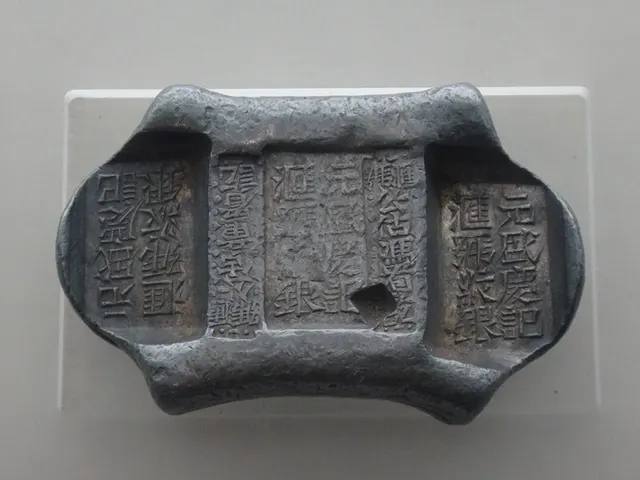
The shapes varied by region too. The classic boat or shoe shape came from the north and east. Sichuan cast round drum-shaped ingots. Yunnan made saddle shapes, and Jiangxi made square ones. Weights of 50, 10, 5 and 1 tael were common, with small pieces and broken scraps of silver for change.
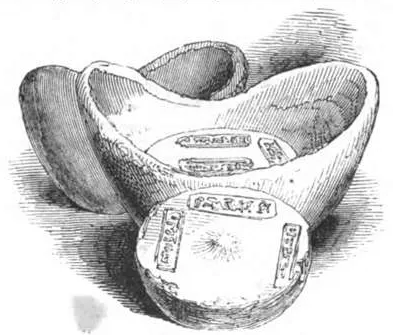
The government kept its own accounts in the Treasury tael (kuping). After 1860 the customs service used the Haikwan tael. Shanghai, Tianjin and Hankou each had their own local tael as well. A merchant moving silver between cities had to convert at every step.
Foreign dollars and chop marks
Foreign coins solved part of that problem. A Spanish dollar had a known weight and fineness, so merchants could count it instead of weighing it. In China it was valued at 7 mace and 2 candareens, or 0.72 of a tael.
Merchants still checked them. A money-changer who tested a coin and found it good would punch it with his own small mark, a chop. Some dollars carry dozens of chops, and heavily chopped coins were sometimes treated as plain silver by weight again.
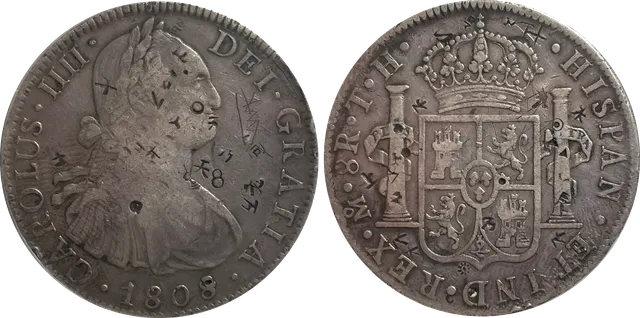
Southern Chinese merchants grew especially fond of the "Carolus" dollars of Charles III and Charles IV. After Mexico became independent in 1821, its new eagle-design pesos slowly took their place. The United States even struck a special trade dollar in 1873 to compete for the China trade.
By the 1830s the flow had turned around. Opium imports were growing, and silver began draining out of China, a crisis that fed into the Opium Wars.
China strikes its own dollars
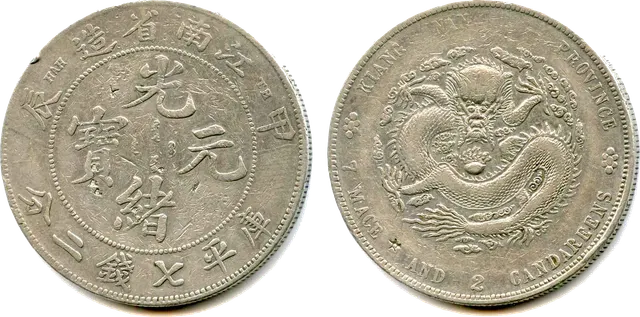
In 1889 a new mint opened in Canton (Guangzhou). It was built with British machinery from the Heaton mint in Birmingham, and at its peak it could run 90 coin presses at once. The viceroy Zhang Zhidong wanted a Chinese coin that could replace foreign dollars.
The result was the dragon dollar. It carried the emperor's reign title on one side and a coiled dragon on the other, and it was struck to the same 7 mace and 2 candareen weight as the Mexican dollar. Other provinces soon opened mints of their own.
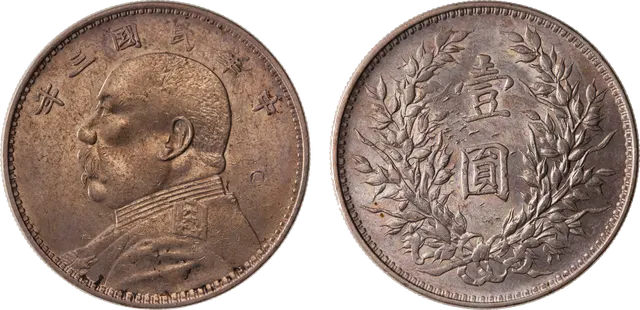
After the 1911 revolution, the Republic of China issued a national silver dollar in 1914 with the portrait of President Yuan Shikai. Collectors nickname it the "Fat Man" dollar. It became the most common silver coin in China.
The end of the tael
In 1933 the Nationalist government abolished the tael as a unit of account and made the silver dollar, the yuan, the national standard. Sycee could no longer be used as money.
The silver dollar didn't last long either. In 1934 the United States began buying silver at high prices, and silver flowed out of China. In November 1935 China left the silver standard for a paper currency, the fabi. After more than 800 years, silver was no longer Chinese money.
The sycee today
The boat shape never went away. Gold and paper yuanbao appear at Chinese New Year as symbols of wealth, and paper ones are burned as offerings to ancestors. Real Qing sycee are popular with collectors, and museums across China display rows of them, each stamped with the name of a shop that closed a century or more ago.
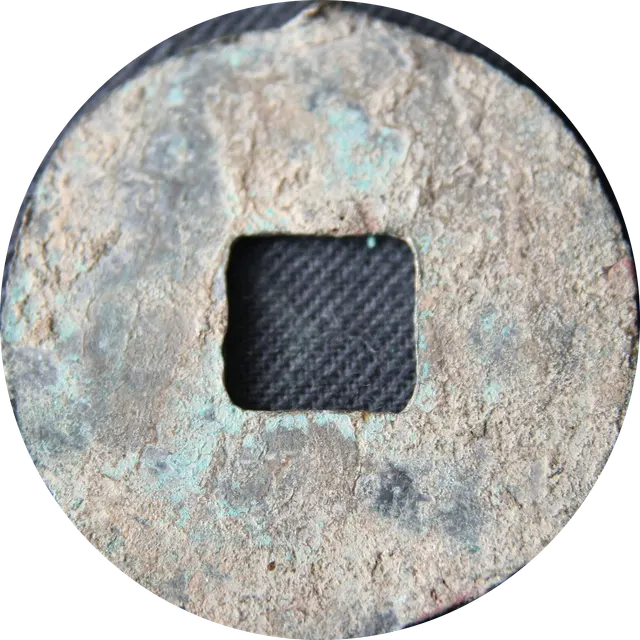
Flip the coins in this story
You can flip a Chinese cash coin, the bronze money that ran alongside sycee, and a Spanish dollar, the coin that carried American silver to China. Or head back to the coin flipper and toss a modern coin.
Keep reading: Ancient Chinese Coins: Spades, Knives and Cash · Pieces of Eight: The Spanish Dollar, First Global Currency · Coins of Medieval Japan: Mon, Koban and Oban · Before Coins: Barter, Cowries and Hacksilver · All Medieval articles
Questions people ask
What is a sycee?
A sycee is a Chinese silver (or occasionally gold) ingot that was used as money by weight. Private silversmiths and banks cast them in shapes such as boats, drums and saddles, and stamped them with the maker's name, the place, the weight and an assayer's mark. They were used for large payments and taxes until 1933.
Where does the word "sycee" come from?
It comes from the Cantonese sai si (細絲), meaning "fine silk." Merchants in Canton used the name for silver of good quality, possibly because of the fine, silky lines on the surface of pure silver as it cools. Western traders wrote it down as "sycee."
How much is a tael?
A tael is a Chinese unit of weight of roughly 37 to 38 grams, a little more than an ounce. The official Qing Treasury tael was about 37.3 grams, and local taels differed slightly. A tael divides into 10 mace or 100 candareens. Hong Kong still uses a tael of about 37.8 grams for gold.
Why is a sycee shaped like a boat?
The boat or shoe shape came from casting molten silver in a mould, and it became the standard form for large ingots in northern and eastern China. Other regions used different shapes, including drums, saddles and squares. The boat shape is the one that became a symbol of wealth, which is why gold-coloured yuanbao appear at Chinese New Year.
When did China stop using silver ingots as money?
In 1933, when the government abolished the tael and adopted the silver dollar (yuan) as the national unit. In 1935 China left the silver standard altogether and switched to paper money.
Sources
- Ulrich Theobald, "Silver Ingots as Money in Premodern China," ChinaKnowledge.de, 2016.
- "Introduction to Sycee," Journal of East Asian Numismatics.
- MoneyMuseum (Sunflower Foundation), "Chinese Silver Ingots."
- Dennis O. Flynn and Arturo Giráldez, "Born with a 'Silver Spoon': The Origin of World Trade in 1571," Journal of World History 6 (1995): 201–221.
- Mark Cartwright, "Ming Taxation & the Silver Economy," World History Encyclopedia.
- Jay Turner, "The 1889 Silver Coins of the Kwangtung Mint, China," CoinWeek.
- CoinWeek, "Chopmarked Coins: A History; the silver coins used in China 1600–1935."
- Museums Victoria, Yuan Shikai dollar, item 72197.
- Richard von Glahn, Fountain of Fortune: Money and Monetary Policy in China, 1000–1700 (University of California Press, 1996).