Bimetallic and High-Security Coins Today
Part 37 of the Modern coins series5 min read
Why money went two-tone: Italy's 1982 500 lire, the toonie, the euro and the 12-sided £1, plus the latent images and hidden tricks that stop forgers.
Look at the change in your pocket in Rome, Paris, London or Toronto and you'll probably find a coin made of two metals: a disc of one colour sitting inside a ring of another. These are bimetallic coins, and since the 1980s they've become the standard way to make a high-value coin hard to fake.
They aren't a new idea. But it took modern presses, cheap counterfeiting and vending machines to make them common.
Two metals, one coin
A bimetallic coin starts life as two separate pieces. The mint punches a ring from one strip of metal and a smaller disc, the core, from another. The core is dropped into the ring and the two are struck together in a single blow.
That blow does two jobs. It stamps the design across both metals, and it squeezes the ring's inner edge into grooves cut into the core's edge, so the pieces lock together and can't twist apart.
The result is hard to copy. A forger has to source two alloys, cut both pieces to tight tolerances and join them so the seam looks right. Two metals also give each coin a distinctive electromagnetic signature, which coin readers in vending machines, parking meters and self-checkouts measure to tell a real coin from a slug.
Early experiments
Roman mints made bimetallic medallions, with a centre of one copper alloy set in a ring of another. These were presentation pieces, not money. A series struck for the emperor Commodus in AD 192 was made to be handed to officials and soldiers on the anniversary of his tribunician power.
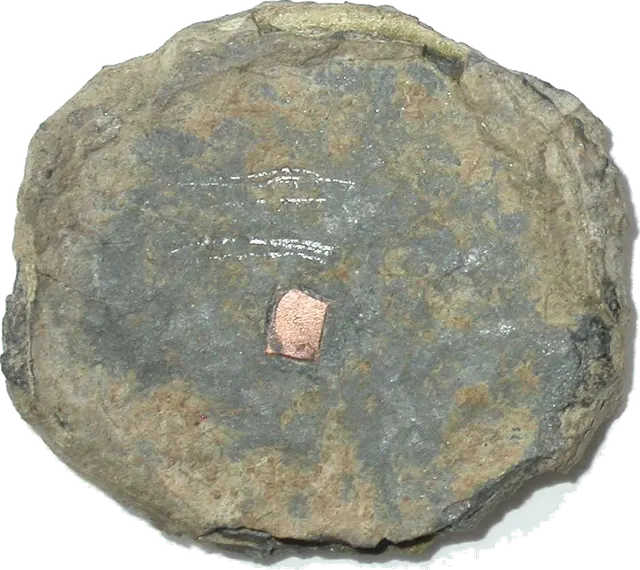
The first two-metal coins meant to circulate came from England. In 1684 Charles II began striking farthings in tin, partly to help Cornwall's struggling tin mines. Tin was cheap, which made the coins tempting to forge, so each one got a small square plug of copper through its centre. The edge carried a Latin motto, NUMMORUM FAMULUS, "the servant of the coinage".
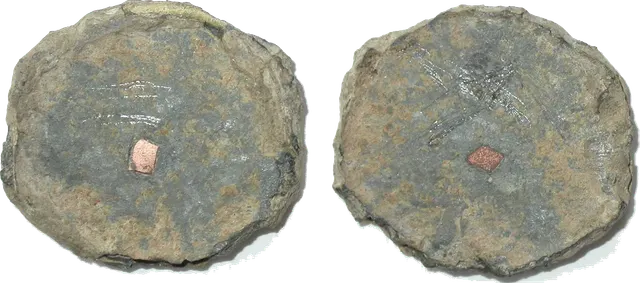
It didn't work. Tin corroded badly, people disliked the coins and forgers copied them anyway. Tin coins stopped after 1692, and England went back to copper in 1694.
Italy's 500 lire, 1982
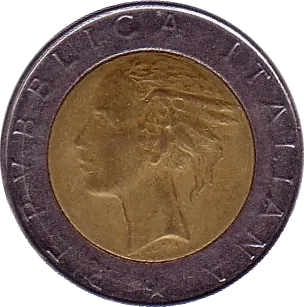
The modern bimetallic coin begins in Rome. In 1982 the Italian mint released a 500 lire coin with a centre of Bronzital, a bronze alloy, inside a ring of Acmonital, a steel alloy. It weighed 6.8 g and was 25.8 mm across.
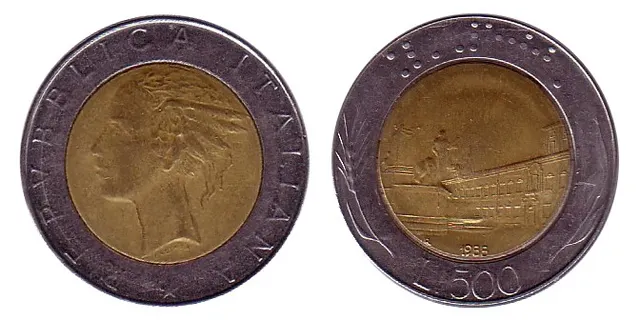
The idea was to protect Italy's highest-value coin from forgers. It was also the first circulating coin with Braille: "L. 500" is raised on the ring above the reverse design, so blind users can read it. The coin was struck until 2001, when the euro arrived.
The idea spreads
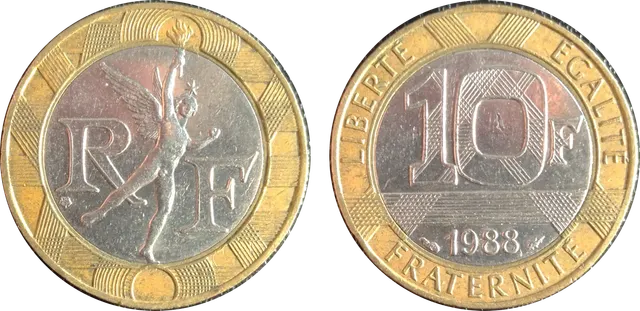
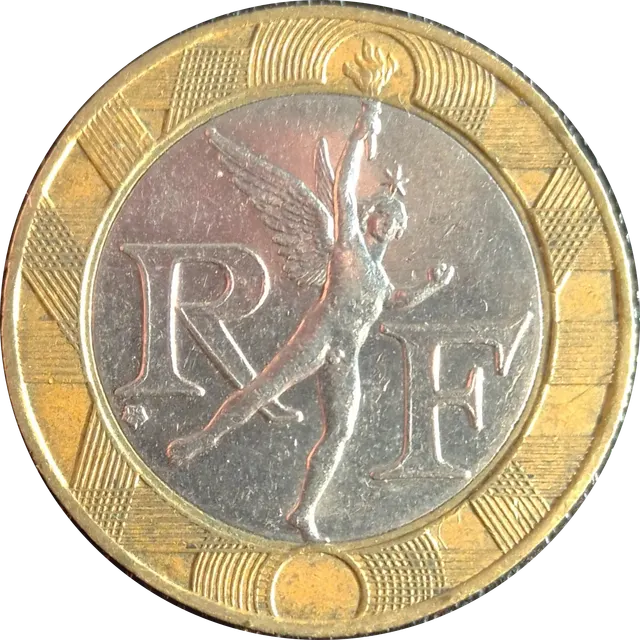
Other countries followed within a few years. France brought out a bimetallic 10 francs in 1988, with the Génie de la Bastille, the winged figure on top of the July Column in Paris. Thailand issued a 10 baht coin the same year, with a cupronickel ring and an aluminium-bronze centre.
Canada's $2 coin went into circulation on 19 February 1996. Brent Townsend's polar bear and the coin's two tones earned it the nickname "toonie". Britain's bimetallic £2, with Bruce Rushin's "Technology" design, was first struck in 1997 and entered circulation on 15 June 1998. Its edge reads STANDING ON THE SHOULDERS OF GIANTS, a line from a letter by Isaac Newton.
The biggest rollout came on 1 January 2002, when the €1 and €2 coins went into circulation across the euro area. They mirror each other. The €2 has a copper-nickel ring around a three-layer core of nickel brass, nickel and nickel brass. The €1 swaps the colours, with a nickel brass ring around a copper-nickel core.
Our article on the euro tells the rest of that story.
America's one bimetallic coin
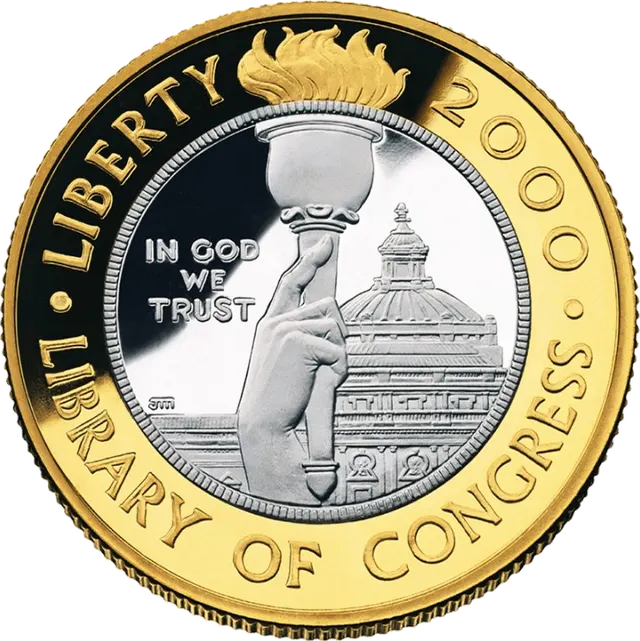
The United States has never put a bimetallic coin into everyday circulation. It has struck exactly one: a $10 commemorative for the Library of Congress bicentennial in 2000.
It's a precious-metal version of the same trick. A gold ring surrounds a platinum core, and both were struck together. The obverse shows the hand of Minerva holding a torch in front of the library's Jefferson Building dome. The reverse has the library's seal inside a laurel wreath.
The Mint sold 27,445 proofs and 7,261 uncirculated coins. It was the first bimetallic coin the US Mint had ever struck. (For more coins like it, see Commemorative Coins.)
The 12-sided £1: "the most secure coin in the world"
By the 2010s, Britain had a counterfeiting problem. The round £1 coin, in use since 1983, was a single brass alloy, and forgers had caught up with it. The Royal Mint estimated that about one in every thirty round pounds in circulation was fake.
Its replacement went into circulation on 28 March 2017. The Royal Mint called it the most secure coin in the world, and it stacked several defences into one small coin:
- Twelve sides. The shape makes it easy to recognise by touch and awkward to copy. It recalls the old twelve-sided threepenny bit.
- Two metals. A gold-coloured nickel-brass ring around a silver-coloured nickel-plated alloy centre.
- A latent image. A small panel that shows a "£" symbol from one angle and the number "1" from another, like a hologram.
- Micro-lettering. Tiny text inside the rim: ONE POUND on the heads side and the year on the tails side.
- iSIS. A hidden feature the Royal Mint has never described in public, which machines can check.
The coin weighs 8.75 g and measures 23.43 mm from point to point. Its first tails design, a rose, leek, thistle and shamrock growing from one stem inside a coronet, was by David Pearce, who won a public design competition at 15.
The round pound stopped being legal tender at 23:59 on 15 October 2017.
Latent images, lasers and plated steel
Britain wasn't the only country upgrading. In 2012 the Royal Canadian Mint redesigned its toonie. The new version added two laser-marked maple leaves on the reverse and a "virtual image" of maple leaves that changes as you tilt the coin. CANADA and 2 DOLLARS are engraved along the edge.
The metals changed too. The ring became steel plated with nickel, and the core aluminium bronze plated with brass. The Mint said the multi-ply plating gives the coin an electromagnetic signature that is harder to counterfeit than a plain alloy.
That's the direction modern coins have taken. The design you see is only part of a coin's security. The rest is in the metals, the edge and features you'd need a loupe or a machine to check.
More on magnifiers: Best Coin Magnifiers and Loupes.
For a coin with no security tricks at all, compare the Krugerrand, whose only defence is the gold inside it. Read how it started a bullion boom in Bullion Coins and the Krugerrand Revolution.
Forgers are as old as coins. See Coin Clipping, Debasement and Gresham's Law for how people cheated the coinage before bimetallic rings, and From Hammer to Machine for how lettered and milled edges began.
Want to see two metals spin? Try the coin flipper.
Questions people ask
What is a bimetallic coin?
A bimetallic coin is made of two different metals, usually a centre disc set inside a ring of another colour. The two pieces are struck together in one blow, which locks them in place. The €2, the British £2 and Canada's toonie are bimetallic.
What was the first bimetallic coin?
Italy's 500 lire of 1982 is generally called the first modern circulating bimetallic coin. Earlier experiments exist: Roman bimetallic medallions, and English tin farthings of 1684–1692 with a copper plug in the centre.
Why are bimetallic coins harder to counterfeit?
A forger has to obtain two alloys, cut a ring and a core precisely and join them cleanly. The two metals also give the coin an electromagnetic signature that vending machines and coin counters check.
Why did Britain replace the round pound?
About one in thirty round £1 coins in circulation was counterfeit. The 12-sided bimetallic £1, released on 28 March 2017, added a latent image, micro-lettering and a hidden security feature called iSIS. The round pound stopped being legal tender on 15 October 2017.
Does the United States have a bimetallic coin?
Not in circulation. The only US bimetallic coin is the 2000 Library of Congress $10 commemorative, a gold ring around a platinum core.
Sources
- The Royal Mint, "The 12-Sided £1 Coin"
- Royal Mint Museum, "Case study: Future-proofing currency"
- NPR, "Britain plans new 12-sided £1 coin to combat counterfeiting" (2014)
- European Central Bank, "Common sides of the euro coins"
- Royal Canadian Mint, "Canada's Two-dollar Circulation Coin Turns 30"
- Canadian Coin News, "OTD: RCM unveils new loonies, toonies"
- US Mint, "Library of Congress Bi-Metallic $10 Coin"
- PCGS CoinFacts, 2000-W $10 Library of Congress Bimetallic
- Chards, "Britannia on British Tin Coins"
- Fleur de Coin, "History of Bimetallic Coins"
- Numismatic Resources, "Italy's Historic 500 Lire Coins Hit the Scene in 1982"
- moneterare.net, "500 Lire bimetallic"
- CNG, Triton XIII lot: Commodus bimetallic medallion, Rome, December AD 192
- Change Checker on the bimetallic £2
- Britannia Coin Company on the bimetallic £2
- Numista, Thailand 10 baht Rama IX
- Wikipedia cross-checks only: "Bi-metallic coin", "List of bi-metallic coins by release date", "Toonie", "Ten-baht coin", "Coins of the Italian lira", "One pound coin"
- First Colonial, "The Striking of Bi-Metallic Coins"
- Good Collector, "How Are Bi-Metallic Coins Made?"
Coins in this story
- Tin farthing
- 500 lire
- 10 francs
- Library of Congress $10