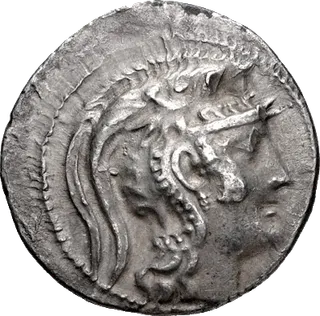
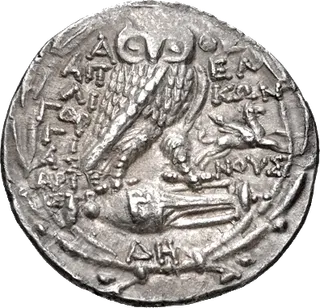
The Euro: Building a Currency From 12 Countries' Coins
Part 35 of the Modern coins series5 min read
How 12 countries traded marks, francs and lire for euro coins in 2002: the shared design, each nation's own side, and the biggest cash changeover ever.
Pick up a euro coin and turn it over. One side looks the same as every other euro coin of that value. The other side tells you where it was made: an eagle from Germany, a harp from Ireland, a Leonardo drawing from Italy.
That split sums up the euro. On 1 January 2002, twelve countries gave up the money they had used for generations and switched to one currency overnight. They agreed to share a single coin. They did not agree to give up their own faces on it.
From treaty to "euro"
The plan goes back to the Maastricht Treaty, signed on 7 February 1992. It set out a route to economic and monetary union, with a single currency at the end of it.
The currency didn't have a name yet. European leaders settled on "euro" at a summit in Madrid in December 1995. It was short, it worked in most European languages, and it didn't belong to any one country.
The euro arrived in stages:
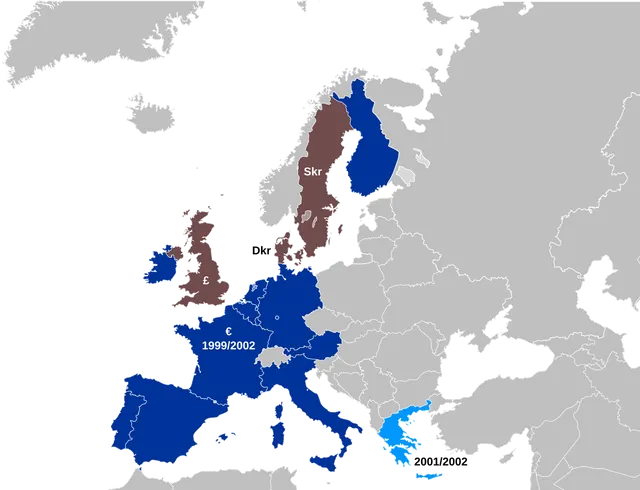
- 1 January 1999: the euro became the official currency of 11 countries, but only on paper. Bank transfers, share prices and accounts could use it. Wallets still held marks, francs and lire.
- 1 January 2001: Greece joined, making 12.
- 1 January 2002: euro banknotes and coins went into circulation.
The exchange rates were fixed for good in 1999. One euro equalled 1.95583 German marks, 6.55957 French francs, 1,936.27 Italian lire and 340.750 Greek drachmas. Shoppers spent much of 2002 doing that arithmetic in their heads.
One side for everyone
Every euro coin has a common side, shared by all countries. The design was picked through a competition held in 1996 across the member states. The winner, announced in June 1997, was Luc Luycx, a designer at the Royal Belgian Mint. His initials, LL, are on every common side.
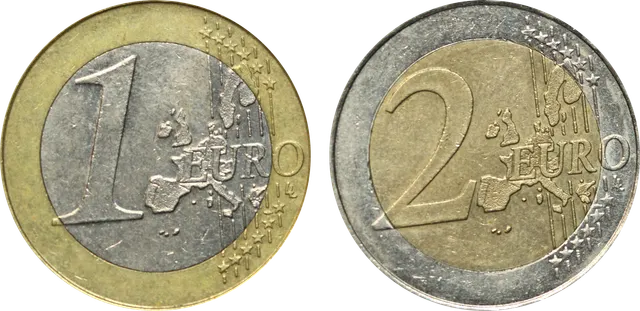
Luycx's designs are built around maps of Europe and the twelve stars of the EU flag:
- 1, 2 and 5 cent: Europe on a globe, placed between Africa and Asia
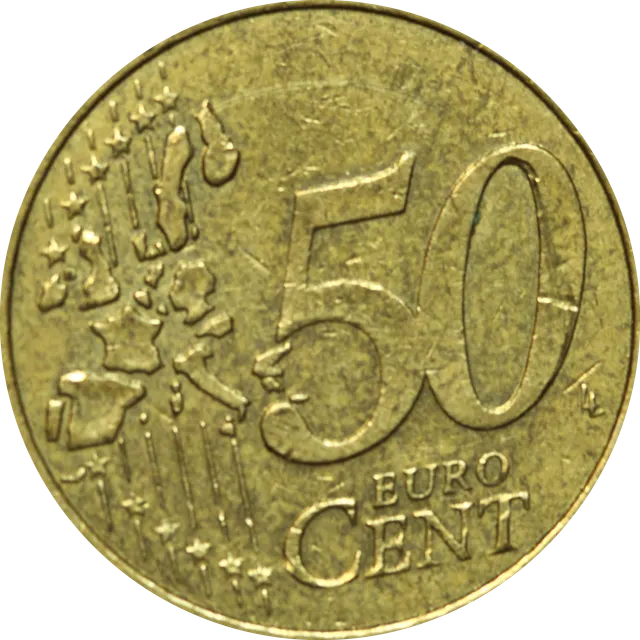
- 10, 20 and 50 cent: the EU's member states shown as separate countries
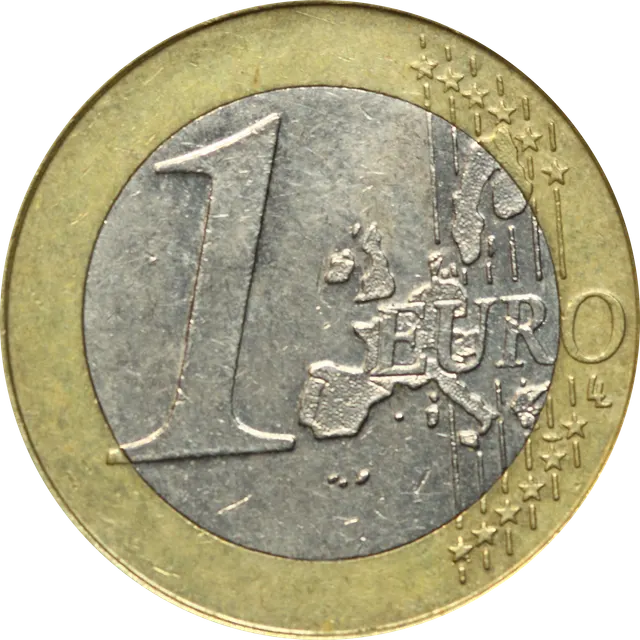
- €1 and €2: the member states drawn together, without borders
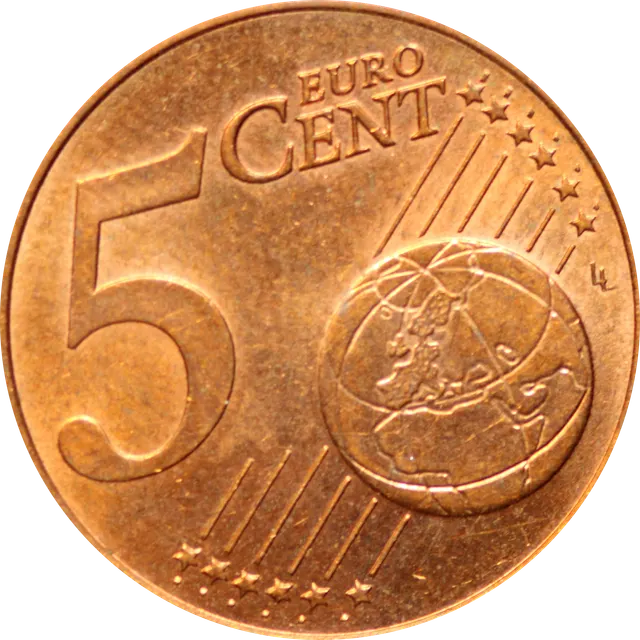
The coins come in three metals. The three smallest are copper-covered steel. The 10, 20 and 50 cent coins are "Nordic gold", a brass alloy of copper, aluminium, zinc and tin that contains no gold at all. The €1 and €2 are bimetallic, with a ring of one alloy around a core of another, which makes them harder to fake. (Bimetallic coins get their own article later in this series.)
And one side for each country
The other side belonged to each country, and every member chose its own designs.
Some picked one design for every coin. Ireland put its Celtic harp on all eight denominations. Belgium, the Netherlands, Luxembourg and Spain (on the €1 and €2) used portraits of their monarchs.
Others split the set into groups:
- Germany: an oak twig on the 1, 2 and 5 cent, echoing the old pfennig; the Brandenburg Gate on the 10, 20 and 50 cent; the federal eagle on the €1 and €2
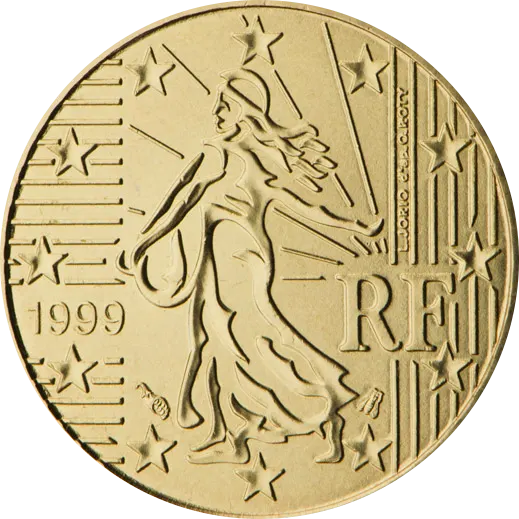
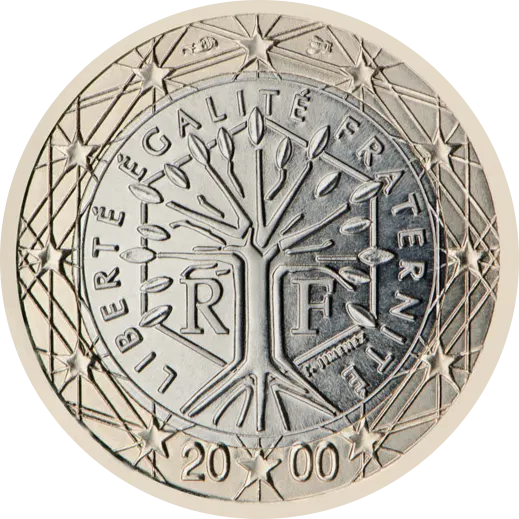
- France: Marianne on the small coins, the Sower on the middle three, and a tree in a hexagon with "Liberté, Égalité, Fraternité" on the €1 and €2
- Spain: the cathedral of Santiago de Compostela on the small coins and Miguel de Cervantes on the middle ones
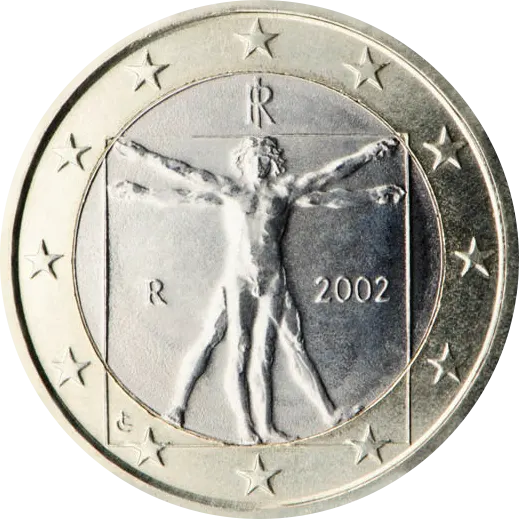
Italy went furthest, with a different design on every coin. The 5 cent shows the Colosseum, the 10 cent Botticelli's Venus, the €1 Leonardo da Vinci's Vitruvian Man and the €2 Raphael's portrait of Dante.
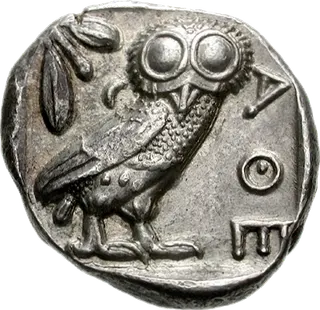
Greece looked furthest back in time. Its €1 copies the owl from the silver tetradrachms of ancient Athens, the same owl that circulated around the Mediterranean 2,400 years earlier. Its €2 shows Europa riding the bull, the myth that gave the continent its name. Austria chose Mozart for the €1 and the peace campaigner Bertha von Suttner for the €2. Finland chose two flying swans for the €1. Portugal used royal seals of its first king, Afonso Henriques.
The rule that makes it all work: any euro coin is legal tender in every euro country. A German euro spends in Lisbon, and an Italian one spends in Helsinki. Within a few years, wallets across the euro area held a mix of national sides.
The biggest changeover in history
Swapping a currency for 308 million people took planning on a scale nobody had tried before.
Sixteen mints struck about 52 billion coins for the launch, worth around €15.75 billion and using roughly 250,000 tonnes of metal. Alongside them came 14.89 billion banknotes worth about €633 billion. From September 2001, banks and shops were stocked with euros so they would be ready on day one.
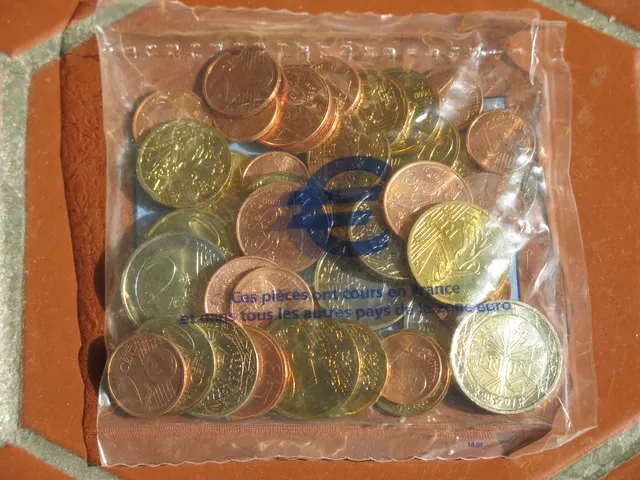
People got a preview too. In the last weeks of 2001, banks sold starter kits: small sealed bags holding a mix of the new coins. In France, a kit held 40 coins worth €15.24, which was exactly 100 francs.
Then it happened fast. By 3 January 2002, 96% of cash machines in the euro area were giving out euro notes. Within a week, more than half of all cash payments were in euros. Old and new money circulated side by side for up to two months, and from 1 March 2002 the euro was the only legal tender in all twelve countries. By then, close to 30 billion national coins had been taken out of circulation.
What has changed since 2002
The common side has been updated once. After ten countries joined the EU in 2004, the maps on the 10 cent to €2 coins no longer matched the Union. From 2007, those coins show the whole of Europe instead of the old member states. The 1, 2 and 5 cent globes stayed as they were.
National sides have changed too. When a monarch changes, the coins follow: Spain switched to King Felipe VI from 2015, and Belgium and the Netherlands moved to King Philippe and King Willem-Alexander. France put a new tree design, made of oak and olive branches, on its €2 in 2022.
Countries can also issue commemorative €2 coins with special national designs, up to two a year. Greece issued the first, for the 2004 Athens Olympics. Some euro-area countries also round cash totals to the nearest 5 cents, so 1 and 2 cent coins rarely turn up in change there.
And the club has grown. Slovenia joined in 2007, and Bulgaria became the 21st member on 1 January 2026. Monaco, San Marino and Vatican City mint their own euro coins under agreements with the EU, and so does Andorra. Their small mintages make them favourites with collectors.
Collecting euro coins
Euro coins are an easy way into world coin collecting. A full set of one country's eight coins costs face value if you can find them in change, and there are 21 countries plus four microstates to work through.
Most circulating euros are worth exactly what they say. The coins collectors pay more for tend to come from the microstates. The best known is Monaco's 2007 €2 for Grace Kelly, with a mintage of just 20,001. Vatican and San Marino strike small numbers too, and most of their coins are sold in collector sets.
More on keeping a set like this: Coin Albums, Folders and Storage Boxes.
Older coins that turn up in this story: the Athenian tetradrachm whose owl returned on the Greek €1, and the drachma that the euro replaced in Greece after about 2,500 years. You can read the drachma's full story in The Drachma: 2,500 Years of Greek Money.
Curious which side a euro lands on? Try the coin flipper.
Questions people ask
When was the euro introduced?
The euro became the official currency of 11 EU countries on 1 January 1999, but only for bank transfers and accounts. Euro banknotes and coins arrived on 1 January 2002, by which time Greece had joined to make 12 countries.
How many countries use the euro?
Twenty-one EU countries use the euro as of 2026, after Bulgaria joined on 1 January 2026. Monaco, San Marino, Vatican City and Andorra also use it, and issue their own euro coins, under agreements with the EU.
Can I spend a euro coin from one country in another?
Yes. Every euro coin is legal tender in every euro-area country, whatever national side it carries. A German €1 is worth exactly the same in Spain as an Italian one.
Who designed the euro coins?
Luc Luycx of the Royal Belgian Mint designed the common side, which shows maps of Europe. Each country designed its own national side, so there are dozens of different designs in circulation.
Are any euro coins rare?
Most circulating euro coins are worth face value. The coins collectors pay more for are mostly low-mintage issues from Monaco, San Marino and Vatican City, such as Monaco's 2007 €2 for Grace Kelly, of which 20,001 were struck.
Sources
- European Central Bank, "Euro coins" (eight denominations, Luc Luycx of the Royal Belgian Mint, national sides, two commemorative €2 coins a year, ECB approves volumes, any coin valid anywhere)
- European Central Bank, "€1" coin page (national side descriptions for all 12 founding countries, edge lettering)
- European Central Bank, "€2" coin page (national side descriptions for all 12 founding countries, edge lettering)
- European Central Bank, "Euro cash changeover 2002" (12 countries, 308 million people, coin and banknote volumes from 16 mints, 250,000 tonnes of metal, frontloading from September 2001, 96% of ATMs by 3 January, sole legal tender from 1 March 2002, ~30 billion national coins withdrawn)
- European Central Bank, "Changeover" (member states and joining years, Bulgaria from 1 January 2026)
- Council of the EU press release, "Bulgaria ready to use the euro from 1 January 2026" (8 July 2025)
- Deutsche Bundesbank, "Bulgaria introduces the euro"
- European Commission, Communication on copyright protection of the common face design of the euro coins (2001/C 318/03)
- Numista, Luc Luycx artist page (common side designer)
- Council Regulation (EC) No 2866/98 on the conversion rates between the euro and the currencies of the member states
- 2euros.org and Numista entries for Monaco 2007 €2 Grace Kelly (mintage 20,001)
- German History in Documents, "Euro Starter Kit (17 December 2001)" and Numismatic News, "Euro starter packs" (kit contents and sale dates)
- Wikipedia, "Euro coins" and "Luc Luycx" (cross-check only: 1996 competition, June 1997 selection, alloys, 2007 redesign, rounding countries, microstates)
Coins in this story
- €1 common side
- French €1
- French 50 cent
- Italian €1
- 5 cent common side
- Athenian tetradrachm
- Drachma