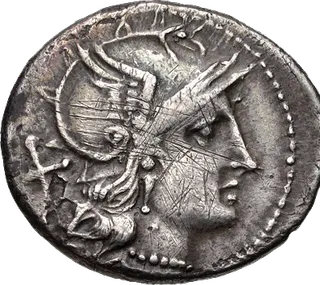
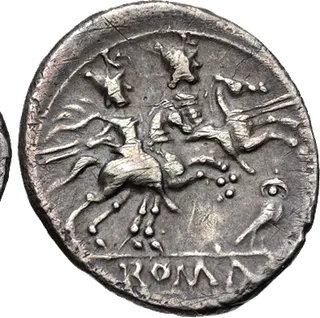
The Drachma: 2,500 Years of Greek Money
Part 8 of the ancient world series5 min read
From silver owls to the euro: how the drachma began as a handful of iron spits, reached India, vanished for 1,500 years and came back to serve Greece until 2002.
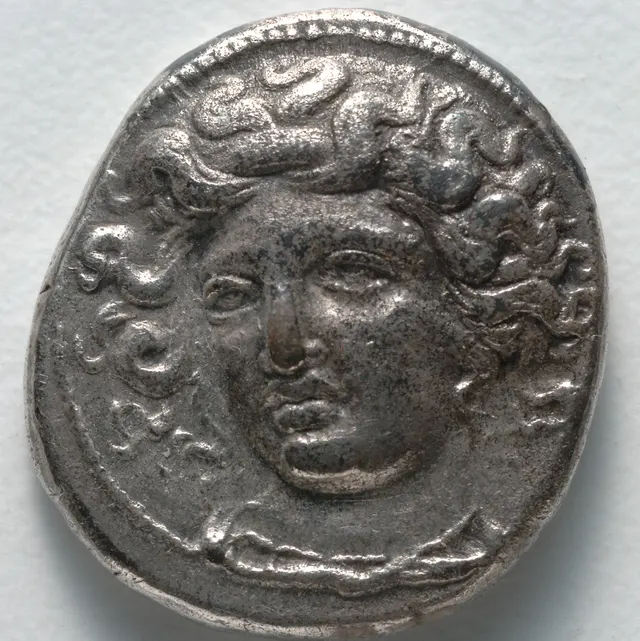
The drachma is one of the oldest currency names in the world. Greek cities were striking silver drachms by the 500s BC, and Greeks were still paying with drachmas when the euro arrived in 2002. Between those dates the drachma spread as far as India, vanished for more than a thousand years, and came back as the money of a new country.
This article follows that whole story.
For specs, weights and photos of a classic Athenian drachm, see our drachma coin page.
A handful of spits
The word comes from the Greek drassomai, "to grasp". Before coins, Greeks used iron roasting spits, obeloi, as a kind of money. Six spits made a handful, a drachmē. When silver coins came along, the old names stuck: the small coin was an obol, and six obols made a drachma.
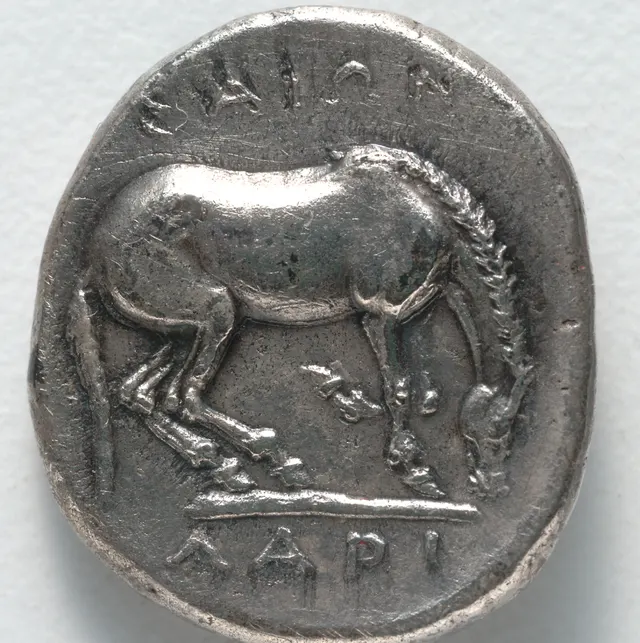
Hundreds of Greek cities struck their own drachms, and they didn't all weigh the same. The Athenian, or Attic, drachm was about 4.3 grams of nearly pure silver. The island of Aegina used a heavier standard of about 6 grams. In late 5th-century BC Athens, a skilled worker on a public building earned about a drachma a day.
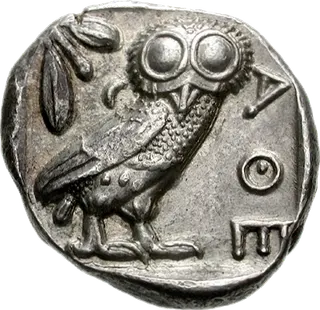
Athens struck far more four-drachma coins, the famous "owls", than single drachms. We tell that part of the story in Ancient Greek coins: owls, turtles and tetradrachms.
Alexander takes the drachma east
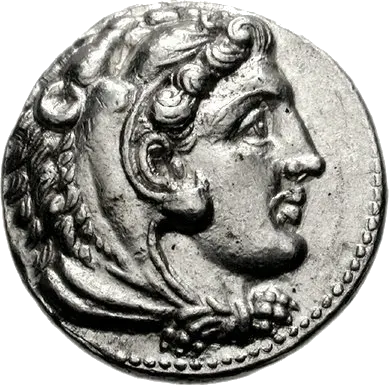
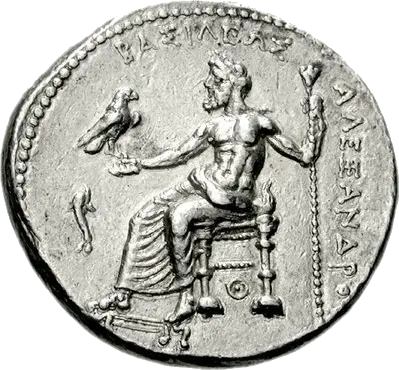
The drachma became truly international with Alexander the Great. After he conquered the Persian Empire in the 330s BC, his mints from Macedonia to Babylon struck silver on the Attic standard. His drachms show Herakles in a lion-skin headdress on one side and Zeus on his throne on the other.
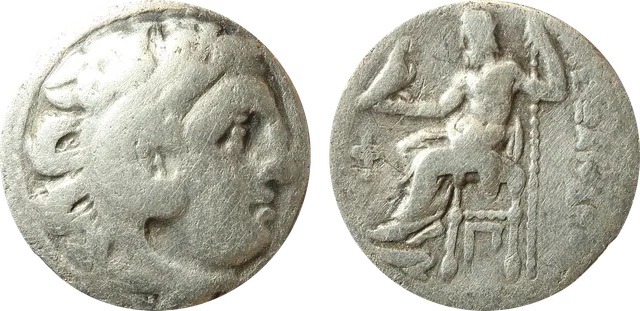
Alexander died in 323 BC, but the coins kept coming. His generals and their heirs went on striking drachms and tetradrachms in his name for generations. More on that in the coins of Alexander the Great.
Drachms in Persia and India
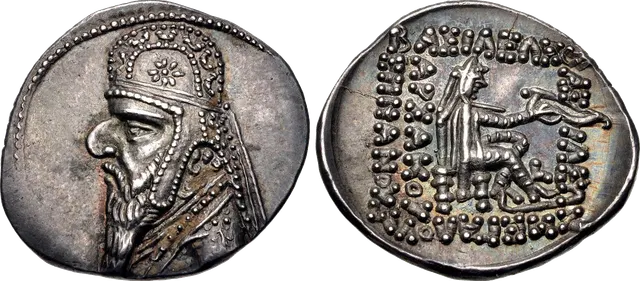
Greek-style drachms outlived Greek rule in the east. The Parthian kings, who took Iran from Alexander's successors, made the silver drachm their main coin. For more than four centuries, from the 3rd century BC to the 3rd century AD, Parthian drachms showed a king in profile and an archer on the back, usually with Greek lettering.
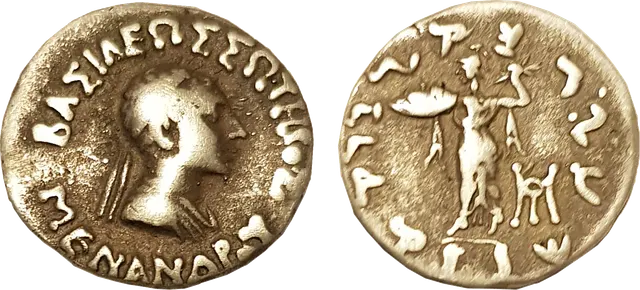
Further east, Greek kings ruled parts of what are now Afghanistan, Pakistan and northern India. Around 150 BC, Menander I struck silver drachms with Greek on one side and an Indian script, Kharoshthi, on the other. The same coin could be read in two scripts.
Under Rome
Rome's silver coin was the denarius. In the Greek-speaking east, people generally reckoned it as equal to a drachma and kept counting in drachmas.
The old name was still in everyday speech in the 1st century AD. In Luke's Gospel, Jesus tells a parable about a woman who has ten silver coins and loses one. In the Greek text those coins are drachmas.
Egypt kept a closed currency of its own under Roman rule. The mint at Alexandria struck "tetradrachms" for three centuries, but the silver in them shrank until they were mostly bronze. Diocletian's reforms ended them in the 290s AD. For what happened to Rome's own silver, see the denarius: how Rome's silver coin lost its shine.
A long silence
After that, no one struck a drachma for about 1,500 years. Byzantine money was the gold solidus and its fractions, and later the Ottomans brought their own coins.
The name lived on in other ways. When the Arab caliphs began striking their own silver coins in the 7th century, they called them dirhams, a word borrowed from drachma. In English, a "dram" of whisky goes back to the drachm as a unit of weight.
Rebirth: the phoenix and the drachma
Greece fought its War of Independence from 1821. In 1828 its first governor, Ioannis Kapodistrias, gave the new state its own coin, struck on the island of Aegina. He called it the phoenix, after the bird reborn from its own ashes.
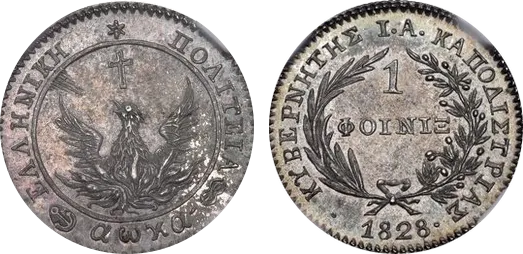
The phoenix didn't last long. In 1832 the great powers made a Bavarian prince, Otto, king of Greece. His regency council loved classical Greece, and it brought back the ancient name. A royal decree of 1833 made the drachma the national currency in place of the phoenix.
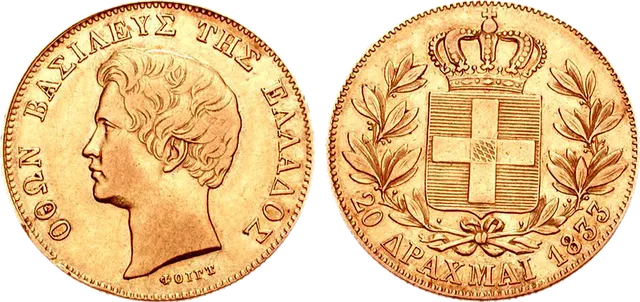
Otto's silver drachma weighed about 4.5 grams, close to its ancient ancestor. Like his gold coins, it showed the young king on the front and the royal arms on the back. The first coins were struck in Munich and Paris; Athens had its own mint from 1836.
In 1868 Greece joined the Latin Monetary Union, alongside France, Belgium, Italy and Switzerland. One drachma was now equal to one French franc, in weight and in value.
War and the billion-drachma notes
The drachma's worst years came under the German, Italian and Bulgarian occupation of 1941 to 1944. The occupiers made Greece pay for its own occupation, and the government printed money to do it.
Prices ran out of control. In October 1944, according to the Cato Institute's hyperinflation table compiled by Steve Hanke and Nicholas Krus, prices were rising about 13,800 percent a month, doubling roughly every four days. The largest note, issued that year, was for 100 billion drachmas.
After liberation, a new drachma was introduced on 11 November 1944, at 50 billion old drachmas to one new one. Inflation went on for years. On 1 May 1954 Greece knocked three more zeros off: 1,000 drachmas became one. The new drachma was pegged at 30 to the US dollar and held that rate for almost twenty years.
The last drachmas
The last series of drachma coins put famous Greeks on the reverse. Aristotle was on the 5 drachmes, Democritus on the 10, and the poet Dionysios Solomos, who wrote the national anthem, on the 20. The 100-drachma coin showed Alexander the Great, the man who had carried the drachma to India 2,300 years earlier.
The two smallest coins honoured women of the War of Independence. Laskarina Bouboulina, a ship-owner who commanded her own vessels, was on the 1 drachma. Manto Mavrogenous, who spent her fortune on the cause, was on the 2.
Goodbye to the drachma
Greece joined the euro area on 1 January 2001. The exchange rate had been fixed the summer before at 340.750 drachmas to one euro, and it was fixed for good.
Euro notes and coins arrived on 1 January 2002. For two months Greeks could pay in either currency. On 28 February 2002 the drachma stopped being legal tender, after about 2,500 years on and off.
The owl came back with it. Greece's one-euro coin carries the owl from an ancient Athenian tetradrachm, so a design about 2,500 years old is still in Greek pockets.
More books for collectors: Best Coin Collecting Books.
Flip a drachma
Our drachma coin page has the specs and photos of an Athenian drachm, and you can flip it there. Or try the Athenian tetradrachm, its four-drachma big brother, or flip any coin on the coin flipper.
Questions people ask
Is the drachma still used in Greece?
No. Greece adopted the euro in 2001, and euro notes and coins replaced drachmas on 1 January 2002. The drachma stopped being legal tender on 28 February 2002.
How many drachmas were in a euro?
340.750 drachmas to one euro. The rate was fixed in June 2000 and applied from 1 January 2001, when Greece joined the euro area.
What does "drachma" mean?
It comes from the Greek drassomai, "to grasp". A drachma was originally a handful of six iron spits (obeloi), which is why six obols made one drachma.
How old is the drachma?
Greek cities were striking silver drachms by the 500s BC. The modern drachma ran from 1832 to 2002, so the name was in use, on and off, for about 2,500 years.
What was the largest drachma banknote?
A 100-billion-drachma note issued in 1944, during the hyperinflation under the Axis occupation. In November 1944 the government swapped 50 billion old drachmas for one new one.
Sources
- Alpha Bank Numismatic Collection, "Silver drachma of King Otto" (1833 decree replacing the phoenix, Bavarian regency's choice of name, design, Munich/Paris/Athens mints)
- Bank of Greece, "History of the euro" (euro entry 2001, 340.750 rate, 2002 changeover)
- Banco de España, "Irrevocable exchange rates" (Council Regulation (EC) No 1478/2000) (340.750 drachmas per euro from 1 January 2001)
- Steve H. Hanke and Nicholas Krus, "World Hyperinflations", Cato Institute hyperinflation table (Greece, October 1944: about 13,800% a month, prices doubling about every 4.3 days)
- Numista catalogue, 1976–2000 drachma series: 1 drachma, Bouboulina
- Numista catalogue, 1976–2000 drachma series: 2 drachmes, Mavrogenous
- Numista catalogue, 1976–2000 drachma series: 5 drachmes, Aristotle
- Numista catalogue, 1976–2000 drachma series: 10 drachmes, Democritus
- Numista catalogue, 1976–2000 drachma series: 20 drachmes, Solomos
- Numista catalogue, 1976–2000 drachma series: 100 drachmes, Alexander
- Bryn Mawr Classical Review, review of Coinage in Roman Egypt: The Hoard Evidence (Alexandrian tetradrachms as a closed currency until Diocletian's reform)
- "Modern drachma", "Phoenix (currency)" and "Hyperinflation in Greece", Wikipedia (dates for 1828, 1868, 11 Nov 1944, 1 May 1954, 30/USD peg; cross-checked against the sources above)
- Colin M. Kraay, Archaic and Classical Greek Coins (1976), and Peter van Alfen, ANS Pocket Change (Attic and Aeginetan weights)
- Luke 15:8–10 (Greek text: drachmas deka, the parable of the lost coin)
- Erechtheion building accounts (IG I³ 474–479), as summarised in von Reden, Money in Classical Antiquity (2010) (a drachma a day)