Tap the coin to flip it
The Denarius: Rome's Silver Coin
Ancient Romec. 211 BC to the mid-3rd century AD
Ancient Roman coin
Specs (imperial denarius of Augustus, for reference)
- Issuer
- Roman Republic, then the Roman Empire
- Denomination
- 1 denarius = 10 asses (16 from c. 141 BC); 25 denarii = 1 aureus
- Years minted
- c. 211 BC to the mid-3rd century AD
- Metal
- Silver. Nearly pure at first; a few percent silver by the 260s
- Weight
- About 4.5 g at introduction; about 3.9 g in the late Republic and under Augustus; about 3.4 g after Nero's reform (AD 64)
- Diameter
- About 17–20 mm
- Production
- Hand-struck between engraved dies
In the hand
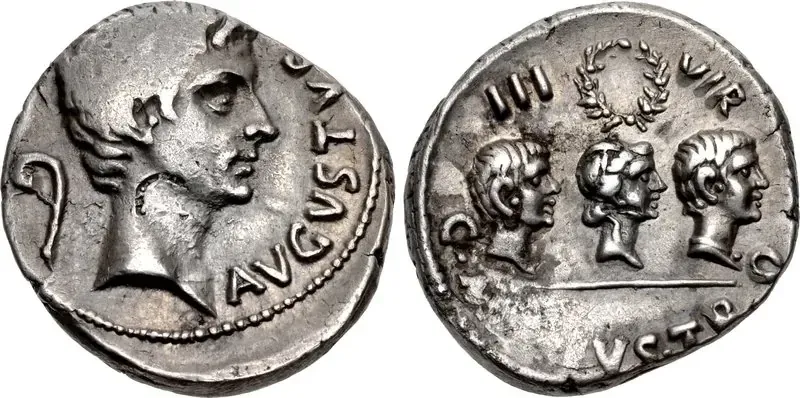
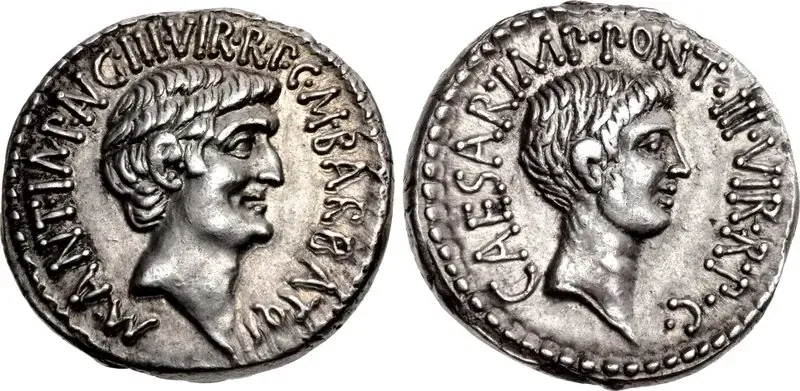
The story of the Denarius
The denarius was the main silver coin of ancient Rome. It was introduced around 211 BC and struck for close to 500 years, longer than almost any other coin of the ancient world.
Rome created it during the Second Punic War, its long war with Carthage. The name means "containing ten," because one denarius was first worth ten bronze asses. Around 141 BC it was retariffed at sixteen asses. Smaller and larger silver and bronze coins sat around it, and the gold aureus was worth 25 denarii.
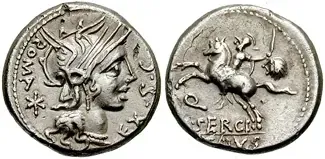
Early denarii show the helmeted head of the goddess Roma on the front, often with the Dioscuri, the twin horsemen, on the back. During the late Republic, the officials in charge of the mint began putting their own family stories and symbols on the coins. Julius Caesar went further. In 44 BC he became the first living Roman to put his own portrait on a coin. From Augustus onward, the emperor's head was standard, and the reverse carried messages about victories, gods, family and good government. For most people, coins were how they learned what their ruler looked like.
What could you do with one? Under Augustus, a legionary soldier earned 225 denarii a year. In the Gospels, the coin Jesus is shown when asked about paying tax to Caesar is a denarius, which is why it's often called the "tribute penny." In the parable of the workers in the vineyard, a denarius is a day's wage.
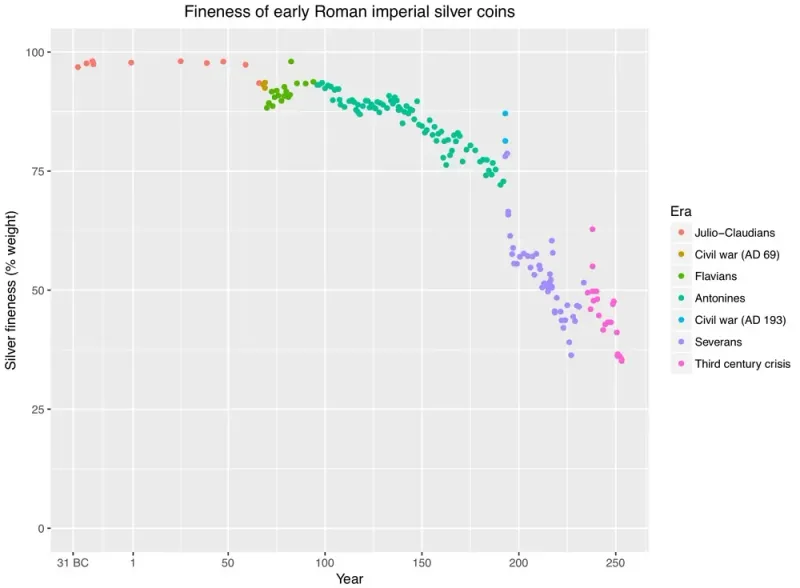
The coin's weight and purity slipped over time. It started at about 4.5 g of fine silver, and was cut to about 3.9 g during the Republic. In AD 64 Nero reduced the weight again and lowered the silver content. Later emperors kept going, especially during the military crises of the 200s. Caracalla introduced a larger coin, the antoninianus, in 215. By the 260s, under Gallienus, Roman "silver" coins held only a few percent silver. The denarius faded out as an everyday coin around the middle of the 3rd century. That decline is the subject of the history article linked below.
The name outlived Rome by a long way. It gave us the Arabic dinar, the Italian denaro and the Spanish dinero. For centuries the British penny was abbreviated "d," for denarius, as in the old £sd system.
From the encyclopedia
The denarius was the standard Roman silver coin from its introduction in the Second Punic War c. 211 BC to the reign of Gordian III, when it was gradually replaced by the antoninianus. It continued to be minted in very small quantities, likely for ceremonial purposes, throughout the Tetrarchy (293–313).
From Denarius on Wikipedia, text under CC BY-SA 4.0. Fetched November 3, 2026.
Questions people ask
How much was a denarius worth?
Under Augustus, a Roman legionary earned 225 denarii a year. The Gospel of Matthew describes a denarius as a day's pay for a vineyard worker.
Is the denarius the coin in the Bible?
Yes. The "tribute penny" shown to Jesus in the question about paying tax to Caesar is a denarius, most likely of the emperor Tiberius.
How much silver is in a denarius?
It depends on the date. Early denarii were nearly pure silver. By the AD 260s, coins in the same role held only a few percent.