The Guinea and the Sovereign: Britain's Gold
Part 27 of the Trade empires series6 min read
The guinea ran from 1663 to 1814 and ended up worth 21 shillings. In 1817 the sovereign replaced it at exactly £1 and put Britain on a gold standard.
For about 150 years, the gold coin in a well-off Briton's purse was a guinea. Then, in 1817, it was swapped for a slightly smaller coin worth exactly one pound: the sovereign.
The guinea gave Britain the habit of thinking in gold. The sovereign made that habit law, and then carried it around the world.
A new coin from a new machine
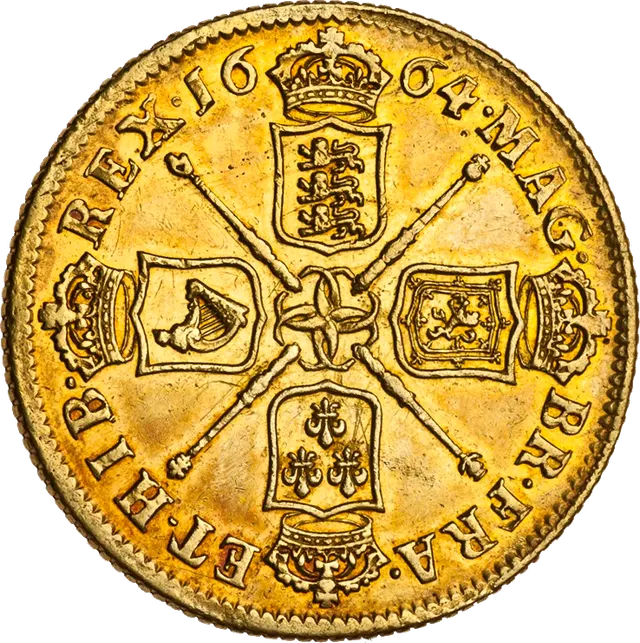
Charles II came back to the throne in 1660, and within two years the Royal Mint in the Tower of London had changed how it made money. In February 1662 it began striking gold coins by machine, using horse-powered mills and screw presses instead of a hammer and a pair of dies.
A Frenchman named Pierre Blondeau came over to install the equipment and run it. His machines also put a raised rim and a grained or lettered edge on each coin. That mattered. A coin with a neat milled edge was hard to clip without someone noticing, and clipping was a constant problem with England's old hammered silver.
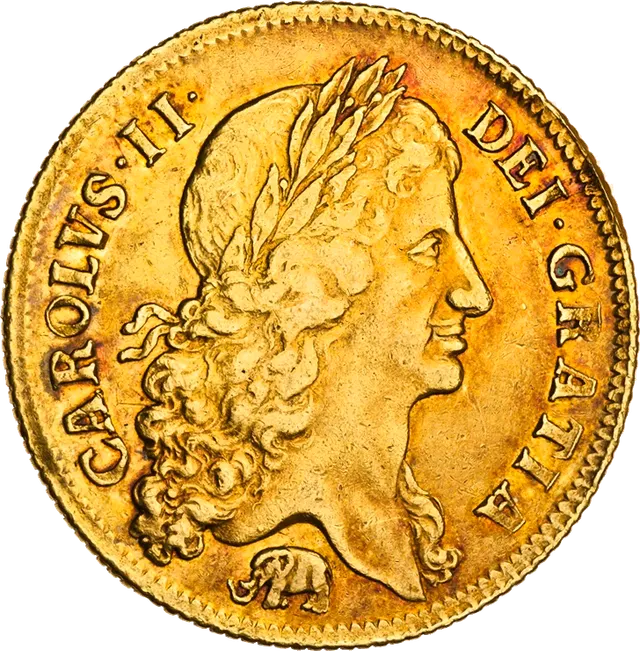
The first new gold coin was the one we now call the guinea, struck from 1663. It held about a quarter of an ounce of 22-carat gold and was meant to be worth 20 shillings, or one pound.
Why "guinea"?
The coin's official name was simply a twenty-shilling piece. People called it a guinea because so much of its gold came from the Guinea coast of West Africa.
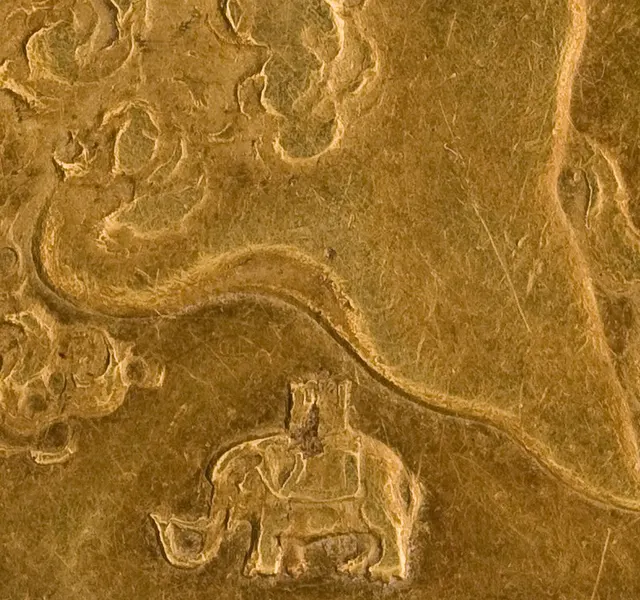
That gold arrived through the Royal African Company and the company that came before it. Their badge was an elephant, and guineas struck from company gold carry a small elephant, or an elephant with a castle on its back, below the king's portrait.
It's worth being plain about what that company was. Alongside gold and ivory, the Royal African Company held England's monopoly on trade with West Africa, including the trade in enslaved Africans, from 1672 until 1698. The little elephant on these coins comes from that business.
A pound that wouldn't stay a pound
The guinea had a problem from the start. Its value was set in shillings, which were silver, while the guinea itself was gold. When the price of gold moved against silver, the guinea's value in shillings moved too.
In the 1690s it moved a long way. England's silver coins had been clipped and worn so badly that a shilling held far less silver than it should. By 1695 a guinea was changing hands for around 30 shillings. (The story of that clipping crisis is in Coin Clipping, Debasement and Gresham's Law.)
The government recoined the silver from 1696, and the guinea's price fell back once full-weight shillings were in circulation again.
Isaac Newton sets the price
Isaac Newton is better known for gravity, but he spent the last 30 years of his life at the Royal Mint, first as Warden and then as Master. In 1717 he wrote a report on the value of gold and silver coins. A royal proclamation that December followed his advice and fixed the guinea at 21 shillings.

That figure stuck. It also valued gold a little too generously compared with silver. Silver coins tended to get melted down or shipped abroad, where the metal was worth more, while gold stayed and circulated.
Without anyone passing a law to say so, Britain slid onto a gold standard in practice during the 1700s. A pound was, in effect, a fixed weight of gold.
Guineas worth knowing
The guinea family included half, two and five guinea coins as well. Each reign added its own variety, and collectors still chase a few of them.
- Vigo guineas, struck under Queen Anne from Spanish gold captured at Vigo Bay in 1702, with "VIGO" under her bust.
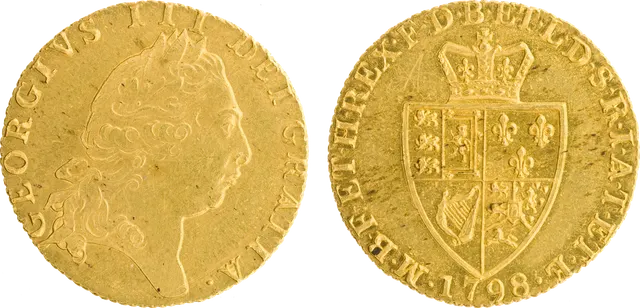
- Spade guineas (1787 to 1799), named for the pointed shield on the reverse, which looks like the spade on a playing card.
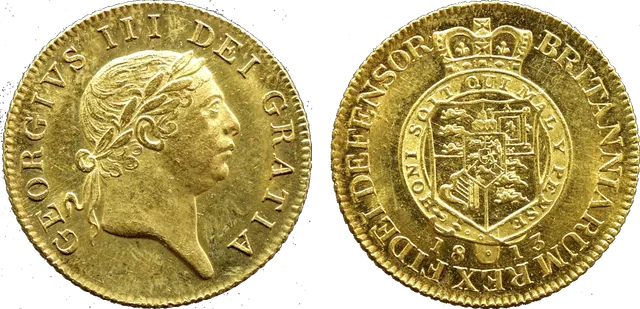
- The military guinea of 1813, the last guinea struck, made to pay the Duke of Wellington's army at the end of the Napoleonic Wars.
Paper money and the vanishing guinea
Then came the long war with France. In 1797, with gold draining out of the Bank of England, the government passed the Bank Restriction Act. The Bank no longer had to swap its notes for gold.
People hung on to their guineas, and paper notes did the work of everyday money. Very few new guineas were struck after that. When the war ended in 1815, Britain needed a new gold coinage.
1816: gold becomes the law
The Coinage Act of 1816, often called Liverpool's Act after the prime minister, put the gold standard in writing. Gold alone would be the standard of value. Silver coins became tokens, worth more as money than as metal, and were legal tender only for payments up to 40 shillings.
The Act set the price of a troy pound of 22-carat gold at £46 14s 6d. Divide that into pounds sterling and you get a coin of 7.98805 grams, holding about 7.32 grams of pure gold. That coin was the new sovereign.
The 1817 sovereign
The first modern sovereigns came off the steam presses at the Royal Mint's new building on Tower Hill in 1817. A proclamation of 1 July 1817 made them current, at 20 shillings each. The guinea's odd 21 shillings were gone, and a coin finally matched the pound.
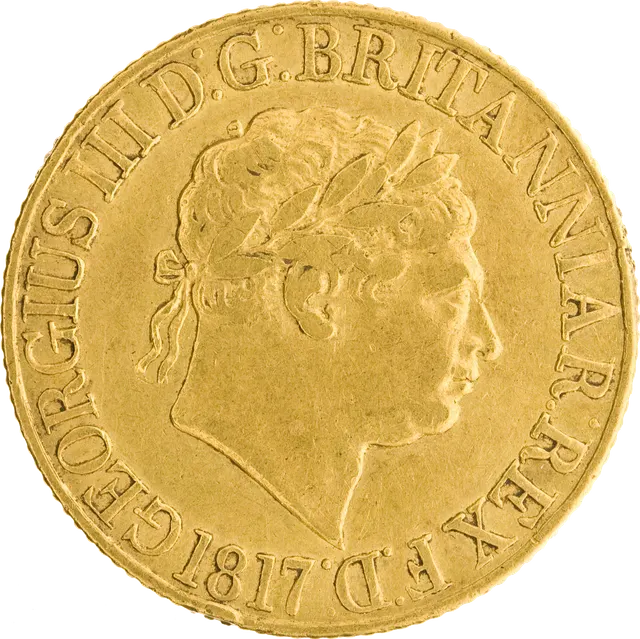
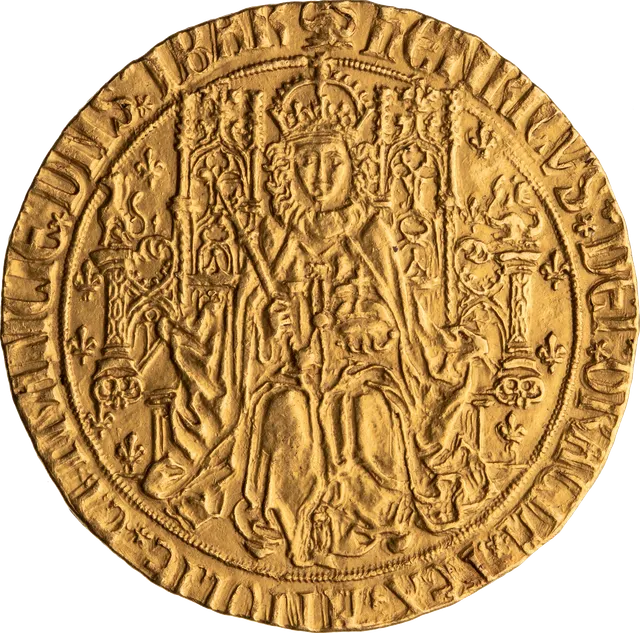
The name was old. Henry VII had struck a large gold sovereign in 1489, England's first pound coin, showing the king enthroned. The new coin was smaller and far more practical.
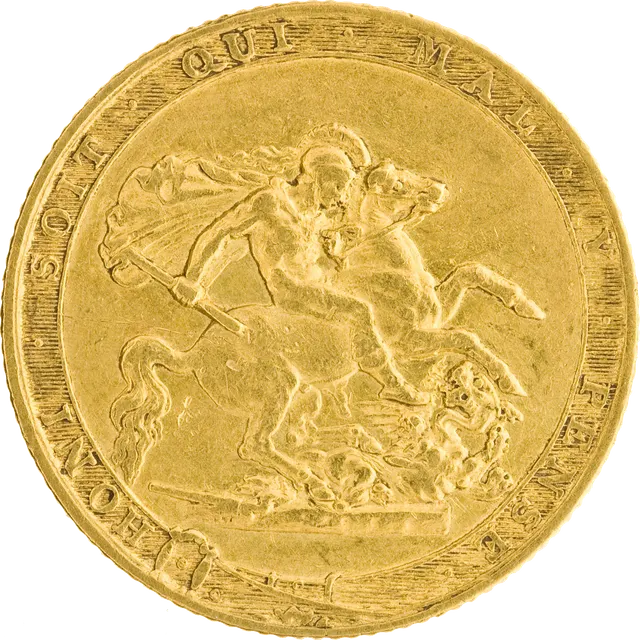
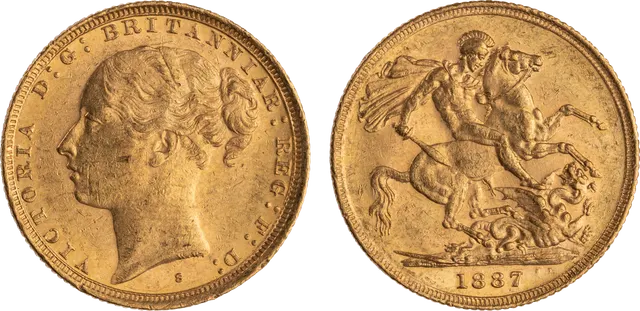
Its design came from Benedetto Pistrucci, an Italian gem engraver working for the Mint. On the reverse, St George rides down the dragon, nude apart from a helmet and a cloak streaming behind him. The first version sat inside the Garter and its French motto. That was dropped in 1821, the shield replaced St George from 1825, and Pistrucci's design returned for good in 1871.
The same year Pistrucci's design was simplified, 1821, the Bank of England went back to paying its notes in gold on demand. Britain was now formally on the gold standard.
The chief coin of the world
For the next century, the sovereign was the coin the British Empire ran on. Gold rushes in Australia led the Royal Mint to open its first branch in Sydney in 1855. Melbourne followed in 1872, then Perth (1899), Ottawa (1908), Bombay (1918) and Pretoria (1923).
Each branch struck sovereigns with its own small mint mark, such as "S" for Sydney or "P" for Perth. Together they made nearly 500 million sovereigns, almost as many as London itself. It was trusted far beyond the Empire's borders, and it earned the nickname "the chief coin of the world."
How the gold standard ended
The First World War ended the sovereign's working life. Gold was pulled out of circulation from 1914 and replaced by Treasury notes. The Royal Mint in London stopped striking sovereigns in 1917.
Britain went back to gold in 1925, but only for large bars, not coins, and left the gold standard for good in September 1931. The branch mints struck their last sovereigns in 1932.
The sovereign survived anyway. Demand for gold coins in the Middle East stayed strong, and in 1957 the Royal Mint started striking sovereigns again as bullion, at the same weight and fineness set in 1816. It still does, and Pistrucci's St George is still on most of them.
The guinea that never left
The guinea coin disappeared, but the guinea as a sum of money hung on. For over 150 years Britons used it for doctors' and lawyers' fees, art and luxury goods, always at 21 shillings, or one pound and one shilling.
Decimal money in 1971 should have ended that. It didn't quite. Some British horse auctions still price lots in guineas, and two of the Classic flat races at Newmarket are still the 2,000 Guineas (first run in 1809) and the 1,000 Guineas (1814).
Flip the coins in this story
You can flip a guinea or a sovereign right now and see both sides up close. Or head back to the coin flipper and toss a coin of your own.
Keep reading in the Trade Empires series: The Thaler: The Coin That Named the Dollar · Pieces of Eight: The Spanish Dollar · The Doubloon: Spanish Gold and Pirate Legend · All Trade Empires articles
Gold elsewhere in the Atlas: The Double Eagle and the Gold Recall of 1933 · Bullion Coins and the Krugerrand Revolution
Questions people ask
Why is it called a guinea?
Much of the gold for the first guineas, struck from 1663, came from the Guinea coast of West Africa through the Royal African Company. The official name was a twenty-shilling piece, but "guinea" stuck.
How much was a guinea worth?
It started at 20 shillings (£1). Its value floated with the price of gold, reaching around 30 shillings in 1695, until a proclamation in December 1717 fixed it at 21 shillings, or £1 1s. In decimal money that's £1.05.
When did the sovereign replace the guinea?
The Coinage Act of 1816 set up the new gold coinage, and the first modern sovereigns were struck in 1817 at 20 shillings each. The last guinea was the military guinea of 1813.
How much gold is in a sovereign?
A sovereign weighs 7.98805 grams of 22-carat gold and contains about 7.32 grams (0.2354 troy ounces) of pure gold. The standard hasn't changed since 1817.
Is the sovereign still made?
Yes. The Royal Mint has struck sovereigns as bullion and collector coins since 1957. They're still legal tender at £1, but the gold is worth far more than that.
Sources
- Royal Mint Museum, "Charles II" (machine-struck coinage from 1662, Blondeau, the guinea and the elephant mark)
- Royal Mint Museum, "George III" (the end of the guinea and the 1817 sovereign)
- Royal Mint Museum, "Victorian Branch Mints"
- The Royal Mint, "The Story of the Guinea"
- The Royal Mint, "Significant Moments for The Sovereign"
- The Royal Mint, "Branch Mints"
- The Royal Mint, "The Modern Sovereign Returns" (1957)
- Coinage Act 1816 (56 Geo. III c. 68)
- Michael A. Marsh, The Gold Sovereign (Spink, 2021)