Roman Gold: The Aureus and the Solidus
Part 12 of the ancient world series6 min read
How Rome paid in gold: the aureus of Caesar and Augustus, its long loss of weight, and Constantine's solidus, the coin that kept its standard for 700 years.
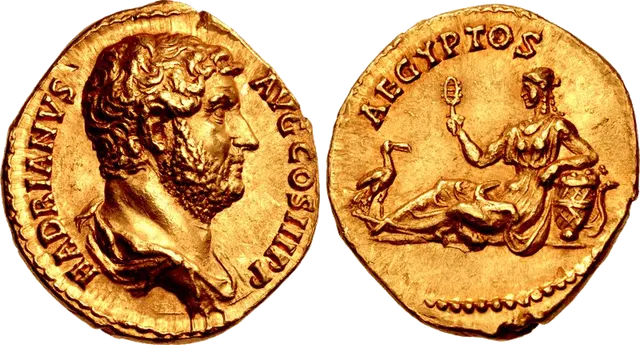
Rome ran on silver and bronze, but its biggest payments were made in gold. For about 350 years that meant the aureus. Then, around AD 309, Constantine replaced it with a lighter coin called the solidus. That coin held its weight and purity for roughly seven centuries.
This is the story of both coins: where Roman gold came from, why it kept shrinking, and how Constantine fixed it.
Rome's first gold was an emergency measure
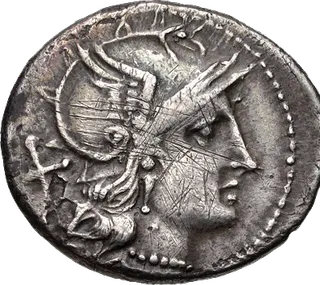
Rome struck its first gold during the Second Punic War, when Hannibal was in Italy and the treasury was desperate. Around 218 BC it issued gold staters, and from about 211 BC it struck gold pieces marked 60, 40 and 20 asses, with the head of Mars on one side and an eagle on the other.
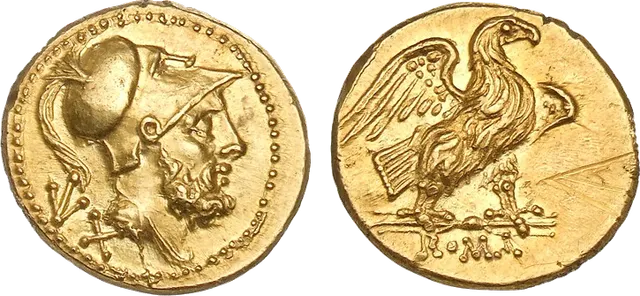
When the war ended, so did the gold. For more than a century afterwards, Roman money was silver denarii and bronze.
Generals and the birth of the aureus
Gold came back in the hands of generals who needed to pay big armies quickly. In the 80s BC Sulla struck gold aurei at about 30 to the Roman pound, close to 11 grams each.
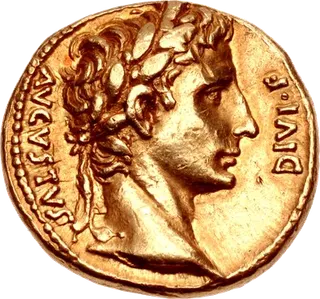
Julius Caesar went much further. In 46 BC he struck the first really large issue of Roman gold to pay and reward his troops, and he fixed the aureus at 40 to the pound, about 8 grams. That standard became the model for the empire.
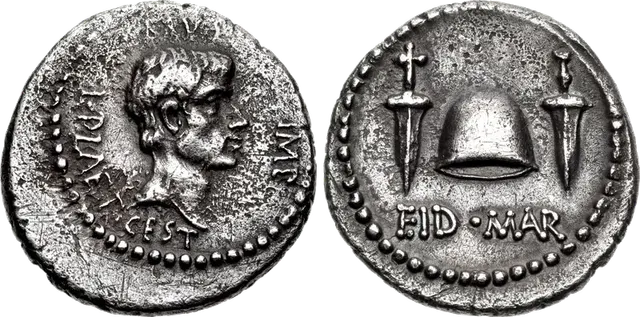
One of the most famous aurei of all comes from this period. After Caesar's murder, Brutus struck coins with a cap of liberty between two daggers and the words EID MAR, for the Ides of March. Only three gold examples are known. One sold in London in 2020 for £3.24 million, but investigators later found it had been looted from Greece, and it was sent back there in 2023.
The aureus under the emperors
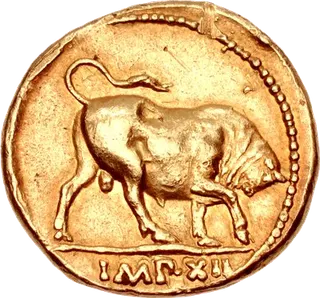
Augustus made the aureus a regular part of the money system. It was worth 25 silver denarii, more than a month's pay for a legionary. Ordinary people rarely handled one. Aurei went into army pay, large purchases, savings and imperial gifts.
They also carried the emperor's portrait into wealthy households across the empire. Early imperial aurei weighed around 7.6 to 8 grams and were struck in almost pure gold. That's why so many survive in fine condition: they were hoarded more than spent.
Our guide to every Roman coin denomination shows where the aureus sat on the ladder, from the copper as up.
Shrinking gold: Nero to the third-century crisis
The aureus didn't lose its purity the way silver did. It lost weight instead.
- Caesar and Augustus: 40 to the pound, about 8 g
- Nero (AD 64): 45 to the pound, about 7.3 g
- Caracalla (around AD 215): 50 to the pound, about 6.5 g
The third century made things far worse. Emperors came and went, armies demanded pay, and the silver coinage collapsed. Gold coins were struck at whatever weight the mint could manage. Some "light aurei" of Valerian, in the 250s, weigh little more than 2 grams.
When the coin in your hand could weigh anything, nobody trusted the stated value. People paid in gold by weight instead. You can read how the silver side of this collapse played out in The Denarius: How Rome's Silver Coin Lost Its Shine.
Diocletian tries a reset
Diocletian started to rebuild. Around 290 he settled on a new aureus at 60 to the pound, about 5.4 grams, and many of his gold coins carry the Greek numeral for 60 to say so.
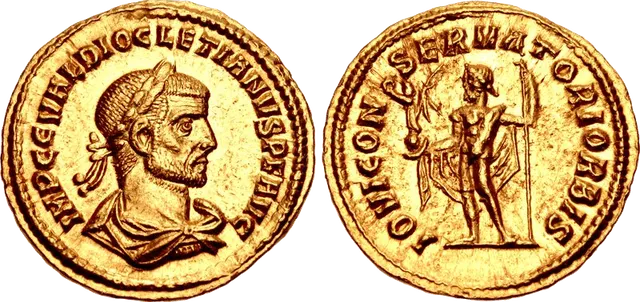
It helped, but it didn't last. Diocletian's wider reforms, including his famous price-cap edict of 301, failed to stop inflation, and the empire was soon split by civil war again.
Constantine's solidus (around AD 309)
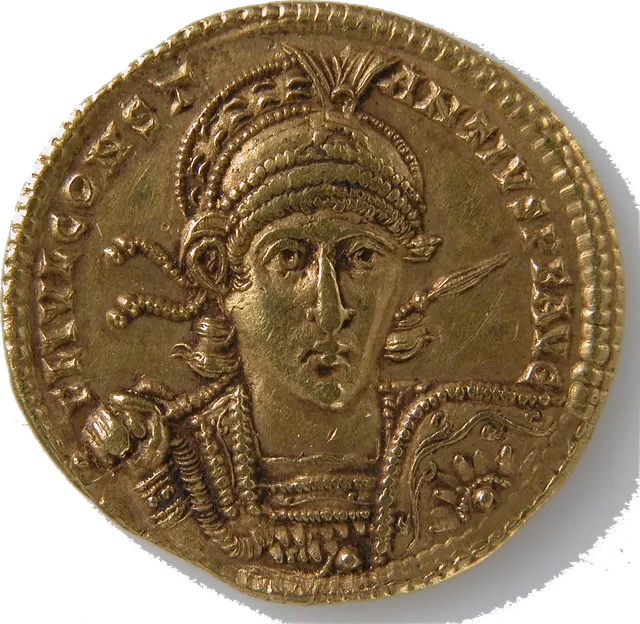
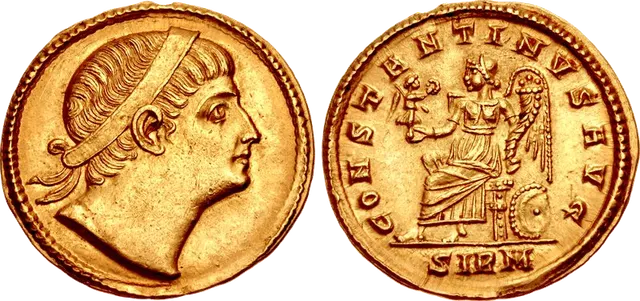
Constantine took the next step. Around 309 to 310, while he still ruled only the western provinces, he began striking a new gold coin at 72 to the pound. Each solidus weighed about 4.5 grams. The name means "solid" or "whole", a promise that the coin was full weight.
The first solidi came from Trier, in what is now Germany, with London and Lyon also striking them. For a while the old and new coins circulated side by side. After Constantine defeated his rival Licinius in 324 and took the whole empire, the solidus became the gold standard everywhere.
The new coin was lighter than the aureus, and that helped. Constantine could strike plenty of solidi at a weight he was able to hold. In the 330s, gold and silver taken from pagan temples added to his supply, and the weight never moved.
OB and CONOB: a guarantee of pure gold
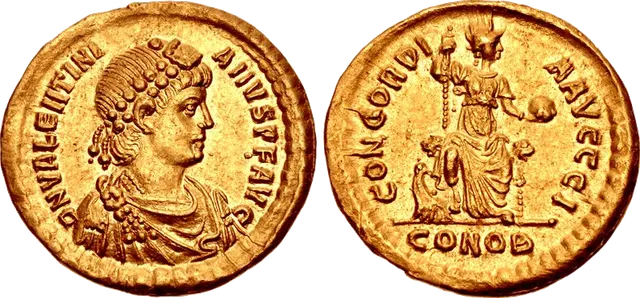
The solidus did slip once. Between about 346 and 368 its gold content fell from over 99% to a little under 95%. In 368 the emperors restored full purity, and mints started adding the letters OB to their marks. OB stands for obryzum, refined gold.
Later solidi from Constantinople carry CONOB at the bottom of the reverse: CON for the city, OB for the gold. It's one of the easiest ways to recognise a late Roman or Byzantine solidus today.
The fractions followed the same standard. The semissis was a half solidus, and from around 383 the tremissis, a third of a solidus at about 1.5 grams, became common.
The Hoxne hoard: solidi at the edge of empire
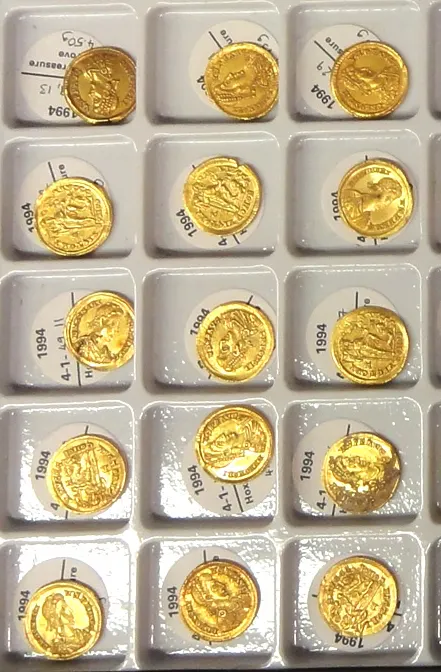
In November 1992 a man searching a Suffolk field with a metal detector for a lost hammer found the largest late Roman hoard ever discovered in Britain. The Hoxne hoard held 14,865 coins, including 569 gold solidi, along with silver tableware and jewellery.
The latest coins date to the early 400s, so it was buried around the time Roman rule in Britain was ending. It's now on display at the British Museum.
The coin that outlived Rome
The western empire fell in the fifth century. The solidus didn't. In the east it became the Byzantine nomisma, still struck at 72 to the pound, and it stayed the standard gold coin of the Mediterranean world for centuries. You can follow that part of the story in Byzantine Coins: The Solidus That Lasted 700 Years.
The end came in the 11th century. From about 1034 the emperors began cutting its gold content. After the defeat at Manzikert in 1071 the debasement sped up, and by the 1080s some coins held little or no gold. In 1092 Alexios I replaced it with a new gold coin, the hyperpyron.
The name lived on even longer. It gave Italian the soldo and French the sou. Through Charlemagne's system of pounds, shillings and pence, it also gave Britain the "s" in £sd, and the slash once written between shillings and pence, as in 2/6, is still called a solidus. The English word "soldier" goes back to the same coin, through words for a soldier's pay.
What Roman gold coins are worth today
Gold coins are the expensive end of ancient collecting. A common aureus in decent condition usually sells for several thousand dollars, and rare emperors or famous types run far higher.
Solidi are more affordable because so many survive. Common late Roman solidi, such as those of Theodosius II, often sell for about $1,500 to $4,000 in certified grades, depending on the emperor and condition.
A few things matter most:
- The ruler. Caesar, Augustus and the Twelve Caesars carry a premium; common fifth-century emperors don't.
- Condition and strike. Gold doesn't corrode, so collectors expect sharp portraits.
- Marks of damage. Many gold coins were mounted as jewellery, and solder marks or holes cut the value sharply.
- Authenticity. Ancient gold is heavily faked. Buy certified coins or from dealers who guarantee them for life.
Where to go next
Before Rome struck gold, the Greeks and Persians already had. Start with Ancient Greek Coins: Owls, Turtles and Tetradrachms or Persian Darics and Sigloi: Gold of the Achaemenids. To see what happened to European gold after Byzantium, read The Florin and the Ducat: Gold of Renaissance Italy.
Or head back to the Ancient World era page, or flip a coin with an emperor on it.
Questions people ask
What is a Roman aureus?
The aureus was Rome's main gold coin from the late Republic until the early fourth century AD. Julius Caesar fixed it at 40 to the Roman pound, about 8 grams of nearly pure gold, and under Augustus it was worth 25 silver denarii.
What is a solidus coin?
The solidus was a gold coin introduced by Constantine the Great around AD 309. It was struck at 72 to the Roman pound, about 4.5 grams, and stayed the standard gold coin of the Roman and Byzantine world until the 11th century.
Why did the solidus replace the aureus?
By the late third century the aureus had been struck at so many different weights that people no longer trusted it. Constantine's solidus was lighter but kept a fixed weight and purity, which made it reliable for paying armies, taxes and trade.
How much is a gold aureus worth today?
A common aureus usually costs several thousand dollars, and rare rulers or historic types sell for far more. The record is the Brutus EID MAR aureus, which sold for £3.24 million in 2020 before it was returned to Greece as looted property.
What does CONOB mean on a coin?
CONOB appears on late Roman and Byzantine gold coins. CON stands for Constantinople, and OB stands for obryzum, refined gold, a guarantee of the coin's purity.
Sources
- NGC Ancients, "A Survey of Roman Gold, Part 1" (via CoinWeek)
- NGC Ancients, "A Survey of Roman Gold, Part 2"
- Art Institute of Chicago, Roman Art at the Art Institute of Chicago, cat. 24, "Solidus Portraying Emperor Constantine I"
- NumisWiki (Forum Ancient Coins), "aureus"
- Wikipedia, "Aureus" and "Solidus (coin)"
- Coin World, "Authorities arrest dealer, repatriate record-setting coin"
- UPI, 2023-03-23
- Wikipedia, "Hoxne Hoard", cross-checked with The Byzantine Legacy
- Wikipedia, "De rebus bellicis" and "Persecution of pagans in the late Roman Empire" (temple-treasure confiscations of the 330s as a source of gold)
- Wikipedia, "Carolingian monetary system" and "Soldo"; Online Etymology/Wiktionary entries for "soldier" (solidus → soldo, sou, the "s" of £sd, the slash called a solidus)
- Price ranges: NGC-certified Theodosius II solidi listed by dealers at about $1,400 to $4,000 (VCoins, LCR Coin; checked 2026-10-11)