Celtic Coins: Horses, Faces and Abstract Art
Part 13 of the ancient world series6 min read
How Celtic tribes copied the gold stater of Philip II of Macedon and turned Apollo and his chariot into wild horses, strange faces and early abstract art.
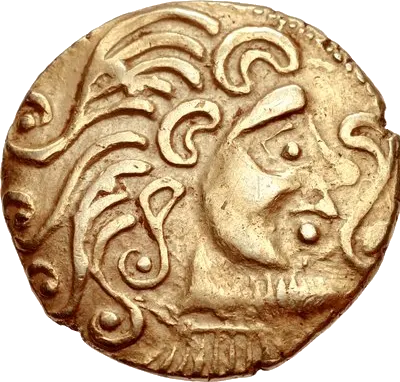
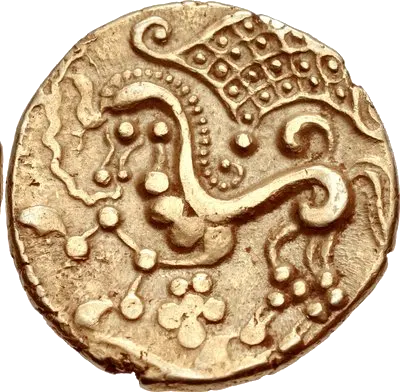
Look at a Celtic gold coin and you might think it was made last year by a modern artist. A horse breaks up into dots and crescents. A face turns into a tangle of curls with one eye floating in the middle. The lettering becomes a row of strokes.
All of it started with one Greek coin: the gold stater of Philip II of Macedon. Over two or three centuries, tribe after tribe copied the copies, and the design drifted into something new.
The coin everyone copied
Philip II ruled Macedon from 359 to 336 BC. He took control of the gold mines around Mount Pangaion, and that gold let him strike staters in huge numbers. Each weighed about 8.6 grams of very pure gold.
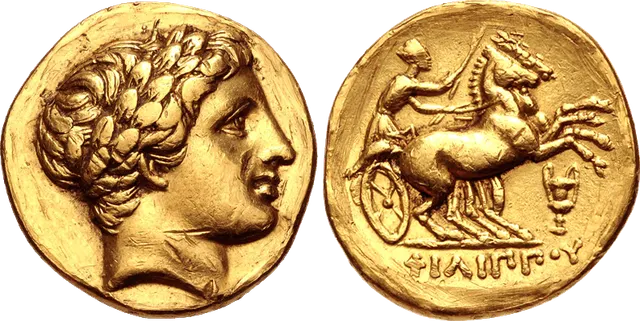
The design is simple and handsome. The front shows the god Apollo with a laurel wreath in his hair. The back shows a two-horse chariot at full gallop, with Philip's name in Greek underneath. It's often linked to the chariot race Philip won at the Olympic Games.
These coins travelled a long way from Greece. Celtic warriors served as mercenaries in Greek armies and were paid in gold, and staters also moved north through trade and gifts. Long after Philip died, his gold was still the coin people knew and trusted. His son's coins spread the same way, as you'll see in The Coins of Alexander the Great.
From copy to Celtic
By the third century BC, Celtic tribes in central Europe and Gaul were striking coins of their own. At first they stayed close to the Greek model. Early staters of the Arverni, in what is now central France, still show a recognisable Apollo and a recognisable chariot.
Then the copies began to drift. One die engraver copied a coin that was itself a copy. The next engraver copied that one. Each time, the details that made sense to a Greek mattered a little less, and the shapes a Celtic eye enjoyed mattered a little more.
The wreath in Apollo's hair grew bigger and bolder until it ran across the whole head. His curls became separate swirls. The chariot shrank to a wheel or a fan of lines, and the driver dissolved. Philip's name broke into dashes that nobody could read, and probably nobody tried to.
You could call this bad copying, but most specialists don't. Celtic art loved curves, spirals and animals long before the Celts had coins. The engravers took a Greek god and drew him in their own style.
Horses everywhere
The horse survived almost every change. It stayed on Celtic coins for more than two centuries, which says a lot about how much horses mattered to these societies of riders and charioteers.
Each region made it its own:
- The Parisii, who lived around what is now Paris, struck staters with a horse under a fine net pattern. Many collectors call them the most beautiful Celtic coins.
- The Redones of Brittany show a galloping horse ridden by a naked woman warrior, sometimes linked to the horse goddess Epona.
- The Coriosolites of northern Brittany gave the horse a human head.
- In Britain, the horse often became a few bold strokes, its body built from crescents and pellets.
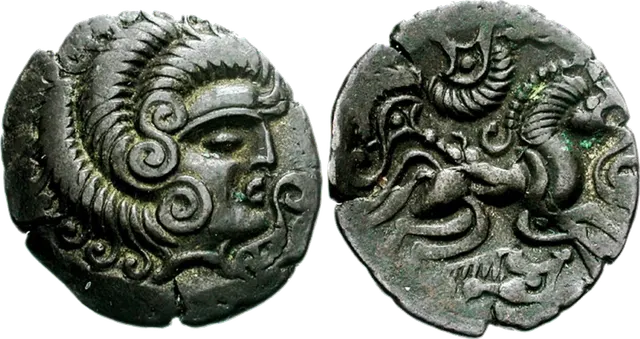
The faces got stranger too. On coins of the Veneti, another Breton tribe, strings of beads curl out from the head and end in tiny severed heads.
Celtic coins come to Britain
The first coins seen in Britain came from across the Channel. In the second century BC, gold staters struck by the Belgic tribes of northern Gaul arrived in large numbers. Collectors call them Gallo-Belgic coins.
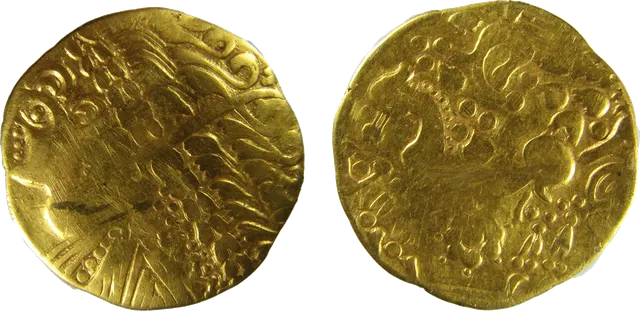
The most common is the Gallo-Belgic E stater. One side is completely blank. The other shows a stylised running horse. Huge numbers were struck around 60 to 50 BC, while Julius Caesar was fighting his way through Gaul. Many turn up in southern England, and one theory is that British warriors fought for the Gauls and came home with their pay.
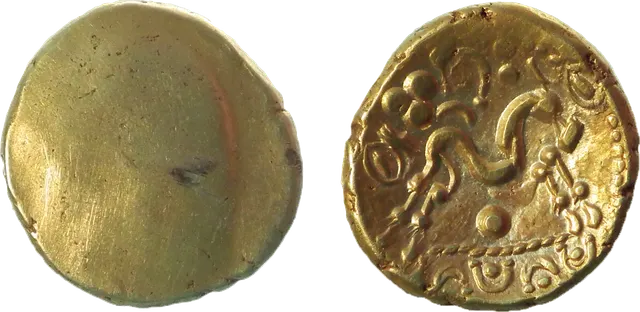
Britain made its own coins from the second century BC. Some of the earliest are cast coins called potins, made in Kent. They were poured into moulds, not struck, and they copy small bronze coins of the Greek port of Massalia (Marseille), with Apollo's head on one side and a butting bull on the other.
Struck gold followed. For about 150 years, tribes across southern and eastern Britain made their own coins. The Iceni of Norfolk, the Corieltauvi of the East Midlands, the Dobunni of the west country and others each had a style you can learn to spot. The Durotriges of Dorset struck a silver coin so abstract that collectors call it the "Badbury starfish".
Kings put their names on the coins
Late in the story, British coins started carrying names. Commius, a leader of the Atrebates, is the first well-known one. Later rulers called themselves his sons on their coins, and one of them, Verica, used the Latin title REX, king.
The most famous is Cunobelin, who ruled the Catuvellauni and Trinovantes from about AD 8 to 40. He struck huge numbers of gold staters at Camulodunum, today's Colchester. The best known show an ear of barley between the letters CA and MV on one side, and a horse on the other.
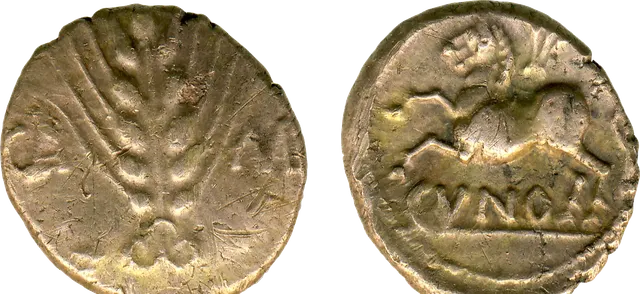
Shakespeare knew him as Cymbeline. His coins look more Roman than earlier British ones, with Latin letters and classical-style designs, a sign of how close Britain already was to the empire.
The Roman conquest ends it
Rome brought Celtic coinage to an end. In Gaul it faded after Caesar's conquest in the 50s BC. The Arvernian leader Vercingetorix struck rare gold staters with his own name, probably to pay for his revolt in 52 BC. By the end of that year he was a prisoner of Rome.
In Britain the end came after Claudius invaded in AD 43. The Iceni kept striking coins a little longer, until around the time of Boudica's revolt in AD 60 or 61. After that, Britain used Roman money, including the silver denarii you can read about in The Denarius: How Rome's Silver Coin Lost Its Shine.
Hoards in the fields
Many of the Celtic coins we know today came out of the ground in hoards, and some of those hoards are enormous.
- Le Câtillon II, Jersey (2012). Two metal detectorists found a mass of about 70,000 coins, most of them billon staters of the Coriosolites, along with gold torcs. It's the largest Celtic coin hoard ever found, and it was probably buried as Caesar's armies moved through Gaul.
- Wickham Market, Suffolk (2008). A detectorist found 840 gold staters, nearly all struck by the Iceni. Ipswich Museum bought the hoard in 2011.
In southern Germany and Bohemia, small cup-shaped Celtic gold coins kept turning up in ploughed fields after rain. Local people called them Regenbogenschüsselchen, "little rainbow cups", and believed they lay where a rainbow touched the ground.
Collecting Celtic coins today
Celtic coins are one of the cheaper ways into ancient gold. They also reward a good eye, because every tribe had its own look.
As a rough guide, potins and many silver units sell for a few hundred dollars or less. Common British gold staters often cost around $1,000 to $3,000. The great rarities sit far higher: CoinWeek reports that a gold stater naming Vercingetorix brought over $233,000 at a European auction.
A few things matter most:
- Centring. Celtic dies were often bigger than the blanks, so collectors pay more when the horse or face is fully on the coin.
- Tribe and ruler. Inscribed coins of named kings, like Cunobelin, carry a premium.
- Metal. Gold content varies a lot. Many later "gold" coins are pale alloys with plenty of silver and copper.
- Paperwork. In England and Wales, many finds are recorded by the Portable Antiquities Scheme. A clear findspot and ownership history protects you from looted or fake pieces.
Where to go next
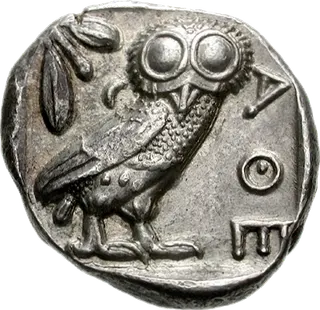
The Celts weren't the only people to turn Greek coins into something new. Start with Ancient Greek Coins: Owls, Turtles and Tetradrachms, or see the other great gold coin of the age in Persian Darics and Sigloi: Gold of the Achaemenids. To see what replaced Celtic coins in Britain, read Roman Coins: A Guide to Every Denomination.
Or head back to the Ancient World era page, or flip a coin and see whether the horse lands face up.
Questions people ask
What are Celtic coins?
Celtic coins were struck by the Iron Age tribes of central Europe, Gaul and Britain from about the third century BC until the Roman conquest. Most began as copies of Greek coins, above all the gold stater of Philip II of Macedon, and grew more abstract over time.
Why do Celtic coins have horses on them?
The horse comes from the two-horse chariot on Philip II's stater. Celtic engravers dropped most of the chariot and kept the horse, which suited societies that prized horses and riders. It stayed the main design for more than two centuries.
When were Celtic coins made in Britain?
Coins from Gaul reached Britain in the second century BC, and British tribes were making their own before the century was out. Production ended after the Roman invasion of AD 43, with the Iceni striking last, until about AD 60 or 61.
How much are Celtic coins worth?
Potins and many silver Celtic coins sell for a few hundred dollars or less. Common British gold staters often cost around $1,000 to $3,000, while rare named issues, such as staters of Vercingetorix, have sold for over $200,000.
What is the biggest Celtic coin hoard ever found?
The Le Câtillon II hoard, found in Jersey in 2012, held about 70,000 coins, most of them struck by the Coriosolites of Brittany. It is the largest Celtic coin hoard on record.
Sources
- CoinWeek, "The Celtic Coinage of Gaul" (Philip II stater about 8 g of pure gold; copied from the 3rd century BC; early Arverni copies; Parisii "most beautiful"; Redones rider; Veneti severed heads; Vercingetorix stater over $233,000)
- CoinWeek, "The Ancient Celtic Coinage of Britain" (Gallo-Belgic staters arriving in the 2nd century BC; Thurrock potins of Kent; about 150 years of British coinage; Commius, Verica REX, Cunobelin; Durotriges "Badbury starfish"; Iceni)
- Portable Antiquities Scheme records via Google Arts & Culture and Commons: Gallo-Belgic E stater, "large quantities minted between 60 and 50 BC", mercenary theory; Cunobelin "Classic" stater with CA/MV corn ear, AD 8–41 (FindID 807941)
- Van Arsdell, Celtic Coinage of Britain, "Earliest British coinages", with Numista 228370 (Thurrock potins copy Massalia bronzes, Apollo and butting bull, 2nd century BC)
- Alpha Bank numismatic collection, "Gold stater of Philip II" and Wikipedia "Philippeioi" (Pangaion gold; about 8.6 g Attic standard; Apollo / biga; Olympic victory link)
- CoinsWeekly, "Jersey: the treasure island of Celtic coins" and Heritage Auctions lot 3063-238019 (Coriosolites staters with a human-headed horse)
- Le Câtillon II: Numismatic News (found 2012 by two detectorists; about 70,000 coins, over 94% Coriosolite; gold torcs; largest Celtic hoard)
- Le Câtillon II: Archaeology Magazine (found 2012 by two detectorists; about 70,000 coins, over 94% Coriosolite; gold torcs; largest Celtic hoard)
- Wickham Market: National Lottery Heritage Fund and Wikipedia "Wickham Market Hoard" (840 staters, found 2008, Iceni; bought by Ipswich Museum 2011)
- Rainbow cups: Live Science and Wikipedia "Rainbow cup"
- Iceni coinage to AD 60/61: Current Archaeology, "The die is cast: investigating Icenian coinage" and Wikipedia "Iceni"
- Prices: Silbury Coins listings checked 2026-10-11 (Corieltauvi staters £550 to £1,450; Iceni stater £2,250; Iceni silver unit about £225)
Coins in this story
- Celtic stater
- Denarius
- Athenian tetradrachm