The Islamic Dinar and Dirham
Part 17 of the Medieval money series6 min read
In 696 the caliph Abd al-Malik took the pictures off his coins. How the Islamic dinar and dirham began, spread from Spain to India and reached the Vikings.
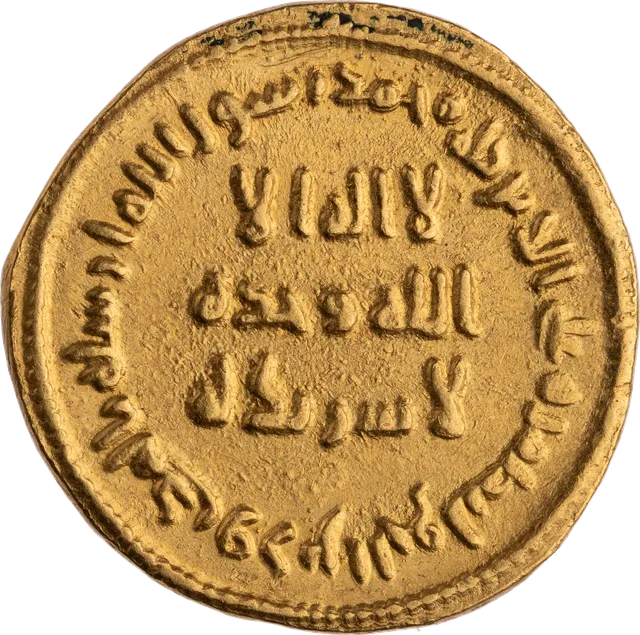
In the year 696, the gold coins of the Islamic caliphate lost their faces. Until then, Muslim rulers had struck money that looked Byzantine or Persian, with emperors, kings and crosses on it. The new gold dinar of the caliph Abd al-Malik had no pictures at all. Both sides were covered in Arabic writing.
That coin, and the silver dirham that followed it a couple of years later, set the pattern for Islamic money for centuries. The dirham also became the most common silver coin in the Viking north. This is the story of both coins, and of where their names came from.
Borrowed money
When Arab armies took Syria, Egypt and Persia in the 630s and 640s, they didn't bring coins of their own. They kept using what was already there.
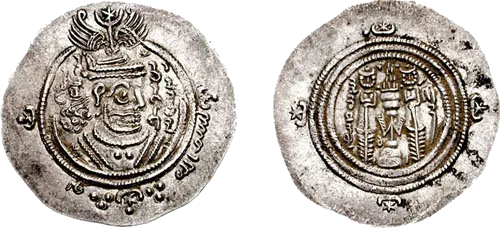
In the old Persian lands, mints went on striking the silver drachm of the Sasanian kings, with the bust of a king in a winged crown on the front and a fire altar on the back. The new governors added a few words in Arabic in the margin, often bismillah, "in the name of God". Collectors call these coins Arab-Sasanian.
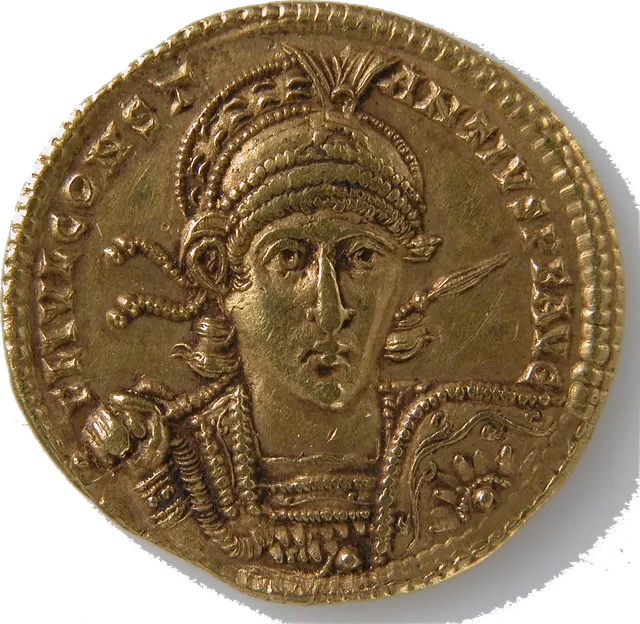
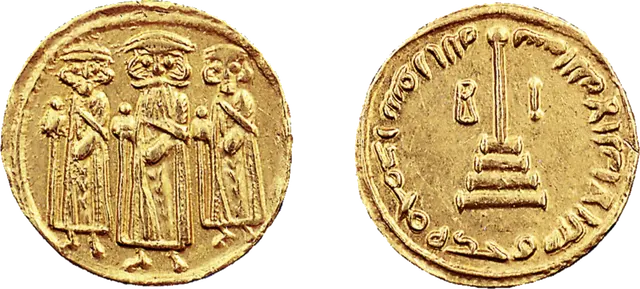
In Syria and Egypt, local mints copied Byzantine copper coins, and gold solidi of the emperor Heraclius kept circulating. Some later gold copies took the crosses off the Byzantine design and put a plain pole or a globe on steps in their place. These are known as Arab-Byzantine coins.
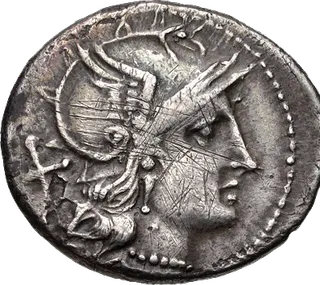
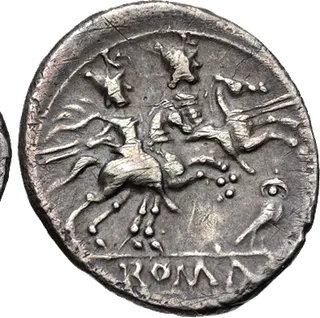
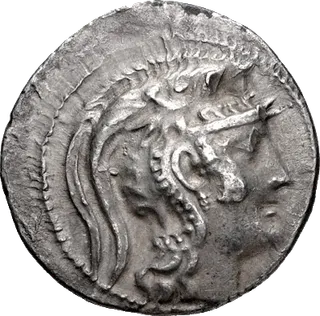
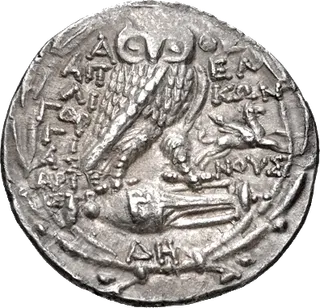
The names stuck too. The Arabic word dinar comes from the Roman denarius, by way of Greek. Dirham comes from the Greek drachma. The copper coin, the fals, takes its name from the Byzantine follis. You can read about the coins behind those names in the denarius, the drachma and Byzantine coins.
The standing caliph
Abd al-Malik ibn Marwan became the fifth Umayyad caliph in 685. He ruled from Damascus and spent his early years fighting a civil war. When it ended in 692, he set about making the state look and sound Arab and Muslim. He also built the Dome of the Rock in Jerusalem, whose inscription is dated 691 to 692.
His first gold coins, dated from the Islamic year 74 (693 to 694), kept a figure on the front. Instead of an emperor, they showed a standing man in Arab dress with a sword at his belt. Most scholars read him as the caliph himself. Copper coins of the same "standing caliph" type were struck in Syrian towns.
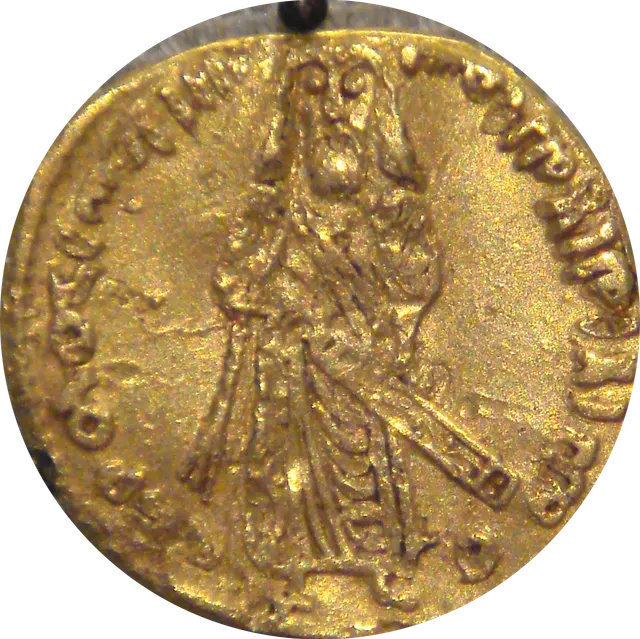
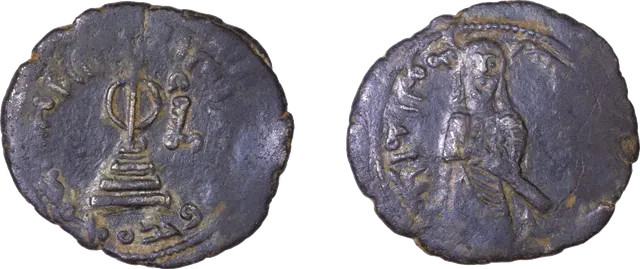
This was a time of rivalry with Byzantium. Around 692 the emperor Justinian II had put the face of Christ on his gold, and the two powers were soon at war. Historians still argue about how far each coin design was a reply to the other. The standing caliph didn't last long either way.
Words instead of pictures
In the year 77 of the Islamic calendar, which ran from 696 to 697, Abd al-Malik's mint struck a new kind of dinar. It had no images and no crosses, only words, in an angular Arabic script now called Kufic.
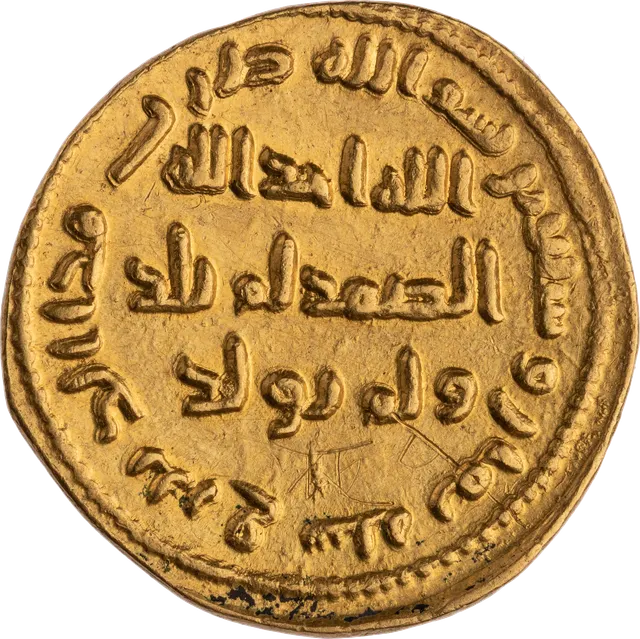
The centre of the front reads: "There is no god but God alone. He has no partner." Around the edge runs a verse from the Quran (9:33): "Muhammad is the messenger of God, whom He sent with guidance and the religion of truth, to make it prevail over all religion."
The centre of the back carries most of a short chapter of the Quran (112): "God is One, God is Eternal. He does not beget, nor is He begotten." The edge gives the date: "In the name of God, this dinar was struck in the year seven and seventy."
The weight changed too. The Byzantine solidus weighed about 4.5 grams. The new dinar was struck to about 4.25 grams, the Arab mithqal, and it was very nearly pure gold.
Why no pictures? The usual answer is that Islamic tradition discourages images of living beings in religious settings. But the coins were also a statement. They proclaimed one God who "does not beget", a line aimed at the Christian empire next door, and they told every trader who handled one who was now in charge.
The dirham follows
Silver came next. In the year 78 or 79 (697 to 699), the mints of the old Persian lands switched from the Sasanian-style drachm to a new dirham covered in writing. It was thin and broad, about 2.9 grams, with the same kinds of inscriptions as the dinar.
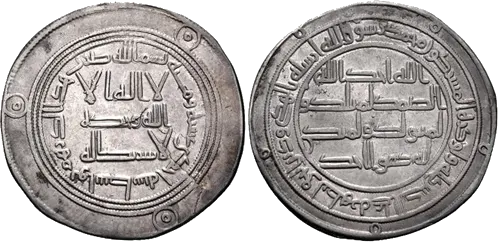
There was one big difference. Umayyad gold almost never named its mint, but nearly every dirham did. The word bi ("at") and a city name, such as Dimashq (Damascus) or Wasit in Iraq, sit in the margin next to the date. Historians love this. Thousands of dirhams survive from dozens of mints across the empire, and each one says where and when it was made.
Later Muslim jurists fixed the relationship between the two coins by weight: ten dirhams weighed the same as seven dinars.
Gold of the caliphs, from Spain to India
By 750 the Umayyad caliphate stretched from Spain and Morocco to the Indus valley. Its dinars and dirhams were accepted across all of it.
That year a revolt brought a new dynasty to power, the Abbasids. They moved the capital to Iraq and built Baghdad. Their coins kept the Umayyad look but changed some of the words, putting "Muhammad is the messenger of God" in the centre of the back. In time they added the names of caliphs, heirs and governors.
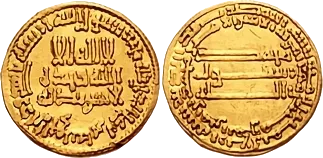
People far outside the Islamic world copied this gold. Around 774, King Offa of Mercia, in England, had a gold coin made that copies an Abbasid dinar of the caliph al-Mansur, Arabic and all, with OFFA REX added in Latin letters. It's now in the British Museum. The engraver almost certainly couldn't read what he was copying.
In twelfth-century Spain, Christian Castile struck gold coins modelled on the dinars of the Almoravids, a North African dynasty. People called them morabetinos and later maravedís, and the first ones even carried Arabic text.
(For the Italian gold coins that took over that job in the 1200s, see the florin and the ducat.)
Dirhams in Viking hands
The most surprising place to find Islamic silver is Scandinavia. From the late 700s into the 900s, Viking traders sold furs, honey and slaves down the rivers of Russia to merchants from the Islamic world. They were paid in dirhams, often through middlemen on the Volga, and huge numbers of those coins came home with them.
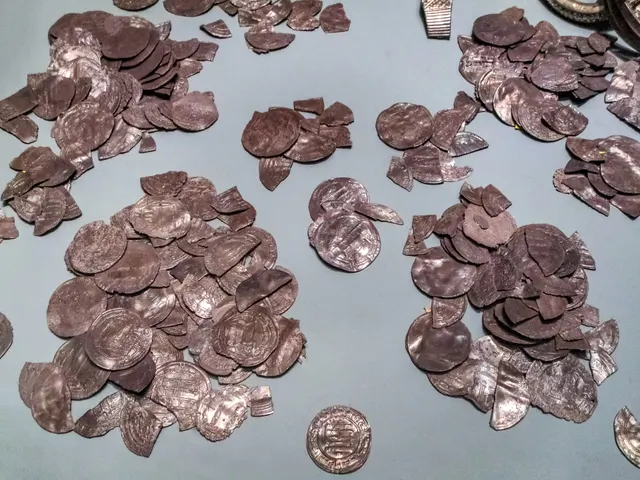
More than 70,000 dirhams have been found on the Baltic island of Gotland alone. The biggest single find, the Spillings hoard, turned up on a Gotland farm in 1999. It held 14,295 coins, about 14,200 of them Islamic dirhams.
The Vikings didn't care much what the coins said. They valued silver by weight and often cut coins into pieces to make up an exact amount, the same idea as the hacksilver in before coins: barter and hacksilver.
The dinar today
The names never went away. The dinar is the currency of Kuwait, Bahrain, Iraq, Jordan, Libya, Tunisia and Algeria, and the dirham is the currency of the United Arab Emirates and Morocco. These modern coins have nothing to do with the Umayyad weights, but their names come from the caliphs' coins, and through them from Rome and Greece. (Serbia's dinar and North Macedonia's denar share the name, but they come from the Roman denarius by a European route.)
Early Islamic gold can fetch huge sums. In 2011, an Umayyad dinar of the year 105 (723 to 724), made from gold from the caliph's own mine, sold in London for £3.72 million including fees. That story is in the rarest and most valuable coins in the world.
How to recognise an early Islamic coin
If you have a coin covered in Arabic writing with no pictures, start here:
- Gold, about 19 to 20 mm across and about 4.25 grams: probably a dinar.
- Thin, broad silver, about 25 to 28 mm and around 2.9 grams: probably a dirham.
- Small, thick copper with Arabic and sometimes a simple design: a fals.
- Look in the outer ring for the date, written out in words ("in the year ..."). On dirhams, the mint name follows bi.
- Rings of text around a dot or small circle in the centre usually mean a later coin, such as a Fatimid dinar from Egypt.
Umayyad and Abbasid dirhams are common and still fairly cheap. Gold dinars cost far more, and fakes are around, so buy from a dealer who guarantees authenticity.
More books for collectors: Best Coin Collecting Books.
Flip a coin of your own
See the dinar in our coin gallery, the solidus it replaced, or flip a coin on the coin flipper.
Questions people ask
What was the first Islamic coin?
For about fifty years after the Arab conquests, Muslim rulers struck copies of Byzantine and Persian coins with Arabic words added. The first coins of a fully Islamic design were the gold dinars of the Umayyad caliph Abd al-Malik, dated to the Islamic year 77 (696 to 697), which carry only Arabic inscriptions.
Why do early Islamic coins have no pictures?
Abd al-Malik's reform replaced the images on coins with religious texts, including the declaration of faith and verses from the Quran. Islamic tradition discourages images of living beings in religious settings, and the words also announced the new state's faith to everyone who used its money.
What is the difference between a dinar and a dirham?
The dinar was the gold coin, struck to about 4.25 grams. The dirham was the silver coin, broad and thin, at about 2.9 grams. By weight, ten dirhams equalled seven dinars. A third coin, the copper fals, was used for small change.
Where do the words dinar and dirham come from?
Dinar comes from the Roman denarius, by way of Greek, and dirham comes from the Greek drachma. The copper fals takes its name from the Byzantine follis.
Why are Islamic coins found in Scandinavia?
Viking traders sold furs and slaves along the rivers of Russia to merchants from the Islamic world and were paid in silver dirhams. Tens of thousands of these coins have been found in Scandinavia, especially on the Swedish island of Gotland.
Sources
- John Walker, A Catalogue of the Muhammadan Coins in the British Museum, vol. 2: Arab-Byzantine and Post-Reform Umayyad Coins (1956). (Reform dinar inscriptions, standing caliph type, weight standards)
- Ashmolean Museum, "Standing caliph dinar". (standing caliph gold, AH 74–77)
- Islamic Awareness, "The Reformed Umayyad Dinar" and "The Standing Caliph Dinar". (inscriptions, dates)
- Clive Foss, Arab-Byzantine Coins: An Introduction, with a Catalogue of the Dumbarton Oaks Collection (Dumbarton Oaks, 2008). (Arab-Byzantine copies, altered crosses, copper coinage of Syria)
- Museum of Fine Arts, Boston, solidus of Justinian II with the bust of Christ, object 56102. (Christ type, c. 692)
- Islamic Awareness, "Offa's dinar" and British Museum 1913,1213.1 (via Google Arts & Culture). (Offa copy of al-Mansur's AH 157 dinar)
- Swedish History Museum (Historiska museet), "The world's largest Viking treasure". (Spillings hoard)
- Medievalists.net, "Nearly 500,000 dirhams were buried in Viking-age Scandinavia, study finds" (2023). (dirham flow to Scandinavia, Gotland totals)
- CoinWeek, "Rarest of Islamic coins sells for £3.7 million in Morton & Eden sale" (2011).
- Antiques Trade Gazette (2011).
- Stephen Album, A Checklist of Islamic Coins (3rd ed., 2011). (Mints, types, Abbasid and Fatimid designs)