Punch-Marked Coins of Ancient India
Part 15 of the ancient world series6 min read
India's first coins were bent silver bars and small punch-marked karshapanas. Who made them, what the symbols mean, and how the Mauryan empire spread them.
Pick up one of India's oldest coins and it won't look much like a coin. It's a small, flat scrap of silver, often square or a rough oblong, with a few tiny symbols hammered into one face. There's no king's portrait and no writing at all.
These are punch-marked coins, and for several centuries they were the everyday silver money of the Indian subcontinent. Millions were made. They turn up today in hoards from Afghanistan to Bangladesh, and they're still among the most affordable ancient coins a collector can buy.
This is where the ancient coins of India begin.
What is a punch-marked coin?
A punch-marked coin is made in a very simple way. A silver bar or sheet was cut into pieces, and each piece was trimmed until it hit the right weight. Corners were often snipped off to adjust it. Then a worker hammered small symbols into the face, one at a time, each with its own iron punch.
That's the big difference from Greek coins of the same age. A Greek coin was struck between two engraved dies, which stamped the whole design in one blow (see How the First Coins Were Made). An Indian punch-marked coin got its design piece by piece. So two coins from the same issue can have the same symbols in slightly different places.
The coins were mostly silver. Their weight mattered more than their shape, which is why they come in such odd outlines.
The karshapana: a coin named after a weight
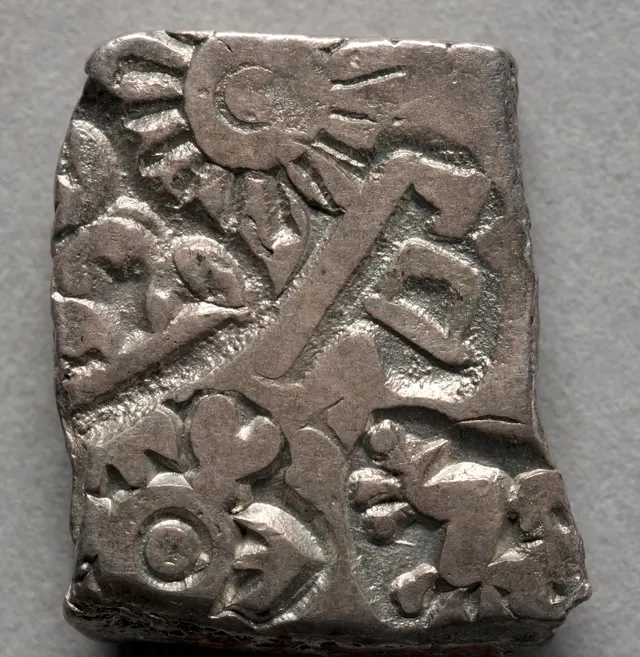
The standard punch-marked coin was the karshapana. The name comes from the karsha, an old Indian unit of weight, so a karshapana was simply a coin that weighed one karsha. Buddhist texts written in Pali call it the kahapana.
The usual standard was 32 ratti, about 3.4 to 3.5 grams of silver. A ratti was the weight of a single gunja seed, a small red and black seed that Indian jewellers used as a weight into modern times.
The word has had a long life. The Tamil kasu, a later South Indian coin, goes back to the same Sanskrit root. Portuguese traders picked it up as caixa, and English turned that into "cash", the name Europeans gave to Chinese coins with a square hole. We tell that side of the story in Ancient Chinese Coins.
The sixteen great kingdoms
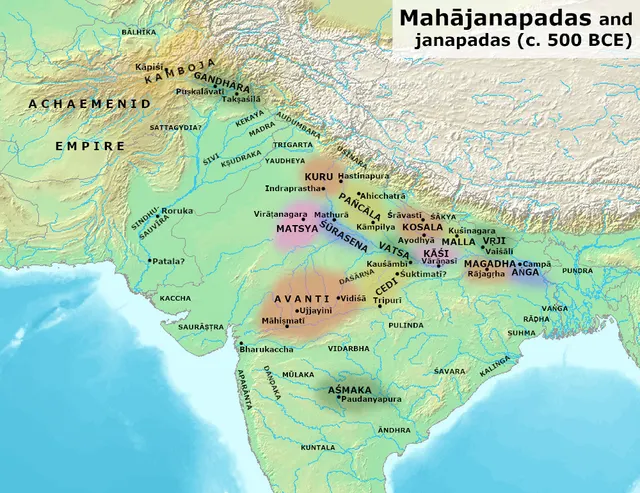
Around the 6th century BC, northern India was divided into states that Buddhist and Jain texts call the sixteen Mahajanapadas, the "great realms". They included Magadha and Kosala in the Ganges valley, Avanti in central India, Kashi around Varanasi, and Gandhara in the far north-west, with its capital at Taxila.
Many of these states, or the merchants working in them, made their own punch-marked silver. Each region had its own weights and its own favourite symbols.
- Gandhara made long, curved "bent bars" (more on those below).
- Kosala made thin coins, often with four symbols.
- Avanti, around Ujjain, used symbols such as a wheel and an elephant.
- Magadha, which would later swallow most of its neighbours, began with heavy coins carrying a single "six-armed" symbol, then added more punches over time.
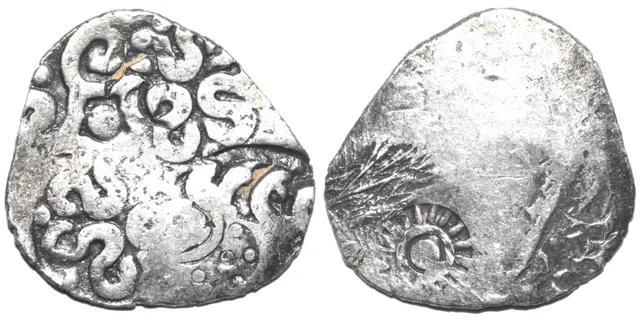
India's Reserve Bank, which runs a monetary museum in Mumbai, describes the earliest coins as issued first by merchant guilds and later by the states. Either way, they belonged to a time when cities were growing and long-distance trade was picking up.
Bent bars of Gandhara
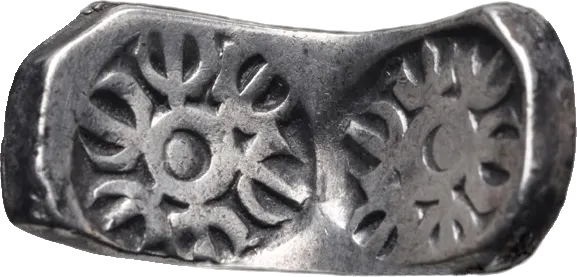
The strangest early Indian coins come from Gandhara. They are bars of silver about the length of a finger, slightly curved, with a symbol punched at each end. Collectors call them bent bars. Their weight standard, the shatamana, was about 11 grams.
Gandhara also made cup-shaped coins, punched with a single symbol. These are smaller and are usually found alongside the bars.
Gandhara sat on the eastern edge of the Persian empire, which ruled the region from the late 6th century BC. The Persians had their own punch-marked silver coin, the siglos (see Persian Darics and Sigloi), and some scholars think the idea of coinage reached India from there.
How old are they?
This is still argued over, and you'll see very different dates on dealer listings.
One view holds that the first Indian coins were made in the 6th century BC by the Mahajanapadas of the Ganges plain. That's the date the Reserve Bank of India's museum gives, and it's supported by numismatist Osmund Bopearachchi.
The other view, argued by the British Museum's former keeper of coins Joe Cribb, puts the start later, in the mid-4th century BC or a little before, with the idea spreading east from Persian-ruled Gandhara.
Two hoard finds anchor the debate. In 1933 a hoard of about 1,000 coins was found at Chaman Hazouri, near Kabul. It held Greek coins, Persian sigloi, and 14 bent bars together, and the Greek coins date its burial to around 380 BC. Nine years earlier, in 1924, at the Bhir Mound in Taxila, archaeologists found a pot holding 1,055 punch-marked coins and 33 bent bars. It also contained gold coins of Alexander the Great and his half-brother Philip III in mint condition, which date the hoard to about 317 BC.
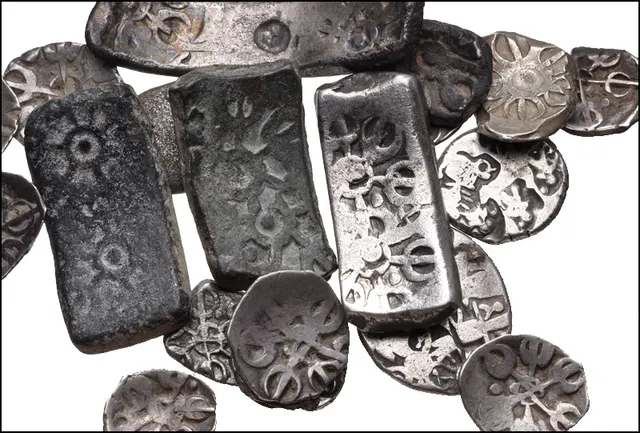
So we know for certain that punch-marked coins and bent bars were in use by the 4th century BC. Whether they began a century or two earlier is the open question.
Magadha and the Mauryan coins
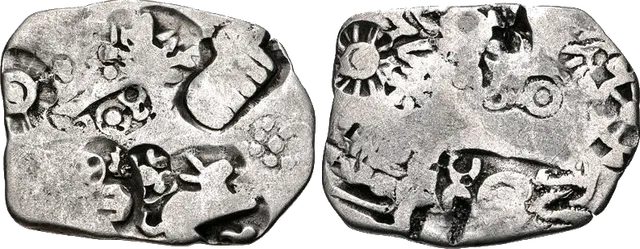
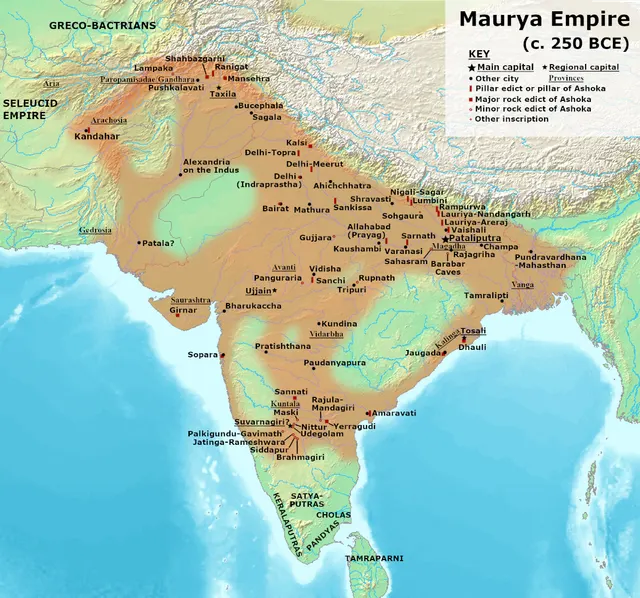
Magadha, in modern Bihar, became the dominant power of the Ganges valley. Its coins tell the story in miniature. The earliest weighed about 7.6 grams and carried a single six-armed symbol. Later issues got lighter and gained extra punches. Around 420 BC Magadha settled on the karshapana of about 3.5 grams with four punches, then five.
In 322 BC or thereabouts, Chandragupta Maurya took over Magadha and went on to build the Maurya empire. At its height under his grandson Ashoka, it covered nearly the whole subcontinent.
The Mauryans kept Magadha's five-punch karshapana and made it in huge numbers. Mauryan coins are the punch-marked coins you're most likely to find for sale today.
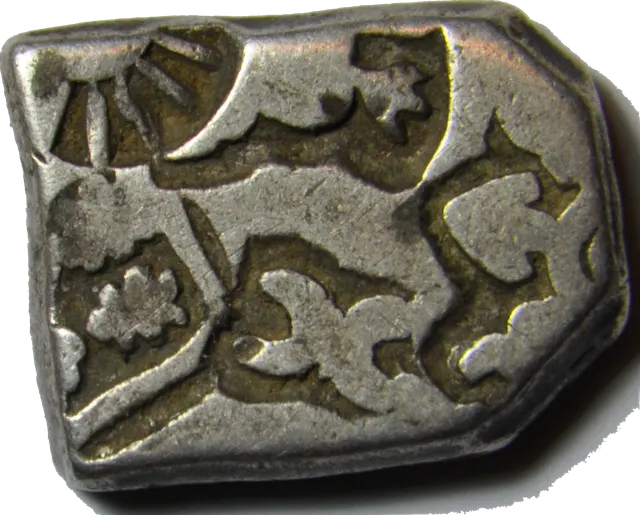
Reading the symbols
A typical Mauryan karshapana has five symbols on the front:
- The sun, a circle surrounded by rays.
- The six-armed symbol, a central dot or circle with six arms around it, usually mixing arrows, cups and other small shapes.
- A hill, drawn as three arches with a crescent on top. Collectors often call it the Mauryan hill or chaitya.
- A tree in a railing, a branch growing out of a small square fence.
- An animal, often a bull, an elephant or a dog, sometimes with a small mark in front of it.
The sun and the six-armed symbol appear on almost every coin. The other three changed from issue to issue, and specialists use them to sort coins into series. Scholars have catalogued about 450 different punches. Nobody is quite sure what most of them meant.
The back of the coin is often blank or carries a few tiny marks. These were probably added later as the coin passed through different hands, and collectors usually call them banker's marks.
What the Arthashastra says
The Arthashastra, a treatise on statecraft traditionally credited to the Mauryan minister Kautilya, describes a royal mint. It names a superintendent of the mint (the lakshanadhyaksha) and an examiner of coins (the rupadarshaka). Its silver coin is the pana, another name for the karshapana.
It's also strict about fakes. Anyone who passed counterfeit coins could be fined 1,000 panas.
The text's date is disputed, and parts of it were probably written after the Mauryan period. But it shows that by the time it was compiled, coinage was run by the state.
Debasement and the end of punch-marked coins
The last Mauryan series are usually debased. They carry more copper in the silver, and the punches are cruder than on earlier coins.
When the Maurya empire broke up around 185 BC, new kinds of money moved in. In the north-west, the Indo-Greek kings struck round, die-struck coins with royal portraits and legends in two languages: Greek on one side, Prakrit on the other. They were silver drachms, close cousins of the coins we cover in The Drachma. Elsewhere, local cities and kingdoms cast or struck their own copper coins.
Punch-marked coins faded out in the north by about the turn of the era. In the south they lasted longer, possibly until around AD 300.
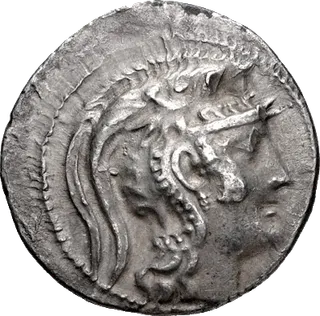
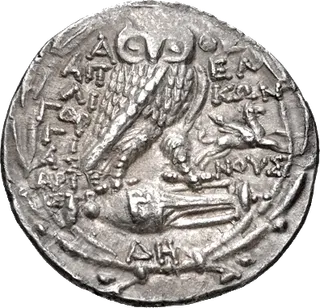
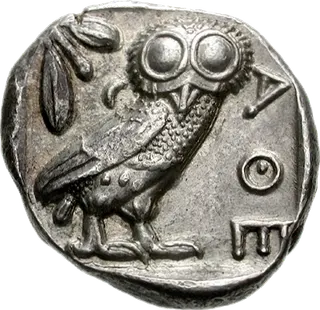
Altogether that's six centuries or more of silver punched one symbol at a time. If you want to compare one with the Greek coins of the Kabul hoard, flip an Athenian tetradrachm on our coin page, or try the coin flipper.
Keep reading
- Part of the Ancient world series. Previous: Ancient Chinese Coins: Spades, Knives and Cash. Next era: Byzantine Coins: The Solidus That Lasted 700 Years.
- Persian Darics and Sigloi: Gold of the Achaemenids, the Persian coins that circulated in Gandhara
- The Coins of Alexander the Great, whose gold dated the Taxila hoard
- The First Coins Ever Made: Lydia's Electrum Lion, the Western coin tradition that started a little earlier
- Ottoman and Mughal Coins, India's coins two thousand years later
- The Most Circulated Coins in Every Era of History
Questions people ask
What are punch-marked coins?
Punch-marked coins are ancient Indian silver coins, cut from bars or sheets and trimmed to a set weight, with symbols hammered into them one by one using separate punches. They were made from at least the 4th century BC, and possibly the 6th, until around the turn of the era in the north and later in the south.
What is a karshapana?
The karshapana was the standard punch-marked silver coin of ancient India. It was named after the karsha, a unit of weight, and usually weighed 32 ratti, about 3.4 to 3.5 grams. Pali texts call it the kahapana, and the Arthashastra calls it the pana.
What was the first coin of India?
The earliest Indian coins are the punch-marked silver coins of the Mahajanapadas and the bent bars of Gandhara. Scholars disagree on the date. Some place the first ones in the 6th century BC, others in the mid-4th century BC. Hoards from Kabul and Taxila prove they were in use by about 380 to 317 BC.
What do the symbols on Mauryan punch-marked coins mean?
A Mauryan karshapana usually carries five symbols: a sun, a six-armed symbol, a three-arched hill with a crescent, a tree in a railing and an animal. The sun and the six-armed symbol are nearly always present. Their exact meaning isn't known, though the varying symbols help specialists sort coins by issue.
Are punch-marked coins rare?
Most are not. Mauryan karshapanas survive in very large numbers because they were made for centuries and buried in big hoards, so they're among the cheapest ancient coins to collect. Early Janapada types, bent bars and coins in good condition are scarcer.
Sources
- Reserve Bank of India Monetary Museum, "Ancient India" coin gallery
- Pankaj Tandon, COININDIA coin galleries, "Magadha Janapada"
- Pankaj Tandon, COININDIA coin galleries, "Gandhara Janapada"
- Joe Cribb, "Dating India's Earliest Coins" (South Asian Archaeology 1983, publ. 1985) and "The Origins of the Indian Coinage Tradition", South Asian Studies 19 (2003)
- P.L. Gupta and T.R. Hardaker, Punchmarked Coinage of the Indian Subcontinent: Magadha-Mauryan Series (revised edition, IIRNS, 2014)
- E.H.C. Walsh, Punch-Marked Coins from Taxila, Memoirs of the Archaeological Survey of India no. 59 (1939)
- CoinWeek, "CoinWeek IQ: An Introduction to Ancient Indian Punch Mark Coins"
- Banglapedia, "Punch Marked Coins" (Mahasthangarh finds and the five Mauryan symbols)
- Kautilya, Arthashastra, book 2 ch. 12 and book 4 (trans. via wisdomlib.org)
- Wikipedia: "Punch-marked coins", "Karshapana", "Kabul hoard", "Bhir Mound", "Post-Mauryan coinage" (used to cross-check dates, not as the only source for any claim)
Coins in this story
- Karshapana
- Athenian tetradrachm
- Drachma